
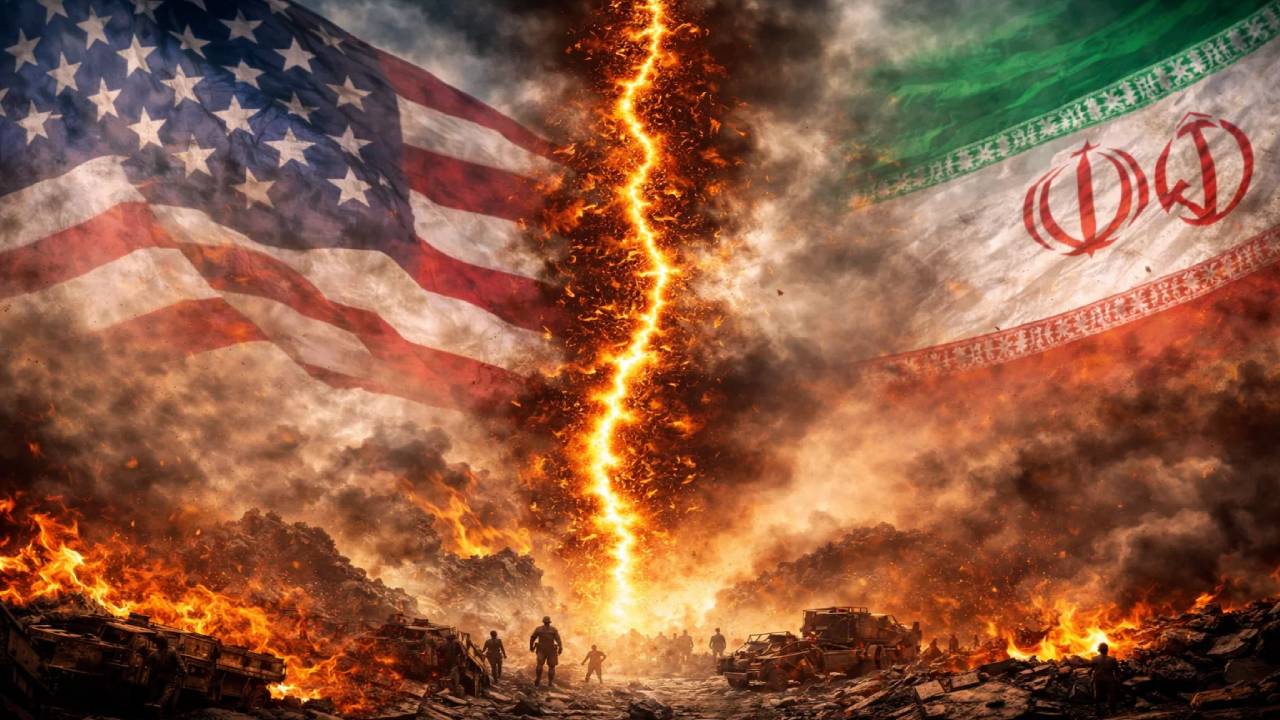
Once upon a time we were close friends, now we are staunch enemies! When and how did the rift arise in America-Iran relations? Complete timeline of 7 decades

US-Iran Relations: America Even though relations between Iran and Iran may have turned into deep enmity today, there was a time when both the countries were very close partners because of oil and arms trade. The situation changed completely after the Islamic Revolution of 1979 and from then till today the relations between the two countries have been full of constant tension and conflict.
Many issues like the hostage crisis, nuclear program and proxy war made these relationships more complex. in the last 75 years iran Is posing a big challenge to almost every American President. This is the reason why Washington launched many risky international campaigns against Iran. Let us know the complete timeline of relations between the two countries.
1953: Conspiracy to remove PM
In 1953, America feared that Iran’s Prime Minister Mohammad Mossadegh was putting the country in economic crisis and could take it closer to the Soviet Union. At that time, US President Dwight D. Eisenhower gave approval to the CIA to remove Mossadegh from power and the coup took place.
1953–1979: America-Iran closeness during the Shah era
After this coup, the power of Persian ruler Shah Mohammad Raza Pahlavi increased. With this, a big trade in American weapons in exchange for Iranian oil started. Shah became one of the few leaders who were given a warm welcome at the White House by seven consecutive US Presidents.
1979: Islamic Revolution and breakdown of relations
The situation suddenly changed in 1979 when Shah had to flee the country. The public was angry with his rule and in this environment Shia religious leader Ayatollah Ruhollah Khomeini, who was living in exile, came to power. With this incident, American influence in Iran almost ended.
About ten months after the Islamic Revolution, thousands of Iranian students attacked the US Embassy in Tehran and took dozens of people, including American diplomats, hostage.
1980: Hostage crisis and failed military operation
The US launched a secret military operation to rescue the hostages, but the mission was unsuccessful and eight American soldiers were killed. This incident also affected American politics and President Jimmy Carter lost the election, while Ronald Reagan got a big victory.
1981: release of hostages
Within minutes of Reagan taking the oath of office, Tehran released all 52 American hostages.
1983: Major attack in Beirut
In 1983, there was an attack on the American military barracks in Beirut, in which 241 American soldiers were killed. This attack was blamed on Iran-backed groups. This was the largest single-day loss of lives for the US military since World War II.
1981–1986: Iran–Contra scandal
The ‘Iran-Contra’ scandal came to light during the Reagan administration. The allegation was that the US administration secretly sold anti-tank and anti-aircraft missiles to Tehran to free hostages held by the Iran-backed group Hezbollah. The money received from these deals was secretly sent to anti-communist rebels in Nicaragua.
1989: Fatwa against Salman Rushdie
George H.W. During the Bush era, Ayatollah Khomeini issued a fatwa against writer Salman Rushdie, which created a huge controversy at the international level. Salman was accused of saying objectionable things against Prophet Mohammad (S.A.) in his book.
1990: Tension eases during Gulf War
Iran, weakened by the long war with Iraq, did not intervene much when America started the first Gulf War.
1995: Strict economic sanctions
President Bill Clinton imposed tough economic sanctions against Iran and barred American companies from participating in petroleum projects there. He also implemented secondary sanctions that made it difficult for non-American companies to do business with Iran.
2001: Iran’s response to the 9/11 attacks
The 9/11 attacks on America in 2001 had no connection with Iran. At that time, Iran’s President Mohammad Khatami had strongly condemned these attacks.
2002: ‘Axis of Evil’ statement
US President George W. Bush described Iran as part of the “Axis of Evil” along with Iraq and North Korea. During this time, information came to light that Iran was building two secret nuclear centers, which further increased America’s concern.
2009: Attempt to stop the nuclear program
President Barack Obama tried to start talks with Iran’s supreme leader Ali Khamenei, but it did not succeed. At the same time, America launched a cyber attack named ‘Stuxnet’, the purpose of which was to damage the centrifuges of Iran’s nuclear program.
The Obama administration also imposed strict sanctions on Iran’s oil exports, which increased the economic crisis and public dissatisfaction there.
2015: nuclear deal
In 2015, a nuclear deal was signed between Iran and America, which was called JCPOA. Under this, Iran agreed to limit its nuclear program and allow international inspection. In return, America freed Iran’s frozen assets worth about $100 billion.
2018: Trump canceled the agreement
In 2018, President Donald Trump ended this agreement and imposed strict sanctions on Iran’s oil exports, which put a huge pressure on its economy.
2020: assassination of Qasim Sulemani
In 2020, on Trump’s instructions, a missile attack was carried out on a car in Baghdad, in which Iran’s chief military commander Qasim Suleimani was killed. Soleimani was considered the main strategist of many of Iran’s covert operations in the Middle East.
2023: Tension after Hamas attack
After the attack on Israel by Hamas in 2023, America said that Iran-backed groups remain a major challenge for its allies. After this, President Joe Biden strengthened the security system in the Middle East.
In response to Iran-backed groups attacking US bases in Iraq and Syria, the US formed a coalition of more than 20 countries to stop the Houthi rebels’ maritime attacks next year. Allegations were made that Iran was working to supply weapons to Hamas.
2025: Trump’s tough stance
After becoming president again, Trump openly supported Israel’s military action against Iran-backed groups in Gaza, Lebanon, Syria and Yemen. He later ordered B-2 stealth bombers to attack Iran’s underground nuclear facilities and claimed to have destroyed Iran’s nuclear capabilities at three major sites.
2026: Appeal for change of power
In 2026, Trump announced new attacks on Iran with the support of Israel and said that Iran’s 88 million people should take the opportunity to change their government. Trump said, “No president in history was willing to do what I am willing to do.”
In this way, in the last seven decades, relations between America and Iran went from friendship to enmity and even today this conflict remains an important issue of global politics.

Comments are closed.