
India Urges Diplomacy as Iran–US Conflict Escalates; Focus on Energy Security and Safety of Indians in West Asia

India has reiterated its support for dialogue and diplomacy to resolve the escalating conflict between the United States and Iran. External Affairs Minister S. Jaishankar emphasized that India’s primary concerns remain the safety of Indian nationals in West Asia and the country’s energy security.
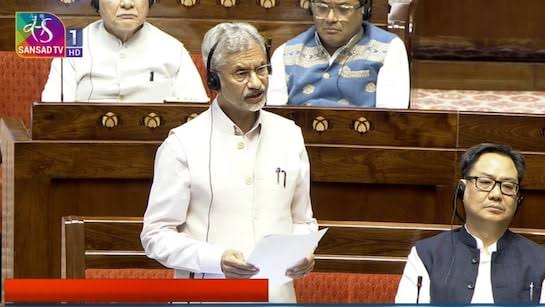
Speaking in the Rajya Sabha on Monday, Jaishankar described the war that began on February 28 as a matter of “deep concern.” He stressed the importance of restraint and de-escalation while urging all parties involved to return to diplomatic engagement.
India has also been monitoring the safety of nearly 10 million Indian nationals living across West Asia, particularly in countries such as Saudi Arabia and the United Arab Emirates, which have recently faced drone and missile strikes from Iran.
India’s Strategic Concerns: Energy Security and Trade
A major concern for India is the impact of the conflict on global oil supply. Oil prices have already crossed $100 per barrel, largely due to disruptions linked to the ongoing war and Iran’s closure of the strategically critical Strait of Hormuz.
The waterway is vital for global energy transportation and carries nearly half of India’s oil imports. As the world’s second-largest crude oil buyer, India depends on imports to meet about 85% of its energy needs. Any prolonged disruption could significantly affect fuel prices and economic stability.
Jaishankar said the government remains committed to ensuring energy availability while balancing cost and market risks. He also emphasized that the interests of Indian consumers will remain the government’s top priority.
Return of Indian Nationals From West Asia
India has been actively facilitating the return of citizens stranded due to the conflict. According to the external affairs minister, nearly 67,000 Indian nationals have already returned through commercial and special flights.
Air travel has gradually resumed following partial reopening of regional airspace. Indian airlines operated 15 inbound flights on March 7, followed by 49 flights on March 8 and 50 flights on March 9.
Indian diplomats have also been assisting transit passengers stranded in regional hubs such as Dubai, Doha, and Abu Dhabi. Support has also been provided for cross-border travel from the UAE to Oman and from Qatar, Kuwait, and Bahrain into Saudi Arabia.
Iranian Warships and India’s Humanitarian Gesture
Jaishankar also clarified the presence of three Iranian warships in the region during India’s International Fleet Review and a multinational naval exercise last month.
Iran requested permission on February 28 for the ships to dock at Indian ports, and India granted approval on March 1. One of the ships, IRIS Lavan, docked in Kochi on March 4, where its crew was accommodated at Indian naval facilities.
The Iranian foreign minister reportedly thanked India for the humanitarian gesture.
Another vessel, IRIS Dena, was torpedoed and sunk by a U.S. submarine during the conflict. Meanwhile, Sri Lanka allowed IRIS Booshehr to seek refuge and provided shelter for its crew at a naval camp.
Safety Concerns for Indian Seafarers
The government has also raised concerns about attacks on merchant shipping vessels, many of which are staffed by Indian sailors. Two Indian mariners have already lost their lives in recent incidents, while another remains missing.
Authorities have advised shipping companies not to deploy Indian seafarers on vessels traveling to Iranian waters until the security situation improves.
India Engages Regional Leaders
Prime Minister Narendra Modi has held discussions with several leaders from West Asia to ensure the safety of Indian citizens. These include leaders from Saudi Arabia, the UAE, Qatar, Kuwait, Bahrain, Jordan, and Oman, as well as the Prime Minister of Israel.
India is also maintaining diplomatic contact with the United States while attempting to stay engaged with Iran. Jaishankar confirmed he had spoken with Iranian Foreign Minister Seyed Abbas Araghchi on February 28 and again on March 5.
India Pushes for Peaceful Resolution
India has reiterated that stability in West Asia is critical not only for regional peace but also for global trade and supply chains. With bilateral trade between India and West Asian nations valued at nearly $200 billion annually, prolonged instability could have significant economic consequences.
Jaishankar concluded that India will continue to advocate diplomatic solutions and work with international partners to restore stability and ensure the safety of civilians.

Comments are closed.