
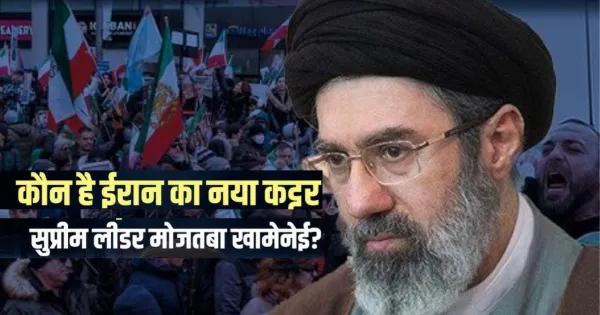
Who is Iran’s new Supreme Leader Mojtaba Khamenei; Why is his name discussed so much, why don’t Trump-Netanyahu like it?

The death of Iran’s Supreme Leader Ali Khamenei during the holy month of Ramadan is one of the most significant turning points in the history of the Islamic Republic of Iran. Ali Khamenei’s successors and his son, Mojtaba Khamenei, represent both continuity and contradiction in the revolutionary system established after the 1979 Iranian Revolution. At stake is not only who will lead Iran, but also what becomes of the Islamic Republic nearly half a century after a revolution that promised the end of dynastic rule.
Who is Mujtaba Khamenei?
Mojtaba Khamenei is a cleric who has spent most of his career away from public office but close to power (working in the Office of the Supreme Leader). He was often seen as a gatekeeper and arbiter of the corridors of power rather than a public political figure holding a formal position. At the age of just 17, he served briefly in the Iran–Iraq War. He began to attract public attention in the late 1990s, as his father’s authority as supreme leader was by then firmly established. Over time his reputation has centered on two key characteristics.
First, their close ties to Iran’s security apparatus, particularly the Islamic Revolutionary Guard Corps (IRGC) and its radical networks. Second, his strong opposition to reformist politics and Western intervention. Critics have linked him to the repression of protests that followed the disputed 2009 presidential election.
He is also believed to have exerted influence over Iran’s state broadcasting organization, giving him indirect control over the country’s information landscape and parts of state discourse. In 2019, the Trump administration imposed sanctions on Mujtaba over allegations that he was acting in an official capacity on behalf of the supreme leader without holding any formal government position.
Mujtaba’s legitimacy as a leader
Iran’s Constitution stipulates that the Assembly of Experts (88-member body of religious leaders) selects the Supreme Leader. The assembly lists the religious, political and leadership qualifications of potential candidates. The assembly’s candidates are vetted through institutions that are ultimately influenced by the influence of the Supreme Leader, and its deliberation process is opaque.
It is also important when assessing why Mujtaba is seen as a viable supreme leader, while he is accused of lacking the prestige traditionally associated with this position as a senior religious leader. Middle-ranking religious leader Mujtaba was given the title of Ayatollah only in 2022.
This title is necessary to become a supreme leader. This promotion therefore indicated that he was being groomed to take over power after his aging and ailing father. The fundamental myth of the revolution was clearly anti-dynastic. After the Shah was removed from power, revolutionary leaders rejected hereditary rule.
For many Iranians, a son succeeding his father as supreme leader seems like an ideological fallacy. This system of governance appears more like a theocratic monarchy than the famous ‘Patron of Lawyers’. Then it is also important to be accurate. Mujtaba cannot attain this position merely on the basis of lineage. It is necessary for him to be selected by the Assembly.
Nevertheless, political systems can become dynastic even without rewriting constitutions. Dynastic outcomes emerge when informal power networks, such as family ties, political patronage, security ties, and control over the media, present one candidate as more natural, secure, or indispensable. *Mujtaba’s story in Iran has been this for years: a man who established his influence not by winning elections but by controlling his path to the country’s highest office. The circumstances of Ali Khamenei’s death provide another dimension of significance and, ironically, legitimacy to Mujtaba’s rise to power. The killing during Ramadan has deep symbolic significance for many Shia Muslims.
Ali Ibn Abi Talib, the first Imam of Shiism, lost his life in an attack during the morning prayers of Ramadan in 661 AD, which Shia Muslims still remember every year. Shia historical monuments place special emphasis on martyrdom. In particular the martyrdom of Hussein ibn Ali, the Prophet Muhammad’s grandson, in Karbala symbolizes the struggle between justice and oppression.
Because of this tradition, the deaths of leaders past and present in violent attacks are seen in the context of a broader story of sacrifice and resistance. Iran’s revolutionary ideology has long been based on these themes. If the government presents Khamenei’s death this way, it could strengthen the narrative of martyrdom and rebellion. This provides his son Mujtaba with an aura of religious legitimacy which is deeply ingrained in the mentality of Shia Muslim people.
How different will he be from his father?
This is the most important question for Iran. The answer probably won’t be as different as many might be expecting. Ali Khamenei was a leading figure of the revolutionary generation. His power was based on ideological legitimacy, the accumulation and consolidation of power over decades, and his ability to mediate between competing factions.
With time he became the final arbiter of the system. In contrast, Mojtaba Khamenei is often portrayed as a product of the defense establishment rather than a public theologian or political leader. They are known more for their influence and the networks they have built for behind-the-scenes coordination than for their speeches or religious authority. The image of Mojtaba Khamenei suggests a more security-focused leadership style, with three possible paths forward.
First, domestic controls may become more stringent. Given Mujtaba’s alleged ties to the defense establishment, the unrest is more likely to be quelled by swift repression rather than political reconciliation. Second, given Mujtaba’s close ties with security forces, the IRGC may increase its influence in regional affairs. Third, any transformative dialogue with the West would likely use tactical rather than strategic tactics. In short, Iran under the leadership of Mojtaba Khamenei will likely adopt a confrontational stance at the rhetorical level, but a pragmatic approach if the regime’s survival is at risk.

Comments are closed.