
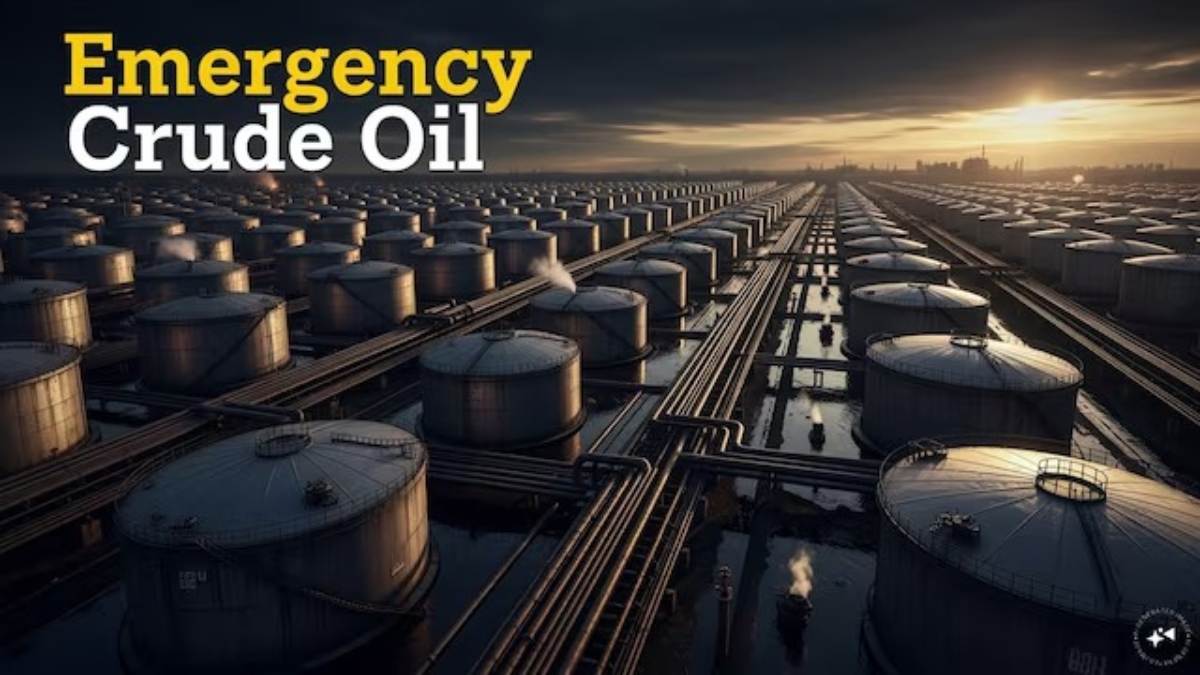
Crude Oil Emergency Reserve: Meeting of Finance Ministers of G7 Countries, will emergency oil reserve be opened?

According to a report by the Financial Times, the finance ministers of the G7 countries will discuss a possible plan to release emergency petroleum reserves. This discussion is taking place amid the sharp rise in oil prices due to the conflict in the Gulf region.
International Energy Agency Executive Director Fatih Birol will also participate in the meeting. The impact of the Iran war on the global energy market will be discussed. According to people associated with the discussion, three G7 countries including America have so far supported the proposal to release oil from the strategic reserve.
400 million barrels of oil may be released
Some US policymakers believe that about 300 million to 400 million barrels of oil could be released in a coordinated manner. This will be about 25 to 30 percent of the approximately 1.2 billion barrels of oil kept in the strategic reserves of IEA member countries.
Crude oil prices have increased after increasing conflict in West Asia. During Asian trading on Monday, international benchmark Brent crude oil rose 24 percent to $116.71 per barrel. At the same time, WTI increased by 28 percent to $116.45 per barrel.
Global market instability
This surge in oil prices has increased the volatility in the global financial market. Many Asian stock markets fell on Monday, while US stock market futures indicated a big decline even before the open. Pressure on fuel prices has also increased in the US. As of Sunday, the average price of gasoline in the US reached $3.45 per gallon, up from $2.98 a week earlier.
US President Donald Trump commented on the rise in oil prices in a post on Truth Social. He said that after the end of Iran’s nuclear threat, short-term oil prices will fall rapidly. This is a small price to pay for the security and peace of the US and the world. According to reports, if oil prices remain high for a long time, it may increase global inflation and threaten economic growth.
Major oil importing countries like China, India, South Korea, Japan, Germany, Italy and Spain may be more affected by the price increase because they are dependent on imported energy. Emergency oil reserves were created with the establishment of the International Energy Agency in 1974.
This initiative was started after the Arab oil embargo, which led to a severe shortage of fuel across the world and a sharp rise in prices. IEA member countries have been ordered to maintain strategic oil reserves for use in case of serious disruption in supply.
About 1.24 billion barrels of oil in reserves
IEA member countries have coordinated emergency oil reserves five times so far. The most recent intervention occurred in 2022 when energy prices increased following Russia’s invasion of Ukraine. According to a document, IEA member countries have about 1.24 billion barrels of oil in public strategic reserves. Apart from this, the industries have about 600 million barrels of additional reserves which can be used if needed.
These reserves can cover approximately one month’s total oil demand and more than 140 days’ net imports for IEA countries. According to the report, the US and Japan have about 700 million barrels out of the total 1.24 billion barrel public strategic reserve.

Comments are closed.