
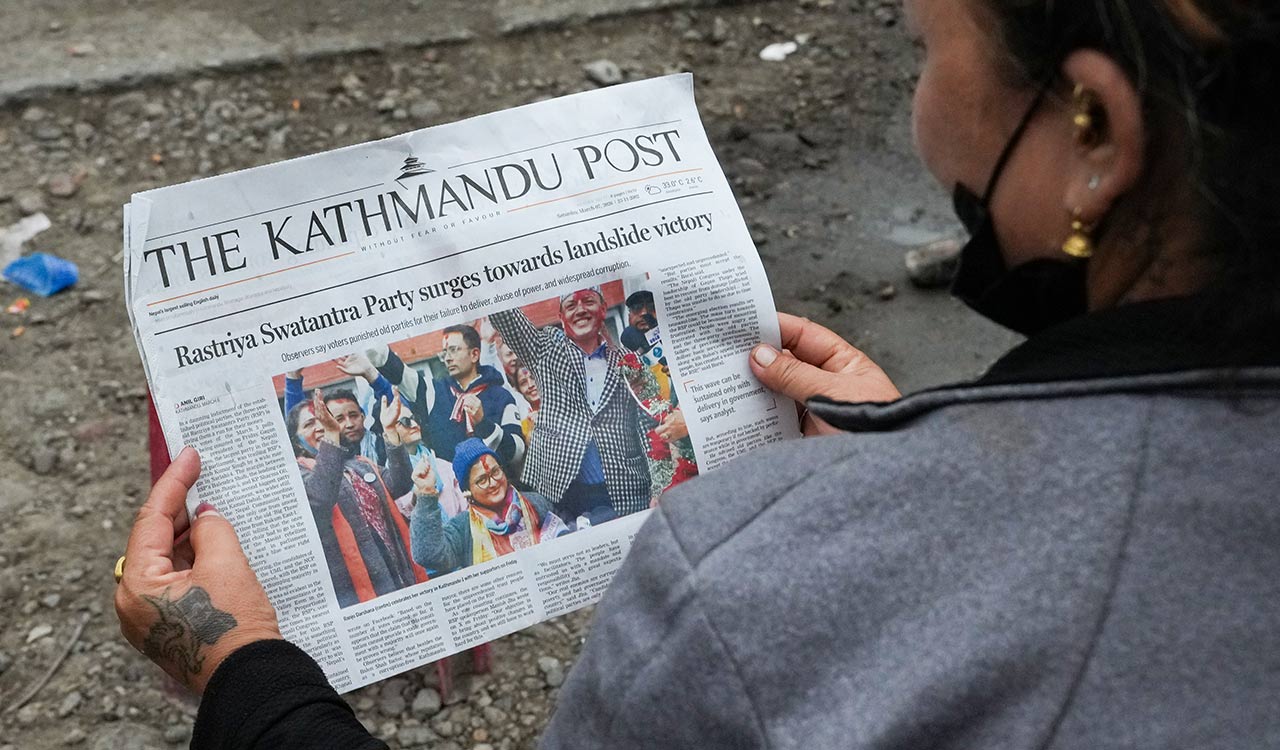

Rabi Lamichhane, chairman of Rastriya Swatantra Party, thanked Narendra Modi after the party’s sweeping win in Nepal’s parliamentary elections. He pledged “development diplomacy” to strengthen Nepal-India cooperation in connectivity, tourism, energy and trade as the party prepares to form a majority government
Published Date – 10 March 2026, 12:52 PM
Kathmandu: RSP Chairman Rabi Lamichhane has said he looked forward to strengthening Nepal-India ties through “development diplomacy” as he thanked Prime Minister Narendra Modi for wishing him on the party’s electoral success.
Rastriya Swatantra Party (RSP) has won 125 of the 165 seats under direct voting in Nepal’s parliamentary polls as vote counting under the first-past-the-post (FPTP) system concluded on Tuesday, putting it in a position to form a majority government.
The party bagged 4,974,957 votes so far under the proportional representation (PR) system.
In a social media post on Monday, Lamichhane thanked Prime Minister Modi for his warm wishes and for “recognising the democratic mandate of the Nepali people”.
“RSP and our government will remain dedicated to fostering a relationship built on mutual respect and shared prosperity where RSP will prioritise on ‘development diplomacy’,” he said.
“We look forward to a partnership with India that scales new heights through cooperation in connectivity, cultural tourism, energy, and trade, ensuring a prosperous future for the people of both countries,” the RSP leader said.
Congratulating Lamichhane and Balendra Shah for their election victory, Modi on Monday conveyed India’s commitment to work with them for the mutual prosperity, progress and well-being of the two countries.
Shah is all set to become Nepal’s first Madhesi prime minister and also the youngest elected executive head.
In a social media post, Modi said, “I am confident that with our joint endeavours, India and Nepal relations will scale new heights in the years ahead.” The House of Representatives (HoR) in Nepal has a total of 275 seats. While 165 members are elected through the First Past The Post (FPTP) or direct voting system, 110 members are elected through proportional representation.
Vote counting for all 165 seats under the direct voting system has been completed, with RSP emerging as the largest party with 125 seats.
The Nepali Congress (NC) secured 18 seats, followed by the CPN-UML with nine, the Nepali Communist Party (NCP) with eight, the Shram Sanskriti Party (SSP) with three and the Rastriya Prajatantra Party (RPP) with one seat. One independent candidate was also elected.
The counting of votes under the proportional representation (PR) system is still underway and is expected to conclude by Tuesday night.
However, a few more days would be required to declare the final results under the PR system and formally allocate seats to candidates of different parties, the Election Commission said.
Under the PR system, the RSP has so far secured 4,974,957 votes, followed by NC with 1,685,722 votes, CPN-UML with 1,402,157, NCP with 763,633 votes, SSP with 350,809 and RPP with 323,744 votes.
Based on the current trend, the RSP is likely to secure at least 50 seats under the PR system, which would take its total tally in the 275-member House of Representatives to around 175 seats, experts said.
This would allow the party to form a majority government under Article 76 (1) of the Constitution of Nepal.

Comments are closed.