
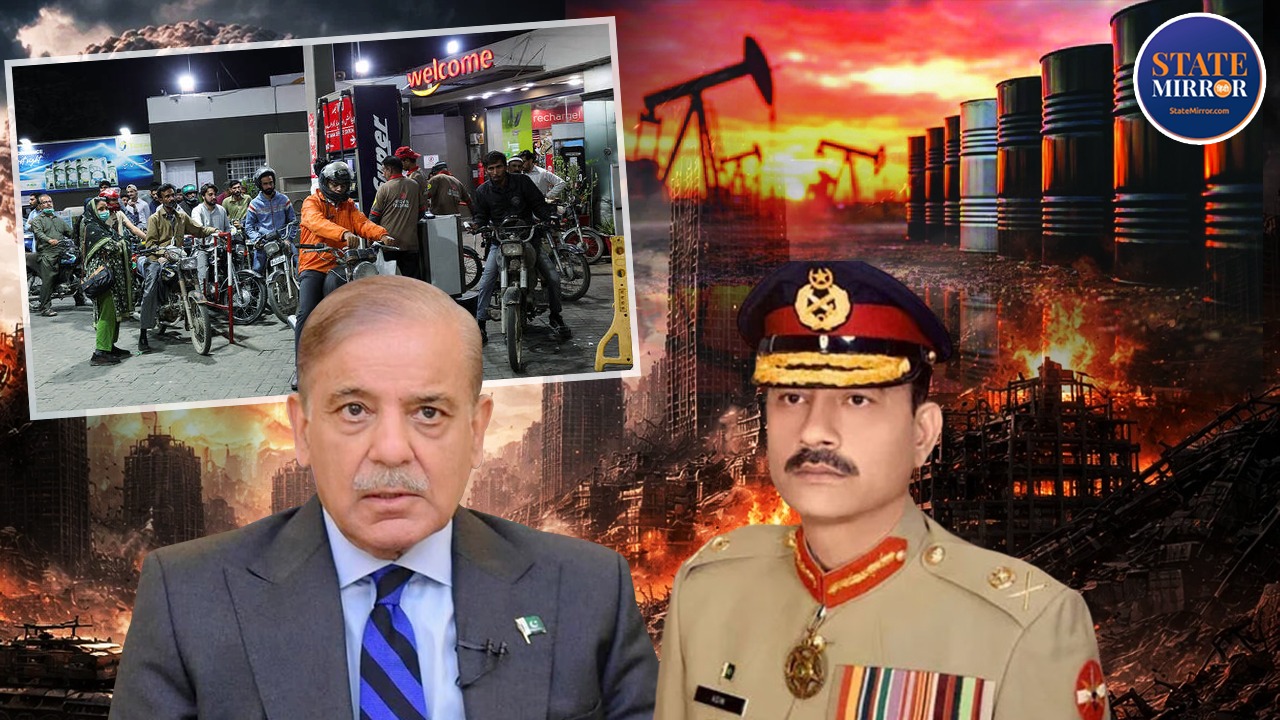
Iran US Israel War: Munir and Shahbaz kept sleeping, Pakistan’s back is broken, see the proof yourself

Pakistan The economy is currently facing pressure on many fronts. Meanwhile, the Iran-Israel war has broken the back of the economy. Inflation, foreign debt, energy crisis and weak economic growth have made the situation such that the common people are being directly affected. It has also been said in the reports of Pakistan’s leading media organizations Dawn and Geo News that the country’s economy is currently hanging on a thin thread of stability and even a small mistake can give rise to a big crisis.
1. What is the impact of Middle East war on PAK’s economy?
According to Pakistani media reports, the impact of the increasing war in the Middle East is now directly visible on Pakistan’s economy. The government has suddenly increased the price of petrol by Rs 55 per liter emergency and it is feared that more such decisions may be taken in the coming days. At present, after this increase, the price of petrol in Pakistan has now become Rs 335.86 per liter. Whereas diesel has reached the level of Rs 321.17 per liter.
Regarding the increase in the prices of petrol and diesel, the government’s argument is that due to America-Israel and Iran war and tension in the Middle East, the prices of crude oil have increased rapidly in the international market, due to which this decision had to be taken.
2. Supply interruption in Strait of Hormuz: What will be the impact on the oil market?
According to the report of Pakistani newspaper Dawn, oil industry officials say that due to the blockage in the Strait of Hormuz, the supply of oil from the global market has reduced by about 20 million barrels per day, which is considered to be the biggest supply blockage in history.
3. Could oil prices surpass the records of 2008 and 2022?
On this situation, Goldman Sachs has warned that if this situation continues, oil prices may go above the record levels of 2008 and 2022. In 2008, oil reached about $147 per barrel, while in 2022, after the Russia–Ukraine War, prices went above $120. If the war in the Middle East continues for a long time, the price of petrol in Pakistan may reach Rs 400 per liter and the dollar may go above Rs 300.
4. Foreign exchange reserves and Saudi Arabia-UAE deposits: What are raising concerns?
Pakistan’s concern has also increased because it is heavily dependent on the deposits of Saudi Arabia and UAE to maintain its foreign exchange reserves. Also, if regional tensions increase, the pressure on Pakistan to increase security cooperation may also increase. If the war in the Middle East does not end soon, its impact can be heavy not only on the oil market but also on both Pakistan’s economy and the global economy. After all, for what reasons are such big questions being raised on the economic condition of Pakistan?
Huge debt remains the biggest threat to Pakistan’s economy. According to the assessment of international organizations, the total public debt of the country has reached approximately 72–73% of the GDP. Such a huge debt puts huge pressure on the government’s budget, because every year a huge amount is spent only on paying interest.
Dawn reports also said that Pakistan’s economic stability is still very weak and the country “has come out of the crisis, but a strong recovery is still far away.” Low investment and slow economic growth are exacerbating this problem.
The recent global situation and energy crisis has made the situation more difficult for Pakistan. The government had to suddenly increase the prices of petrol and diesel by 55 Pakistani rupees per liter. After this, the price of petrol reached around Rs 336 and diesel reached more than Rs 321 per liter. This increase affects not only transport but also the prices of food and everyday items, which further increases inflation.
5. Electricity and energy crisis in Pakistan: How much shock will the general public face?
Pakistan, which is dependent on energy imports, has suffered a direct blow from the increase in global oil prices. According to reports, the oil import bill can reach around $600 million every month. This is increasing pressure on foreign exchange reserves and current account deficit. For this reason, Pakistan has to repeatedly seek financial help from the International Monetary Fund (IMF).
The debt of power sector is also continuously increasing in Pakistan. The government had to take loans worth billions of dollars to handle this crisis. Besides, a plan has also been made to reduce electricity subsidy and increase tariff. Experts say that these steps may provide some relief to the industry, but electricity bills of common consumers may increase by 50%, which will put a heavy burden on the middle class.
6. Slow economic growth and employment crisis: How will the common people be affected?
Economic growth is also a matter of concern for Pakistan. It is estimated that the country’s GDP growth will be around 3%, which is much lower than the rapid population growth. This means that employment generation will be limited and there will not be much improvement in the income of common people. The current economic situation of Pakistan is surrounded by many challenges. These include huge foreign debt, energy and power crisis, inflationary pressure and weak economic growth.
Pakistani media reports like Dawn and Geo also clearly indicate that the country is currently in a delicate state of economic stability. Even a slight global or domestic economic disturbance can turn the situation into a serious crisis again.
On social media, people are expressing anger over the ‘bomb-like’ increase of Rs 55 per liter of petrol and are blaming the government. Many users say that this decision is putting a huge economic burden on the common people, while the people in power are avoiding it. Some have even shared funny and sarcastic posts through memes and videos, such as sarcastic statements like “Nuclear is power but not fuel”.
Many people say that this inflation is not only the result of global oil prices, but also of government decisions and tax policies. A claim has also surfaced in some social media posts that the government has made petrol more expensive by increasing the tax, due to which the common man will have to pay a heavy price.

Comments are closed.