

Bui Minh Dang, head of the CAAV’s Air Transport Department, said Jet A1 aviation fuel has tripled in price since the conflict erupted on Feb. 28, with prices fluctuating near US$200 per barrel on March 9.
Fuel typically accounts for about 30% of an airline’s operating costs, and the surge has pushed total costs up 60-70%. Rising diesel prices have also increased the cost of running ground equipment at airports, adding further pressure on both carriers and airport operators.
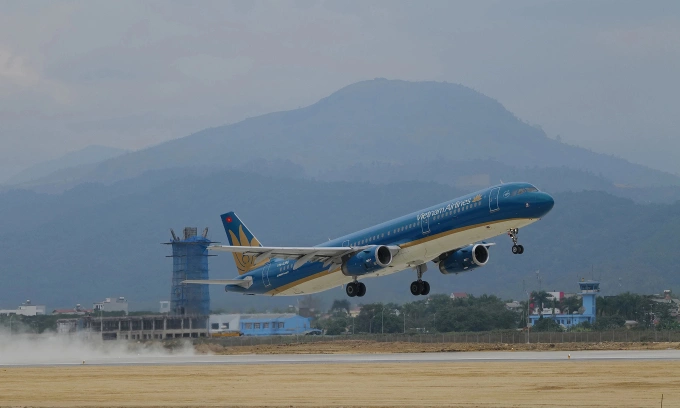
Nguyen Quang Trung, deputy general director of Vietnam Airlines, said if prices stay around $200 per barrel, the airline’s operating costs would double, meaning it would lose money on every flight. Vietnam Airlines has drawn on its March fuel reserves and implemented fuel-saving measures to partially cover operations into April.
The conflict has already disrupted major transit routes linking Europe and Asia through the Gulf. Qatar Airways, Emirates and Etihad Airways have canceled or adjusted 98 flights to and from Hanoi, Ho Chi Minh City and Da Nang between Feb. 28 and March 10, affecting around 20,000 passengers, according to the CAAV. Several Middle Eastern countries have closed or restricted their airspace since the strikes began.
Vietnam Airlines has added about 30 flights on European routes to help clear stranded passengers. Trung said the disruption also presents an opportunity: with Gulf carriers grounded and recovery likely to be slow, Vietnamese airlines could capture more transit traffic and advance Vietnam’s ambition to become a regional aviation hub.
On the supply side, fuel suppliers said they are managing the situation. Tran Minh Tuan, general director of Skypec, the country’s largest aviation fuel supplier, said the company imports 70-80% of its jet fuel from Singapore, Thailand and China, with the rest from the Dung Quat and Nghi Son domestic refineries.
Skypec has guaranteed supply through March 31 and placed orders for April, though Tuan said the outlook beyond that depends on how the Middle East situation develops.
Nguyen Van Hoc, general director of Petrolimex Aviation, the country’s second-largest supplier, also confirmed supply through the end of March. He noted that some April orders could face disruption if counterparties invoke force majeure clauses.
Both suppliers urged airlines to commit to accurate fuel consumption estimates for March through May so they can plan procurement, and called on the CAAV to coordinate with supplier countries to ensure contracted shipments are delivered.
Vietnam Airlines proposed waiving the environmental protection tax on jet fuel and asked the CAAV to negotiate flexible regulatory mechanisms with international aviation authorities, similar to measures adopted during the Covid-19 pandemic.
CAAV Director General Uong Viet Dung called on the industry to work together, directing fuel suppliers to maintain production and airlines to optimize costs while sustaining their route networks. He urged carriers to explore new routes to markets including the Americas, Africa, Australia, Eastern Europe, India, Japan and South Korea, while ensuring service quality is not compromised.
On the policy front, the CAAV said it would ask the Ministry of Construction, which has overseen transport since absorbing the former Ministry of Transport in a 2025 government restructuring, to seek government support. It will also recommend expanded credit limits for fuel importers and airlines from the State Bank of Vietnam, ask the Ministry of Industry and Trade to diversify supply sources, and request tax and fee relief from the Ministry of Finance.

Comments are closed.