
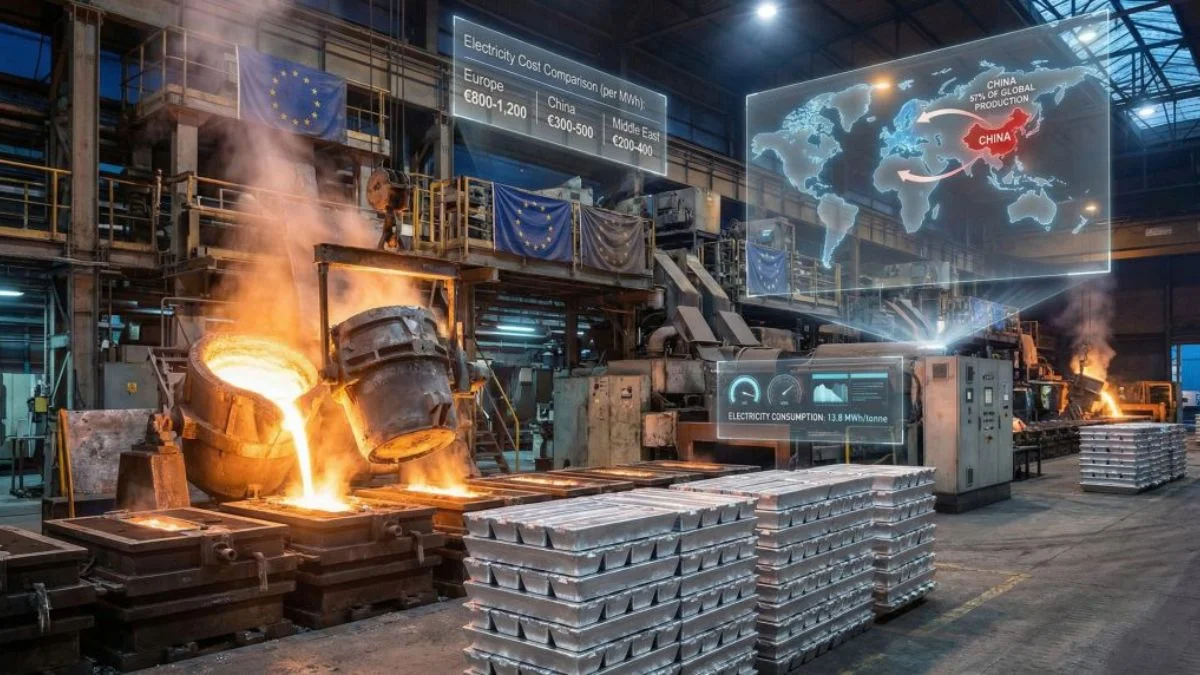

The modern global economy rests upon a handful of industrial materials so foundational that their uninterrupted supply is rarely questioned until a crisis erupts. Among these materials aluminium occupies a uniquely critical position because it sits at the intersection of construction, transportation, aerospace engineering, electrical transmission infrastructure, consumer electronics, food packaging and renewable energy technology. The metal is so embedded within the functioning of contemporary industrial civilisation that disruptions to its supply do not merely affect a single industry but cascade through nearly every productive sector of the world economy. Yet a largely unnoticed structural risk is quietly forming beneath the surface of global markets. As geopolitical tensions intensify across the Gulf and energy security becomes increasingly uncertain, the global aluminium system is entering what may become the most consequential supply shock the industry has faced in decades.
At the centre of this emerging vulnerability lies the fragile energy architecture surrounding the Persian Gulf and particularly the strategic maritime corridor known as the Strait of Hormuz. This narrow waterway represents one of the most important arteries of the global energy system because it carries a massive proportion of internationally traded crude oil, liquefied natural gas and refined petroleum products. Any sustained disruption in the stability of this corridor reverberates far beyond oil markets because modern industrial production depends deeply on reliable and affordable energy flows. Aluminium production is perhaps the most energy intensive major manufacturing process in the world, and it therefore sits directly on the fault line of any geopolitical disturbance affecting global energy supply. To understand the scale of the vulnerability one must appreciate the extraordinary energy demands of aluminium smelting. The transformation of alumina into primary aluminium through electrolysis requires enormous amounts of electricity. In many modern smelters electricity alone accounts for more than one third of total production costs. This reality has shaped the geography of the aluminium industry over the past three decades. Rather than being located primarily in countries with bauxite deposits, the world’s largest aluminium smelters have increasingly migrated to regions offering abundant and inexpensive electricity. The Gulf region has therefore emerged as one of the most important aluminium production hubs on the planet.
Several of the largest and most technologically advanced aluminium complexes now operate within Gulf economies, particularly in countries such as United Arab Emirates, Bahrain and Qatar. These smelters benefit from access to inexpensive natural gas which powers the electricity generation required for electrolysis. Industrial giants such as Emirates Global Aluminium and Aluminium Bahrain have transformed the region into a crucial pillar of global aluminium supply. Their output feeds downstream industries across Europe, Asia and North America, providing metal for automotive manufacturing, aircraft construction, infrastructure projects and consumer goods production. The strategic significance of this industrial cluster is often underestimated outside specialist economic circles. Aluminium smelters cannot simply be turned on and off like conventional factories. They operate continuously because the electrolysis process requires stable electrical current to maintain molten aluminium within enormous reduction cells. Any prolonged interruption to power supply can damage equipment and freeze metal within the cells, causing catastrophic financial losses and forcing shutdowns that may take months to repair. This structural characteristic means that aluminium smelting facilities are uniquely sensitive to instability in electricity supply, fuel availability and geopolitical security.
As tensions escalate across the Gulf region and the possibility of maritime disruption or military escalation increases, the energy infrastructure underpinning these smelters becomes exposed to multiple layers of risk. Natural gas flows, electricity generation systems, maritime fuel deliveries and regional security conditions all form part of an interconnected industrial ecosystem. If instability were to affect gas supply routes, shipping insurance markets, or regional power generation capacity, aluminium production in the Gulf could be rapidly curtailed. The consequences of such a disruption would be profound because global aluminium markets already operate within a delicate balance between supply and demand. The largest producer of aluminium remains China, yet Chinese production is constrained by environmental regulations, energy consumption limits and the structural challenges of coal dependent power generation. Many Western countries have already lost substantial portions of their domestic smelting capacity due to high electricity prices and industrial restructuring. In Europe, numerous aluminium smelters have reduced production or shut down entirely following energy market volatility linked to the Russian invasion of Ukraine. This means that global supply resilience has already been weakened before any new crisis emerges. If Gulf based smelters were forced to reduce output due to energy disruptions, the global aluminium market would face an immediate supply deficit. Prices would surge rapidly on international exchanges such as the London Metal Exchange, triggering a chain reaction across industries dependent on aluminium inputs. Manufacturers of automobiles, aircraft components, building materials, packaging products and electrical infrastructure would confront rising costs and supply shortages simultaneously.
The automotive sector illustrates the magnitude of the potential shock. Modern vehicles increasingly rely on aluminium for structural components, body panels and engine parts because the metal provides exceptional strength to weight ratios that improve fuel efficiency and support electric vehicle design. Major manufacturers including Tesla, Toyota Motor Corporation and Volkswagen Group depend heavily on stable aluminium supply chains. Any sudden spike in aluminium prices would ripple through vehicle production costs and ultimately affect consumers worldwide.
The aerospace industry faces an equally serious exposure. Aircraft manufacturing relies extensively on specialised aluminium alloys used in fuselage structures, wing components and internal systems. Companies such as Airbus and Boeing operate production networks that require consistent metal supply years in advance. A prolonged aluminium shortage would therefore disrupt aircraft manufacturing schedules and potentially delay fleet expansion plans for airlines across the globe. Even the global energy transition depends heavily on aluminium availability. Renewable energy infrastructure such as solar panels, wind turbines and electricity transmission networks incorporate vast quantities of aluminium due to its conductivity and corrosion resistance. Power grids expanding to accommodate renewable generation require extensive aluminium cabling and structural components. Thus a disruption triggered by energy instability in the Gulf could ironically undermine the very clean energy transition that many governments are attempting to accelerate. The financial implications of such a shock would extend well beyond commodity markets. Rising aluminium prices would feed directly into global inflation dynamics because the metal is embedded in construction materials, transportation equipment and consumer goods. Central banks already struggling to contain inflationary pressures could face renewed economic turbulence if industrial metal prices surge. Manufacturing sectors in Europe and Asia would experience cost escalation precisely at a moment when many economies remain fragile after years of pandemic disruption and geopolitical instability.
Another dimension of the crisis lies within the complex web of international trade flows that distribute aluminium products around the world. Raw aluminium ingots produced in Gulf smelters are shipped to fabrication facilities in Europe, Southeast Asia and North America where they are converted into rolled sheets, extrusions and engineered components. These intermediate products then move onward to factories producing automobiles, aircraft, electronics and infrastructure equipment. The disruption of aluminium supply therefore does not merely affect primary metal markets but threatens to destabilise entire industrial supply chains spanning multiple continents. Shipping routes themselves introduce an additional layer of vulnerability. Aluminium exports from Gulf producers travel through maritime corridors that intersect directly with the security environment of the region. Insurance premiums for vessels transiting these waters could rise sharply if geopolitical tensions intensify. Maritime risk calculations conducted by global insurers influence freight costs and shipping decisions across the entire commodities trade. Thus even the perception of heightened danger in regional waters could constrain aluminium exports by making transport economically prohibitive.
The geopolitical context surrounding these risks cannot be ignored. The ongoing confrontation involving Iran and its regional adversaries has already reshaped security dynamics across the Gulf. Military incidents, drone attacks on energy infrastructure and maritime confrontations have periodically raised fears that the conflict could escalate into a wider regional crisis. Should such escalation occur, energy facilities, shipping lanes and industrial infrastructure throughout the Gulf could become targets or collateral damage in a broader geopolitical confrontation.
In this environment global aluminium markets have begun to exhibit subtle signs of stress. Commodity analysts monitoring inventory levels, energy costs and shipping conditions have noted increasing volatility in aluminium pricing. Traders and industrial consumers are quietly evaluating supply diversification strategies while governments assess strategic stockpiles of critical materials. Yet public discussion of the issue remains limited because aluminium supply chains are less visible than oil markets or semiconductor production. This invisibility makes the emerging aluminium vulnerability particularly dangerous. Policymakers and corporate executives often focus their attention on headline commodities such as crude oil, natural gas and rare earth minerals while overlooking the foundational industrial metals that underpin everyday economic activity. Aluminium belongs to this category of quietly indispensable materials whose absence would paralyse vast sections of the global economy.
The world therefore stands at the edge of a potential industrial shock whose origins lie not within mines or smelters but within the geopolitics of energy security. The Gulf region has become a crucial production centre precisely because it offers the abundant electricity required for aluminium smelting. Yet that same energy concentration exposes the industry to geopolitical turbulence capable of disrupting production on a massive scale. If instability across the Gulf were to interrupt natural gas supply chains or electricity generation systems supporting aluminium smelters, the consequences would reverberate through manufacturing sectors across the planet. Construction costs would rise, vehicle production would become more expensive, aircraft manufacturing schedules would face delays and renewable energy infrastructure projects could slow. Financial markets would react to industrial price shocks while governments scramble to secure alternative supply sources. What makes this emerging crisis particularly alarming is the speed with which it could unfold. Aluminium smelting disruptions can remove large volumes of supply from the market almost overnight. Restoring production capacity often requires months of technical repair and logistical coordination. By the time the scale of the disruption becomes visible in commodity markets, supply shortages may already be deeply embedded within global manufacturing systems. The silent aluminium crisis now forming beneath the surface of global markets therefore represents far more than an industrial issue. It is a revealing illustration of how deeply modern civilisation depends on stable energy infrastructure and secure geopolitical conditions. A conflict centred thousands of kilometres away from most industrial centres could ultimately determine the cost and availability of the metal that frames skyscrapers, carries electricity across continents, shapes aircraft fuselages and forms the packaging that protects food supplies.
In a world increasingly defined by fragile supply chains and geopolitical rivalry, the emerging aluminium vulnerability serves as a stark warning. The global economy has built vast industrial systems upon assumptions of uninterrupted energy flows and stable trade routes. Yet those assumptions are now being tested by geopolitical forces capable of reshaping the architecture of global production. If Gulf energy disruption intensifies, the resulting aluminium shock may reveal just how precariously balanced the foundations of modern industrial civilisation truly are.

Comments are closed.