
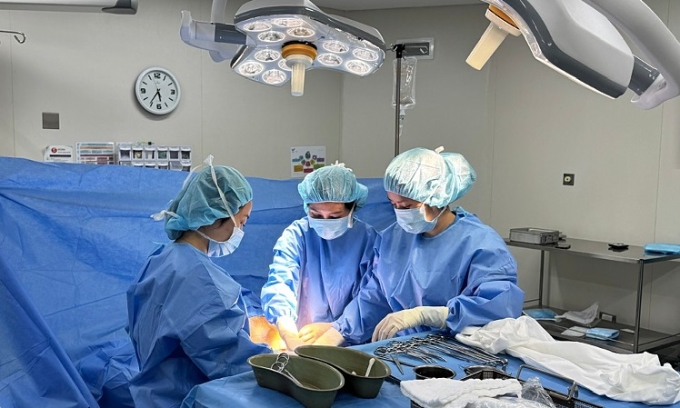

The woman’s family rushed her to Hanoi French Hospital in critical condition on March 6, with dangerously low blood pressure, a racing pulse and pale skin. She was in her third pregnancy and had delivered both previous children by cesarean section, the most recent just one year earlier.
An abdominal ultrasound revealed severe blood loss and a large volume of free blood pooling in her abdominal cavity. The medical team transferred her to the intensive care unit and assembled a multidisciplinary consultation. Doctors determined the growing fetus had caused her uterus to tear open at the weakened scar from her previous cesarean, and decided to operate immediately.
When surgeons opened her abdomen, they found the uterus had ruptured at the exact site of the old cesarean scar. The rupture was caused by placenta accreta, a condition in which the placenta grows abnormally deep into the uterine wall. In this case, it had invaded deep into the muscular layer, weakening the scar tissue to the point of failure.
Working quickly to control the hemorrhaging, the surgical team repaired the damage and managed to fully preserve the mother’s reproductive organs, an outcome that is far from guaranteed in placenta accreta cases, which frequently require a hysterectomy.
The hospital announced March 10 that the patient had been discharged in stable condition after four days of treatment.
Cao Thi Thuy Ha, Deputy Head of the hospital’s Obstetrics and Gynecology Department, said a previous cesarean scar is the single greatest risk factor for placenta accreta. She explained that the one-year gap between the tourist’s two most recent deliveries had left the uterine scar with insufficient time to heal and restructure, severely weakening the wall.
In the most serious cases, Ha said, the uterus can rupture as early as the second trimester, well before the pregnancy reaches viability. She described the complication as rare but extraordinarily dangerous because the patient can hemorrhage massively and go into shock within minutes.
The risk is growing worldwide as cesarean delivery rates climb. The American College of Obstetricians and Gynecologists has documented that the incidence of placenta accreta spectrum increases with the number of prior cesarean deliveries, and research shows that interdelivery intervals shorter than 24 months are associated with a two- to three-fold increase in the risk of uterine rupture.
Medical experts advise women to wait at least two years between cesarean deliveries to allow the scar to heal fully. Women with a previous cesarean scar should undergo ultrasound examinations to check the position of the placenta from the first trimester and be closely monitored throughout pregnancy. Early detection allows doctors to plan risk management and prepare for emergency intervention at facilities equipped with surgical and intensive care capabilities.

Comments are closed.