
Bargaining for brilliance: Vietnamese Stanford alumnus sends hundreds of compatriot scholars to US

His enduring legacy lies in “bargaining” with top American universities to secure tuition for hundreds of Vietnamese PhD students, fueled by an unwavering belief that “Vietnamese talent has a strong reputation.”
The 68-year-old’s lifelong dedication to education earned him a spot among the Stanford Graduate School of Business’s 100 Centennial Alumni Catalysts in October 2025. The honor highlights his transformative leadership at the Vietnam Education Foundation and the establishment of The Vietnam Foundation.
Read spoke with him about his 30-year journey of connecting the education systems of two former adversaries.
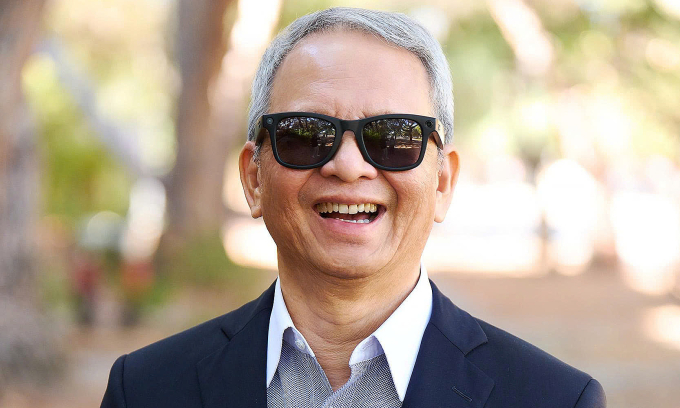
Pham Duc Trung Kien in a photo he provided. |
What went through your mind when Stanford announced the honor?
I immediately thought of my parents. Throughout my entire journey returning to Vietnam to build these educational bridges, their unwavering support has been my foundation.
They are in their 90s now, yet they still tell me to “never forget my roots” and to “help Vietnamese people.” Knowing this recognition brings them pride makes me deeply happy.
Equally important to me is the broader impact. I am so proud that the world is increasingly recognizing Vietnam for our brilliant minds and educational strides, stepping out from the shadow of our wartime past.
You once worked at the White House and the office of the U.S. Secretary of Defense. What motivated you to begin supporting education in Vietnam in the 1990s?
I was 19 when my family migrated to the United States in 1977. My parents always grounded me by reminding me how fortunate I was to have finished my general education in Vietnam. That solid foundation was the very “capital” that fueled my success overseas.
I went on to earn my bachelor’s at the University of Colorado, followed by a Master’s and an MBA from Stanford, persevering even as retinal degeneration gradually claimed my eyesight.
My return to Vietnam came in 1993. I had just finished serving on a strategic planning task force for the U.S. Secretary of Defense, focusing on the liberation of Kuwait and Middle East stabilization.
I wanted to give back, so I approached high schools to offer scholarships for top seniors heading to university. To my surprise, most turned me down.
At that time, there was deep-seated suspicion toward those of us who had left Vietnam for the U.S. Several principals outright refused to see me, worried that associating with me would bring trouble.
It was a bitter disappointment. Yet, my parents and extended family urged me to keep going, assuring me that investing in Vietnamese education was my true calling.
The breakthrough came when friends introduced me to the Vietnam Fund for Supporting Technological Creativity (VIFOTEC). Once I channeled my donations through their official network to reach the students, the doors finally opened.
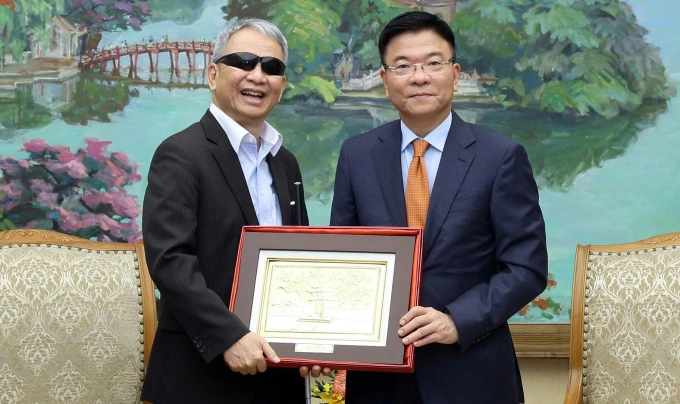 |
Deputy Prime Minister Le Thanh Long (R) receives Pham Duc Trung Kien in May 2025, Photo by Vietnam Government Portal |
What was the turning point in your journey?
The creation of the Vietnam Education Foundation (VEF) in 2003 was definitely the turning point. The White House contacted me and asked me to come to Washington to help build a program supporting Vietnamese students studying in the United States.
At the time, I was living in Texas. I had been married for a few years and had a young child, so I wasn’t sure how I would manage the transition. Still, I felt drawn to the mission. I had been looking for ways to contribute to Vietnam’s education, and this was the perfect opportunity. I packed up and moved my entire family to Washington.
During the VEF’s first year, I set a goal to send 20 Vietnamese students to the U.S. for PhD programs, with plans to increase that number in subsequent years. Many people doubted we could find that many qualified candidates and suggested bringing American professors to Vietnam instead.
I completely disagreed. With Vietnam’s population at 86 million back then, it made no sense that we couldn’t find 20 talented individuals. I asked for two years to prove it. We only recruited 13 students in the first year, but that number quickly surged to 83 in the second year.
Then came the financial challenge. Tuition was about US$60,000 annually, and PhD programs take four to five years. The fund simply couldn’t cover everything.
Some advisors suggested spreading the students across multiple cohorts. I refused, arguing that scientific research thrives on fresh, young talent. Instead, I went directly to the universities and negotiated, asking them to reduce tuition by 50%. Thanks to that approach, the VEF successfully sent all 83 students to the U.S. while preserving funds to support future scholars.
How did you manage to bargain with those universities?
I sought out the leadership of the Association of American Universities (AAU) and the National Academies, two of the most influential bodies in graduate education. The National Academies, which receive government funding, were already tasked with supporting the VEF.
I persuaded the Academy leadership to join me in a meeting with the AAU President. At the time, he also served as the Chancellor of the University of Illinois Urbana-Champaign, a public institution renowned for its engineering and technology programs.
He was actually part of a delegation of American professors visiting Vietnam to recruit fellows for the VEF. Seizing this opportunity, I proposed a bold condition for sending our students to Illinois: the university had to reduce its $46,000 annual tuition by 50%.
Furthermore, I stipulated that the VEF would only fund the first two years. If a student failed the university’s qualifying exams after that period, they would return home with a Master’s degree. If they passed, the university would have to waive their tuition for the remaining years. I felt this arrangement was fair to everyone involved.
The President agreed, knowing well that Vietnamese students are famously talented and that top universities are always hungry for such minds. Thanks to his immense influence, over 100 other universities soon accepted my proposal, with some even granting full tuition waivers.
To date, the Foundation has helped more than 400 individuals earn PhDs and approximately 130 complete Master’s programs in the U.S. The VEF story proves that we can cultivate top-tier talent for Vietnam at a very low cost, or even for free.
After making such an impact by supporting the elite through the VEF, why did you pivot to bringing Khan Academy, a free online platform for the masses, to Vietnam?
When selecting candidates for PhD programs, I always viewed them as the strongest horses needed to pull the entire train. That train represents Vietnam’s 20 million students. We simply cannot allow them to fall behind.
Transforming a country’s education system requires reaching the vast majority. Furthermore, depending on outside help is not sustainable; true progress demands self-reliance. That realization led me to found the nonprofit Vietnam Foundation (VNF) in 2008, aiming to provide our students with free, international-standard learning resources.
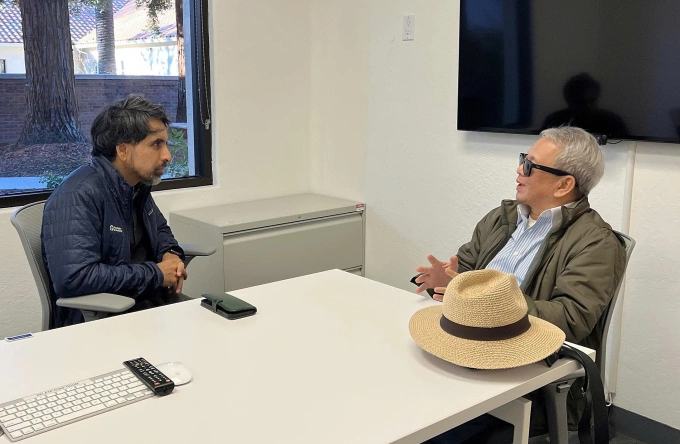 |
Pham Duc Trung Kien (R) with Sal Khan, founder of Khan Academ, during a meeting in the U.S., December 2025. Photo courtesy of Kien |
By 2019, I started connecting with the leadership of Khan Academy, a platform reaching over 150 million learners across 190 countries. I ultimately persuaded them to allow a full Vietnamese localization, and they agreed in 2020.
Today, more than two million Vietnamese students use the platform, making Vietnam their second-largest user base in the world behind Brazil. The platform empowers students to watch lessons, complete exercises, take tests, and prepare for certification exams.
It also supports tens of thousands of teachers nationwide by allowing them to design assignments. Most recently, we launched Khanmigo, a free AI tool designed to help educators create lessons and manage their classrooms more effectively.
Looking back at this rollout, what fills you with the most pride?
People often assume that online learning and smart technology are exclusively privileges for urban students, but that simply isn’t true. Khan Academy is now being utilized in remote areas of the northern Tuyen Quang Province, where nearly 80% of the students belong to ethnic minorities and internet connections are notoriously unstable.
Teachers there go above and beyond by using school computer labs, bringing in their personal laptops, and actively encouraging parents to support their children.
I’ve seen parents from the Dao and Tay ethnic groups, people who typically spend their entire lives farming, come to the school just to have teachers show them how to log into the app for their kids. The Vietnamese hunger for knowledge is incredibly intense. This success is entirely thanks to the persistence of our teachers, who educate the students while simultaneously training the parents to use the technology.
 |
Pham Duc Trung Kie (standing, 4th L) n during a visit to Xuan Son Primary School in Quang Ninh Province in August 2024. Photo courtesy of Kien |
Looking ahead to the next three to five years, what is your next move?
I plan to stay the course. Two million learners on Khan Academy might sound like a staggering number, but that is merely 10% of Vietnam’s students. We have to accelerate our efforts and reach further.
Look at nations like South Korea and Singapore. They were once poor, but through dedication, they became educational powerhouses.
My ultimate hope is that Vietnam will soon stand alongside them. When that day comes, the entire world will finally recognize the power of Vietnamese intellect and our vital contributions to global science.

Comments are closed.