
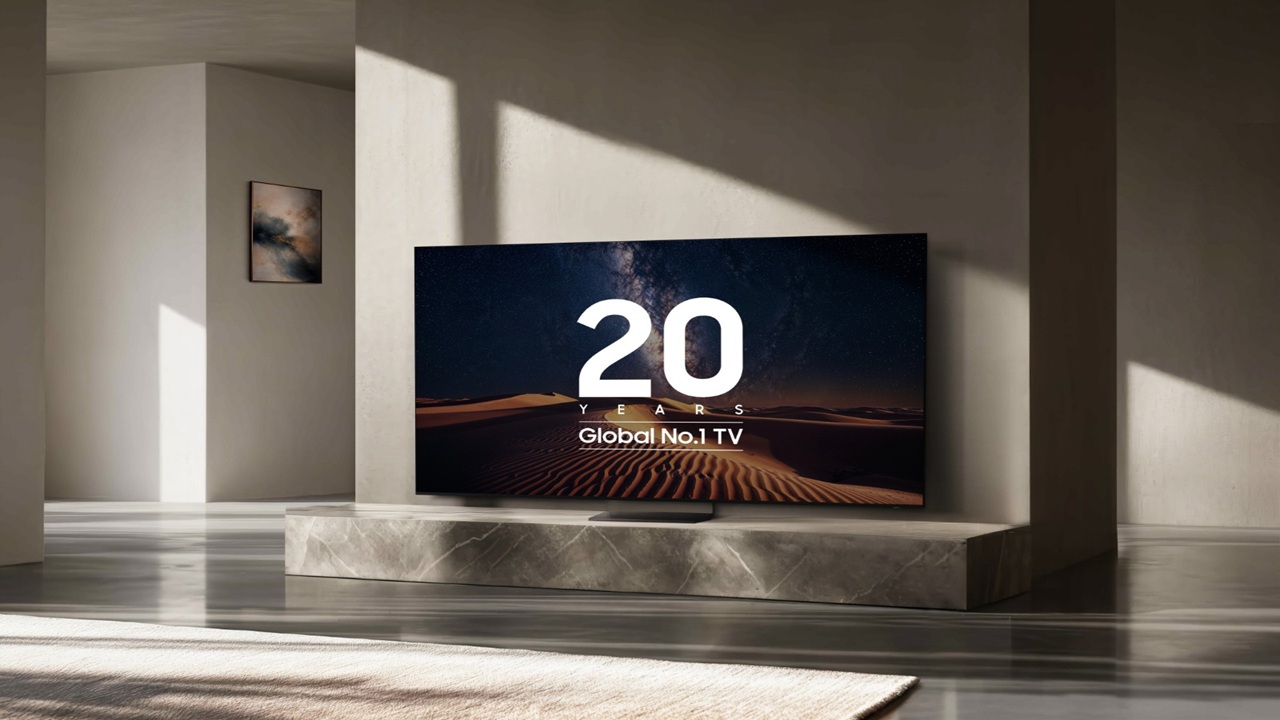

Mumbai: Samsung Electronics has maintained its position as the world’s number one TV brand for 20 consecutive years. Over the past two decades, Samsung has consistently led the global television industry, winning the trust of consumers through innovation, advanced technology and premium quality products.
According to a report by market research firm Omdia, Samsung has maintained the top position in the global TV market since 2006. In 2025, the company further strengthened its leadership, recording a 29.1 percent share of the global TV market. This remarkable achievement further strengthens Samsung’s position in the premium, ultra-large screen and next-generation display technology television categories.
Big bang for Telegram! immediately delete ‘this’ content; The instructions given by the central government
Samsung also recorded a strong performance in the premium TV segment. The company maintained its lead with 54.3 percent market share in the $2,500-plus segment with Neo QLED, OLED and lifestyle televisions. Also in the above $1,500 price range, Samsung maintained its leadership with 52.2 percent market share.
Speaking of this Samsung President and Head of Electronics’ Visual Display (VD) Business S. W. Yong said, “When choosing a TV, consumers prefer brands that offer long-term reliability and consistent quality. Our 20 consecutive years of leadership in the global TV market is a testament to that belief. Over two decades of engineering excellence, state-of-the-art technology and premium innovation, our journey will continue.”
Samsung has consistently achieved significant milestones over the past two decades in its journey of innovation that has taken the television industry to new heights. By introducing the design-focused Bordeaux TV in 2006, the company took the number one position globally and set a new standard in TV design. Then in 2009, Samsung accelerated the transition to LED TVs globally by introducing LED TVs, pioneering a new direction for ultra-slim and energy-efficient displays. The launch of Smart TV in 2011 transformed traditional television into a connected entertainment platform and added a new dimension to the viewing experience of viewers.
Introduced in 2015, The Serif, a design-focused TV, established the television as more than just a screen and an attractive piece of home decor. Later in 2017, Samsung launched The Frame, transforming televisions into customizable digital art canvases and giving new leadership to the art TV category. In the same year, the company introduced QLED TVs based on quantum dot technology, creating new benchmarks for the industry in terms of premium picture quality. 2018 saw the introduction of 8K TVs with over 33 million pixels, four times the resolution of 4K. Then in 2020, Samsung ushered in a new era of self-emissive displays with the introduction of Micro LED technology, setting new standards for greater brightness, superior contrast and accurate color reproduction in ultra-large screens.
Consolidating its legacy of innovation, Samsung is making its premium TV portfolio more comprehensive with expanded Micro RGB models, advancing its next-generation display technologies and consolidating its leadership in high-performance screens. The company is also expanding its OLED and Neo QLED lineups, offering premium picture quality, ultra-large screen options and diverse display capabilities.
Samsung is also expanding its mini LED offerings, offering improved brightness, contrast and precision control in larger screen sizes and price ranges, along with advanced display performance across its lineup. In addition, it is continuously investing in AI-enabled TVs to include advanced processors and best-of-breed features that further customize picture, sound and personalization in real time. With two decades of proven global leadership, Samsung is the most consistently recognized and trusted TV brand worldwide, offering industry-leading technology across a range of price ranges, screen sizes and display innovations.

Comments are closed.