
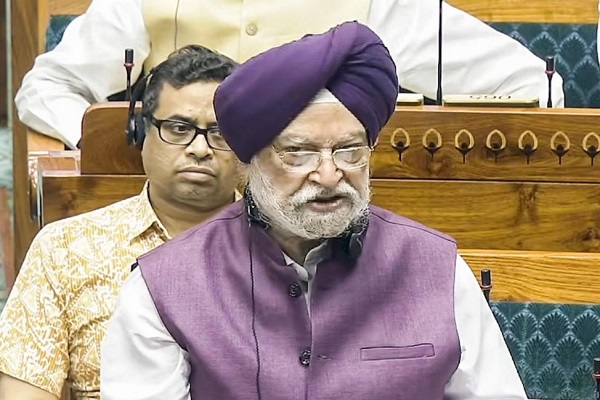

New Delhi, March 12. Petroleum and Natural Gas Minister Hardeep Singh Puri informed Parliament on Thursday that LPG production has been increased by 28 percent following the instructions given to the refineries in the last five days. Additionally, additional LPG is also being actively procured. This is not the time to spread rumors or create false narratives.
Government’s priority – there should be no shortage of gas in the kitchens of the deprived class.
The Union Minister said that the biggest priority of the government is that there is no shortage of gas in the kitchens of more than 33 crore families of the country, especially the poor and deprived sections. He said that the supply of domestic gas is completely safe and the delivery time of the cylinder remains the same as before.
Cylinder delivery time is same as before, two and a half days
Hardeep Puri told Parliament that the average time from booking to delivery of domestic LPG cylinder is still 2.5 days, which was the same even before the crisis. Apart from this, uninterrupted gas supply is being provided to hospitals and educational institutions on priority basis. He said that such information has been received from some places that a tendency of hoarding gas cylinders at the distributor and retail level and making more bookings in panic is being seen. However, this situation has arisen not due to any actual supply shortage, but due to people’s concern.
#BudgetSession2026
Refineries are working at their full capacity. In many cases, they are operating at more than 100% capacity. There is no shortage of petrol, diesel, kerosene, ATF or fuel oil. Availability of petrol, diesel, aviation fuel, turbine fuel, kerosene and fuel oil is fully ensured… pic.twitter.com/jKcJtXNVVl
— SansadTV (@sansad_tv) March 12, 2026
To stop manipulation in cylinder supply DAC system expansion
The Union Minister further said that the government is expanding the Delivery Authentication Code (DAC) system. Currently, this is applicable for about 50 percent consumers, which is being increased to 90 percent. In this system, the delivery of the cylinder will be recorded only when the consumer confirms it with the one-time code received on his mobile, which will make it easier to prevent wrong supply or manipulation of gas. To balance the demand, a gap of at least 25 days has been fixed between booking of gas cylinders in urban areas and 45 days in rural and inaccessible areas.
The purpose of controlling the supply of commercial LPG is to stop black marketing.
He said that field officers of oil marketing companies and anti-adulteration cell are monitoring at the distributor level. Apart from this, the Union Home Secretary has held a meeting with the Chief Secretaries of all the states and discussed connecting the state administration with this system. He said that the purpose of controlling the supply of commercial LPG is to stop black marketing, and not to harm the hotel and restaurant industry. Commercial LPG is sold at completely market-based prices without any subsidy and there is no registration or booking system.
#BudgetSession2026
The world has not faced a moment like this in modern energy history…India’s crude supply position is secure, and the volume secured exceeds what the Hormuz would have delivered. Before the crisis, approximately 45% of India’s crude imports transited through… pic.twitter.com/vQSTHEWdZ6
— SansadTV (@sansad_tv) March 12, 2026
Hardeep Puri said that if the sale of commercial LPG was left completely open, the cylinders purchased over the counter could have been sent to the illegal market, causing loss to genuine commercial and domestic consumers. Therefore, the government has implemented a clear priority and transparent allocation system. To monitor this arrangement, a three-member committee of executive directors of Indian Oil, Hindustan Petroleum and Bharat Petroleum was formed on March 9. The committee has held meetings with state civil supplies departments and restaurant associations across the country and these meetings are ongoing.
Alternative fuel options are also being activated
The committee has assessed the actual need of commercial LPG on the basis of different areas and sectors. Under this, in a major decision, from today onwards oil companies will allocate 20 percent of the average monthly commercial LPG demand, so that there is no hoarding and black marketing. He said that alternative fuel options are also being activated to reduce the pressure on LPG and gas.
The Union Minister said that after the recent adjustment of Rs 60, the price of non-subsidised domestic LPG cylinder is Rs 913, whereas according to the international market, its price should have been around Rs 987. According to global prices, an increase of Rs 134 per cylinder was needed, but the government itself bore Rs 74. Due to this, the additional expenditure for the beneficiaries of Ujjwala Yojana comes to less than 80 paise per day.
To compensate for the losses suffered by oil companies 30,000 compensation of crores
Puri said that LPG prices in neighboring countries are higher than India. LPG cylinder costs around Rs 1,046 in Pakistan, Rs 1,242 in Sri Lanka and Rs 1,208 in Nepal. He also said that the government has approved a compensation of Rs 30,000 crore to oil marketing companies to compensate for the loss of about Rs 40,000 crore in 2024-25.

Comments are closed.