


Sarvam’s Adoption Bottlenecks
India has no dearth of large language models (LLMs). Yet, most AI models struggle with the country itself – 22 languages, multiple scripts, and patchy compute. Sarvam AI wants to fix this with its two indigenous models. But can it turn technical ambition into enterprise adoption?
Sarvam’s Indigenous Pitch: The AI startup is building a full-stack sovereign AI architecture. With its 30B and 105B open source models, the startup provides a mixture-of-experts system that scales reasoning without exploding costs. Unlike Western models, Sarvam uses a custom tokeniser, specifically designed for scripts like Odia and Manipuri, requiring significantly less compute to process complex Indian dialects.
Proving Mettle: The models are already seeing deployments in high-stakes environments. At Aphelion Labs, developers used the Sarvam stack to build a voice-first rural banking assistant. All in all, industry insiders agree the company’s comparative advantage lies in Indic performance, especially beyond Hindi and English.
The Adoption Wall: Despite the Indic and open source advantage, Sarvam faces a brutal reality. Early feedback highlights significant friction – absence of GGUF formats for local execution, lack of day-one support for inference frameworks such as vLLM, broken chat templates and other issues. Without these pre-packaged integrations, many fear that developers may return to the easier closed-source alternatives to Sarvam.
Battle For Mindshare: Pointing out the unforgiving dynamics of the LLM market, critics also flag that Sarvam currently trails global AI giants in long-context and action model capabilities by nearly 18 months. Meanwhile, global giants are racing to ship multilingual, Indic-aware models catering to India’s use cases.
To counter this, the homegrown AI company is trying to bridge this gap by offering credits and hosting founder sessions to tap into the homegrown startup ecosystem. But will this be enough to turn the tide in Sarvam’s favour? Let’s find out…
From The Editor’s Desk
📉 Zomato & Swiggy’s Looming LPG Crisis
- Amid escalating geopolitical tensions in the Middle East, homegrown food delivery platforms are feeling the heat due to the shortage of LPG. These supply-chain issues have forced restaurants to restrict deliveries or halt operations.
- The shortage is expected to have a direct impact on near-term operations of Zomato and Swiggy – hitting revenues, slowing order volumes and limiting menu availability. As a result, shares of the two giants have been under selling pressure for the past few days.
- Meanwhile, ecommerce platforms are seeing an increased demand for induction stove tops across pin codes in major cities. QSR chains, too, have seen limited impact on their operations, as most of them already rely on electric appliances rather than LPG.
💰 More Fuel For Blinkit
- Foodtech major Eternal has infused ₹450 Cr into its quick commerce arm via a rights issue. Blinkit’s board approved the allotment of 2,799 equity shares to Eternal at an issue price of ₹16.07 Lakh per share.
- This is the first capital infusion by Eternal into Blinkit in 2026. The company earlier pumped ₹2,600 Cr into the subsidiary in 2025 via multiple rounds of funding. The fresh investment is expected to support Blinkit’s expansion of dark stores.
- Meanwhile, Eternal’s food delivery arm Zomato has quietly rolled out a new protein-focussed cloud kitchen called ‘Ritual’ to offer a range of high-protein beverages and health-focussed meal options.
🤝🏼 Eat App Acquires ReserveGo
- The Dubai-based restaurant reservation platform has acquired the homegrown B2B table reservation site to expand its footprint in India. The financial terms of the deal were not disclosed.
- Along with the acquisition, Eat App also announced the close of its Series B round at $10 Mn. The Dubai-based company also announced a partnership with foodtech giant Swiggy to foray into the Indian subcontinent.
- Eat App offers cloud-based applications to restaurants for real-time reservations, automation and guest data management. On the other hand, ReserveGo offers SaaS tools that help restaurants manage seating and improve guest experience.
💸 Mosaic Wellness Nets ₹200 Cr
- The health and wellness startup has raised ₹200 Cr in a round from 360One Asset to fuel acquisitions. It also undertook a secondary round, which gave partial exit to early backer Spring Marketing Capital.
- Founded in 2020, Mosaic Wellness runs digital health platforms like Man Matters, Be Bodywise and Little Joys. These platforms offer telemedicine consultation services, supplements, and other wellness products.
- On the financial front, Mosaic Wellness managed to trim its loss by 70% YoY to ₹11.8 Cr in FY25, while the top line zoomed 120% YoY to ₹736.1 Cr during the year under review.
⚙️ India Mulls ₹1 Lakh Cr Chip Warchest
- The Centre is planning to launch a massive $10.84 Bn fund to strengthen domestic chip production in the country. The proposed corpus will offer subsidies for chip design, manufacturing equipment and semiconductor supply chain development.
- This follows FM Nirmala Sitharaman announcing India Semiconductor Mission 2.0 in her FY27 Budget speech. Recent reports suggested that the government is considering a fresh allocation of $20 Bn (₹1.7 Lakh Cr) for the project.
- The move aligns with the Centre’s ambition of making India a global semiconductor manufacturing hub, with industry estimates projecting the homegrown chip market to reach $110 Bn by 2030.
💼 New CFO At Gupshup
- The conversational AI company has roped in Ravi Dugar as its new CFO. In his new role, Dugar will work closely with Gupshup’s leadership team on long-term financial planning, capital allocation and investor engagement.
- Prior to joining Gupshup, Dugar was the CFO of listed coworking space provider Awfis till early February. He was one of the key executives that led the company to its IPO in 2024.
- Founded in 2004, Gupshup enables automated, two-way communication between businesses and their customers. With an eye on an IPO in the long run, the company has pivoted to an AI-first model and also laid off 500 employees in the past two years.
Inc42 Markets

Inc42 Startup Spotlight
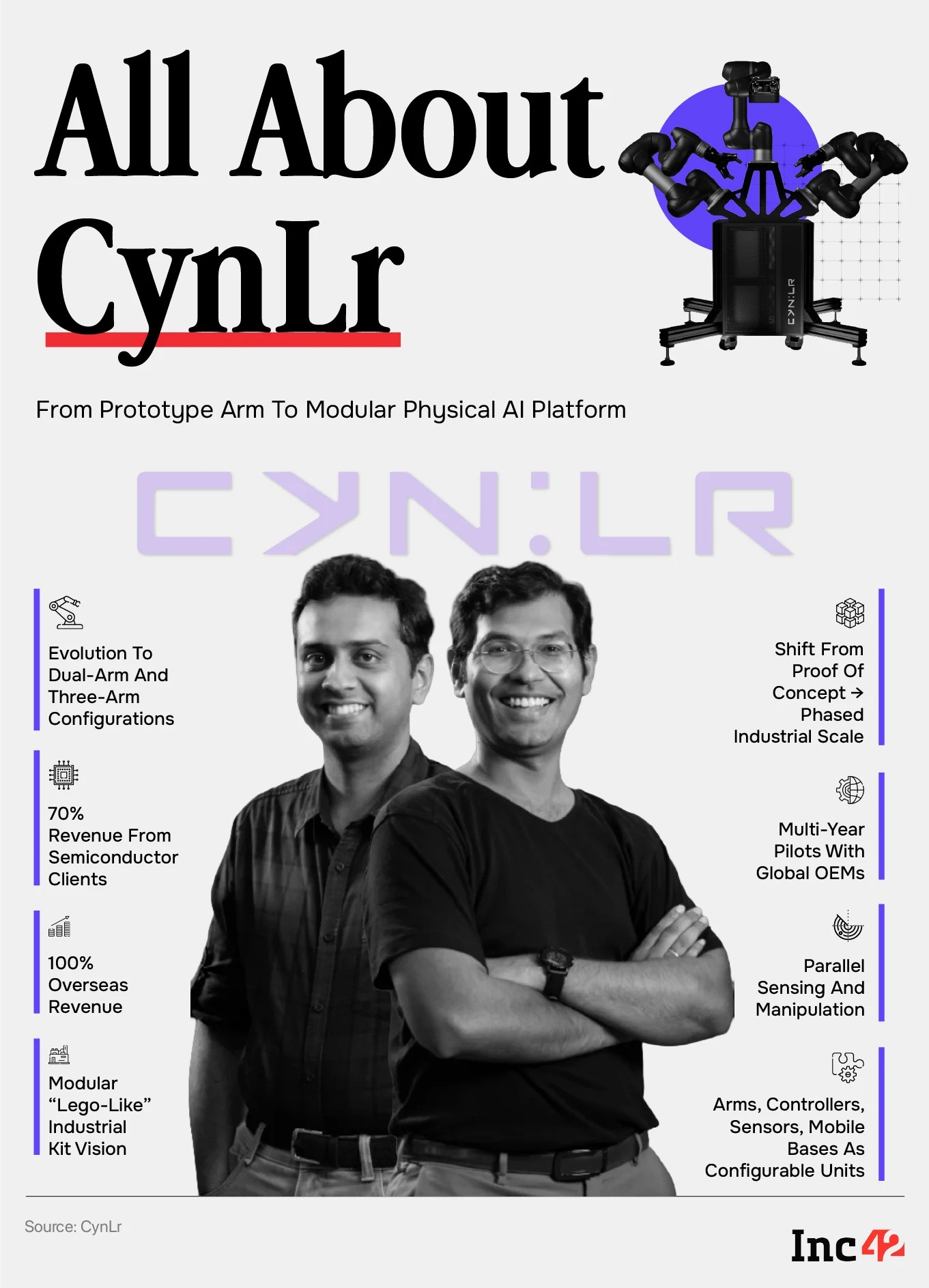
Can CynLr Revolutionise Industrial Robotics?
Robotics has transformed controlled factory floors. However, handling real-world variables — from changing object orientations to harsh conditions — remains a bottleneck. CynLr Datalabs is trying to bridge this gap with its object intelligence.
The Core Problem: Founded in 2015, CynLr’s idea stemmed from a cofounder’s college project – a coconut-harvesting robot. Outdoor challenges revealed rigid arms couldn’t adapt, leading to a focus on vision-guided manipulation over hardware. The result was the company’s multi-arm object intelligence.
The Solution: CynLr’s breakthrough came with multi-arm systems, where one arm senses while others grasp, mimicking human dexterity. Using reinforcement learning and computer vision, robots handle unstructured tasks across semiconductors and automotive industries.
On the back of its novel approach and pilots at global giants, the startup has already hit an annualised revenue of $1 Mn.
Eye On The Prize: Going forward, CynLr is targeting $40-100 Mn in revenue via 300 annual deployments by 2028. With the homegrown robotics market projected to grow to $29.43 Bn by 2029, can CynLr’s physical AI emulate the dexterity of human hands?
Infographic Of The Day
India’s listed startup landscape is diversifying. Fintech, ecommerce and SaaS continue to lead the charge, but the “Bull” is moving into new territories…


Comments are closed.