
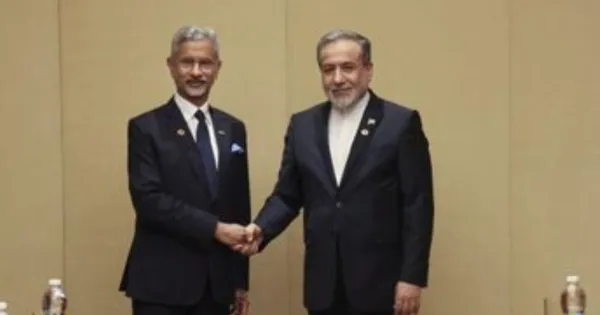
S Jaishankar spoke to Iranian Foreign Minister Araghchi: Called for the third time amid the West Asia crisis, these issues were discussed

Delhi. External Affairs Minister S Jaishankar spoke to his Iranian counterpart Syed Abbas Araghchi over telephone on Thursday night. This is the fourth conversation between the two leaders since the beginning of the Middle East crisis, which comes at a time when India is intensifying efforts to ensure safe passage for 28 merchant ships berthed on either side of the Strait of Hormuz. Jaishankar and Araghchi had talked on February 28, soon after the US and Israel attacked Iran. After this he also spoke on 5 March and 10 March.
Jaishankar said on social media,Last night there was another conversation with Iranian Foreign Minister Araghchi. Along with bilateral matters, issues related to BRICS were also discussed.The phone conversation last night came at a time when India has stepped up efforts to ensure safe passage for Indian-flagged merchant vessels through the strategic shipping route of the Strait of Hormuz.
This sea route has been partially blocked by Iran after the conflict with America and Israel escalated. An Iranian statement said Araghchi briefed his Indian counterpart on the latest situation arising as a result of “attacks and crimes” carried out by the US and Israel against Iran and its consequences for the stability and security of the region and the world.
It said the Iranian Foreign Minister stressed Tehran’s strong will to exercise its legitimate right of self-defense during his talks with Jaishankar. The statement said,Araghchi stressed the need for international and regional forums and organizations to condemn military aggression against Iran।”
It said, “bNoting the importance of the role and status of BRICS as a platform for developing bilateral cooperation, he said that in the present times it is necessary for this institution to play a constructive role in promoting stability and security in the region and the world.Araghchi stressed the importance of finding a way to strengthen stability and the sustainable security situation in the region, calling it a “collective necessity,” the statement said.

Comments are closed.