
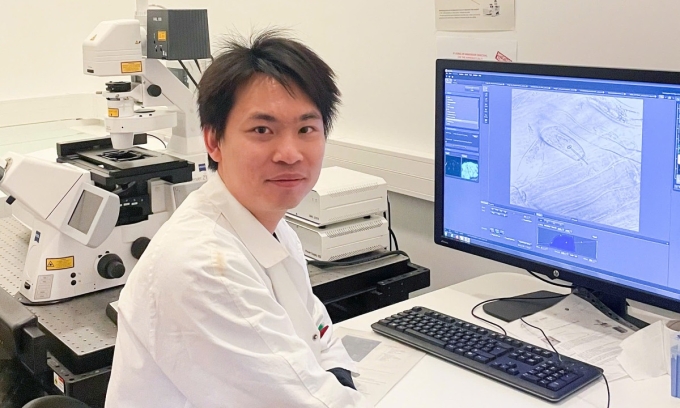
Vietnamese scientist discovers rice compounds that outperform chemo drugs against blood cancer

After eight grueling years of research in Japan filled with dead ends and sleepless nights in the lab, Vietnamese scientist La Hoang Anh has demonstrated that compounds found in rice and an invasive weed have potent anti-cancer properties, outperforming some widely used chemotherapy drugs in laboratory tests against blood cancer cells.
At 35, Anh is now a postdoctoral researcher at the Sophia Agrobiotech Institute (ISA) in southern France, a joint research unit operated by France’s National Research Institute for Agriculture, Food and Environment (INRAE), Universite Cote d’Azur, and the French National Center for Scientific Research (CNRS).
He moved to France nearly a year ago on a scholarship from the French government’s Initiative of Excellence program, after earning his doctorate at Hiroshima University in Japan with distinction.
His doctoral research centered on Momilactone A and B, naturally occurring compounds found in rice husks and white rice that have attracted growing scientific interest. These diterpenoid compounds are exceptionally rare in purified form, with research-grade samples sold by specialty biochemical suppliers at prices far exceeding gold by weight.
Working under the supervision of Prof. Tran Dang Xuan, a prominent Vietnamese plant scientist at Hiroshima University, Anh set out to prove that these compounds could promote apoptosis, or programmed cell death, in leukemia cells and inhibit their proliferation. He built on earlier work by his research group, which had successfully isolated the compounds from rice husks and white rice and demonstrated their ability to suppress diabetes and obesity markers in laboratory settings.
The path was far from smooth. During his first year of doctoral work, Anh hit a wall, unable to identify a viable experimental method. He spent stretches of two to three consecutive days in the laboratory monitoring chemical reactions, running hundreds of failed attempts.
“For the first time, I thought I might have to extend my program and wouldn’t be able to finish my PhD in three years,” he said. “More importantly, I might have to abandon a promising research direction.”
A breakthrough came through an old friendship. Anh reached out to Vu Quang Lam, a former classmate from the biology track at the High School for Gifted Students of Hanoi National University of Education, who was pursuing a PhD at Aichi Medical University’s Division of Hematology. Through a one-month internship at Lam’s laboratory, Anh gained the understanding of cancer cell mechanisms he needed to develop his methodology.
The results were striking. In a 2022 study published in the peer-reviewed oncology journal Cancers, Anh and his team showed that Momilactone B and a mixture of Momilactone A and B exhibited potent cytotoxicity against acute promyelocytic leukemia (APL) cells, with effectiveness comparable to the well-known chemotherapy drugs doxorubicin, all-trans retinoic acid (ATRA), and a combination of ATRA and arsenic trioxide. Against multiple myeloma cells, Momilactone B also showed significant inhibitory effects.
The team opened a second research front involving Andropogon virginicus, an invasive grass native to the southeastern United States that has spread to Japan, Australia and other regions. Using advanced extraction techniques, Anh and his colleagues isolated compound groups with antioxidant properties that also showed the ability to inhibit the enzyme tyrosinase and chronic myeloid leukemia cells. The results were published in late 2020 in the peer-reviewed plant science journal Plants, marking the first study to identify such therapeutic potential in the invasive species.
Anh served as first author on both publications and was twice awarded the Outstanding Student Prize by the president of Hiroshima University. He subsequently worked as a postdoctoral researcher, lecturer and assistant professor at the university, co-supervising 10 doctoral candidates and seven master’s students.
Lam, now a postdoctoral researcher in hematology at Aichi Medical University, described his friend as deeply passionate and relentlessly determined. He recalled that when Anh came for his internship, the Covid-19 pandemic was at its peak, yet he completed all vaccination and quarantine procedures to arrive on schedule.
“He’s always responsible and keeps to his deadlines, no matter what challenges he faces,” Lam said.
To date, Anh has published nearly 40 papers in international journals, with 35 indexed in Web of Science, one of the world’s leading academic databases, accumulating over 600 citations. He is also the author of a book chapter published by Springer Nature and has presented at numerous international conferences.
Beyond research, he has been active in community work through the Vietnam-Japan Expert Association and the Vietnamese Intellectual Association in Japan. In 2023, Vietnam’s Consul General in Fukuoka awarded him a certificate of merit for his contributions to the community.
Anh said he hopes to return to Vietnam at the right time, citing the country’s potential for agricultural research development.
“I want to contribute to public health and the nation’s agriculture by developing applied research to create valuable products,” he said, pointing to the possibility of functional foods or drugs derived from his findings on the cancer-fighting potential of rice and weed compounds.

Comments are closed.