

Virendra Pandit
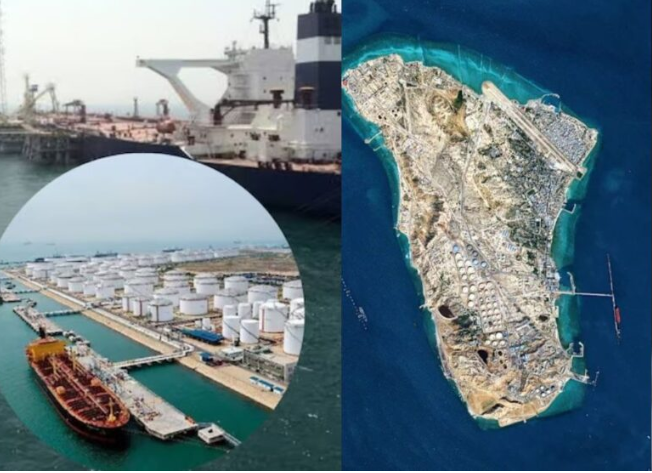
New Delhi: The two-week-long war of the US-Israel against Iran escalated on Saturday when America bombed military targets on Iran’s “crown jewel”, Kharg Island in the Persian Gulf, the media reported.
US President Donald Trump said American forces executed one of the most powerful bombing raids in the history of the West Asia, including destroying military targets on Kharg Island.
Oil pipelines that terminate at Kharg Island handle the vast majority of Iran’s energy exports, making it crucial for the country’s economy.
Trump said the US bombed military targets on this critical Iranian outpost in the Persian Gulf and threatened additional strikes targeting oil infrastructure if Tehran continued to block energy flows.
Writing in a social media post, he added that “for reasons of decency, I have chosen NOT to wipe out the Oil Infrastructure on the Island,” although he warned Iran’s leaders that he would immediately reconsider that decision if they interfered with ships transiting the Strait of Hormuz, Bloomberg reported.
He reporters earlier Friday evening the US would continue its campaign as long as necessary, while also insisting “we’re way ahead of schedule.” He also suggested the US Navy would begin escorting ships through the Strait of Hormuz “very soon.”
The 14th day of the West Asian war, that has now spread to over a dozen countries and impacting fuel supplies worldwide, marked the largest attacks yet against the Islamic Republic of Iran. The US and Israel have hit around 15,000 targets since the war began on February 28, according to US War Secretary Pete Hegseth.
Iran was, however, defiant. Pictures posted on social media showed Ali Larijani, the secretary of the Supreme National Security Council, and several government ministers participating in rallies on Friday.
The assault on military sites on Kharg Island but not the energy facilities there amounts to a warning shot to Iran and a threat that the US may be willing to strike targets that are part of the country’s energy infrastructure, something Trump had so far sought to avoid doing.
Kharg Island is off the coast of the Iranian mainland and deep in the Persian Gulf. Mainland Iran’s oil pipelines that terminate on the island handle the vast majority of Iran’s energy exports, making it crucial for the country’s economy. Facilities on this island process about 90 percent of Iran’s oil shipments.
Energy analysts warned that attacking civilian infrastructure on the island or taking it over could send oil prices even higher.
Efforts by the Trump administration and other governments to tame soaring energy costs for consumers have so far had little effect. Asian countries are grappling with shortages of cooking gas and road fuel. In the US, gasoline prices are already at the highest levels in about two years.
Brent crude settled above USD 100 a barrel on Friday for the second straight session, ending the day at the highest level in more than three years while US crude futures settled near the highest since July 2022. Millions of barrels of oil remain trapped in the Persian Gulf and traffic through the vital Strait of Hormuz is effectively at a standstill.
Iran’s new Supreme Leader Mojtaba Khamenei on Thursday said the Islamic Republic would seek to ensure the Strait of Hormuz remains effectively closed. In his first public comments since succeeding his late father, he also warned Tehran would look to open other fronts in the war if the US and Israeli attacks continue.
Hegseth said Mojtaba was “likely disfigured” at some point in the US-Israeli operation, and the fact that he had only released a written statement suggested his injuries prevented him from making public appearances.
The US is also sending the 31st Marine Expeditionary Unit from Japan to the West Asia, a voyage that’s likely to take at least a week. The unit has up to 2,400 troops and its command vessel, the USS Tripoli, carries a squadron of F-35 fighters, V-22 Ospreys and helicopters.
Almost 2,600 people have died in the war, most of them in Iran, latest tolls from officials and non-government agencies show. Almost 700 people have been killed in Lebanon, where Israel is battling Iran-aligned Hezbollah. A dozen Israeli civilians and two soldiers have also been killed, according to the health ministry. Additionally, more people in other Arab countries have died.
The US Central Command in a statement said all six crew members aboard a US refueling aircraft that crashed in western Iraq on Thursday were killed, bringing to 13 the number of American service members who have died. The loss of the plane wasn’t from enemy or allied fire, the military said.
Pro-government rallies were held across Iran on Friday to mark Quds Day, an annual pro-Palestinian event. An explosion was reported a few blocks away from a march in Tehran. Iran’s Tasnim news agency said a woman was killed in a US-Israeli attack.
The blockage of the Strait of Hormuz has disrupted the flow of millions of barrels of oil a day, causing what the International Energy Agency (IEA) described as the biggest hit to global supply on record. Saudi Arabia, Iraq, Kuwait and the UAE have all had to curb crude output.
The price surge has also been felt at US gas stations, where the average cost of a gallon of gas at the US pump has risen to USD 3.63, the highest since May 2024, according to American Automobile Association data.
cnn reported Iran was considering allowing a limited number of oil tankers to pass through the strait, provided that the oil cargo is traded in Chinese yuan.
Germany, Canada and Norway criticized the US decision to temporarily loosen sanctions against Russia in a separate attempt to curb surging oil prices. The US has issued its second authorization for buyers to take Russian oil cargoes already at sea, expanding a temporary waiver given last week to India.
Saudi Arabia, Oman and Turkey are leading mediation efforts, with the support of European countries and France taking a lead role. Qatar backed off from talks after it came under repeated attack.
Strikes on three commercial ships in the Arabian Gulf over the past two days have highlighted the risk of expanding disruptions to maritime transport.
Turkey’s defense ministry said the North Atlantic Treaty Organization (NATO) neutralized an Iranian ballistic missile that entered the country’s airspace on Friday, the third such interception since March 4.
In Oman, two people were killed after drones crashed in the Sohar region, state media said on Friday. Oman’s Port of Sohar has suspended operations. Dubai, the financial hub of the United Arab Emirates, reported missile threats and Saudi Arabia intercepted more than a dozen drones in its airspace.

Comments are closed.