
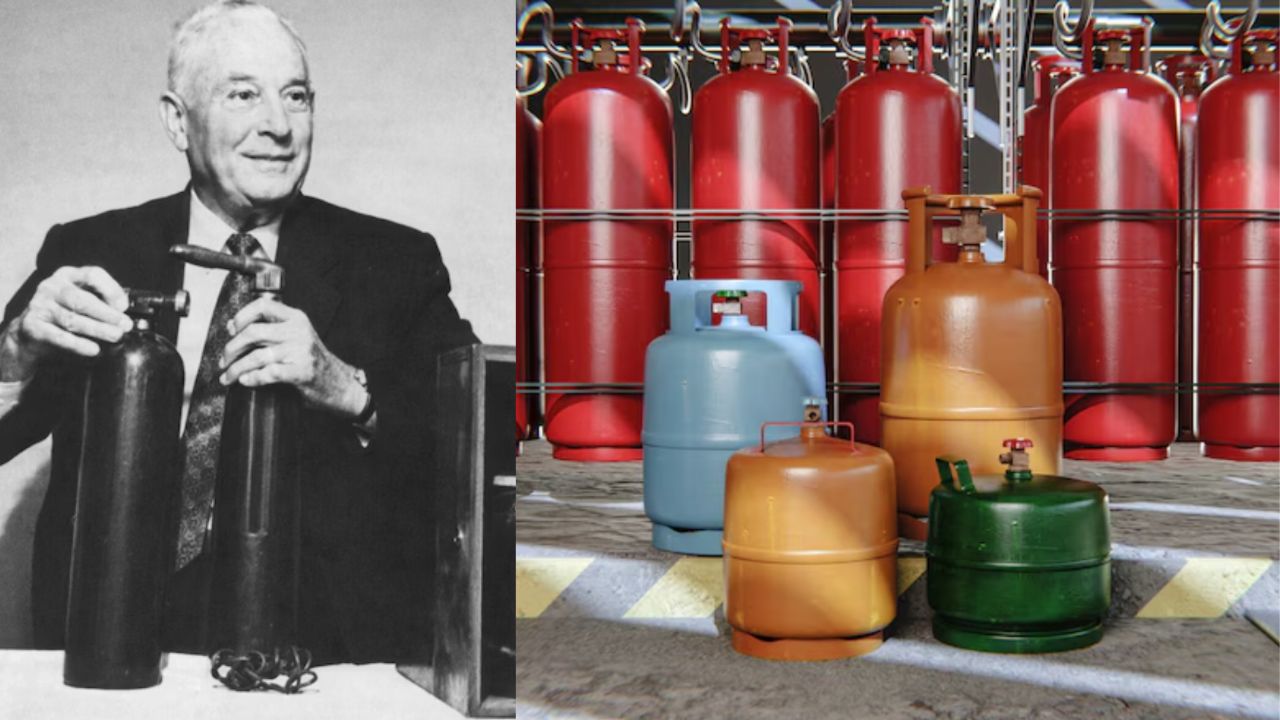

- Storing petrol was a major challenge; Evaporation reduced the fuel and risked explosion
- A customer complained that half of the petrol carried from the tank was blown by the time it reached home
- Walter Snelling started studying this and realized that gasoline consists of gases like propane and butane.
Iran-USA War: Amid rising tensions in the Middle East and the ongoing conflict with Iran, the fuel supply crisis is escalating. There are reports of shortage of LPG fuel in many places and changes in the process of gas cylinder booking. People’s concern regarding LPG cylinders in daily use has further increased. But today we are going to know if we know how this LPG reached our house, who discovered it and where.
In the early 1900s, storing gasoline was a major challenge for fuel retailers and consumers. During storage or transportation, gasoline evaporates quickly, causing fuel loss. This creates security risks. Gasoline can build up in gasoline containers, reducing the volume of liquid fuel and increasing the risk of explosion. This problem prompted scientists to investigate why gasoline behaved as it did.
A very interesting incident is responsible for the discovery of LPG (Liquefied Petroleum Gas), which is used in households today. This discovery was made by the famous chemist Walter Snelling.
iPhone 17e vs iPhone 16: Two models from the same company… Which iPhone is more powerful at Rs 64,900? Read the difference
A journey from experiment in a bottle to global fuel-
In 1910, Walter Snelling started researching the problem of evaporation. The investigation was triggered by a strange complaint. A customer complained that almost half of the petrol he bought had disappeared by the time he got home. To understand why gasoline volatilizes so much, Snelling decided to study the chemical properties and behavior of gasoline in depth.
While studying this phenomenon, Snelling realized that there are some gases in petrol which change from liquid state to gaseous state at normal temperature. They succeeded in separating these gases and storing them in liquid form, which we know today as LPG.
Experimenting with gasoline at different temperatures, Snelling found that gasoline contained gases such as propane and butane. At normal temperatures, these gases separate from liquid gasoline and mix with air. That is why petrol evaporates quickly. Instead of discarding these gases as waste, Snelling decided to collect them and use them as a separate fuel.
Big change on Instagram! The company will delete this important privacy feature, how will it affect users? find out
Walter Snelling, after studying the evaporation of petrol, actually used very simple equipment to isolate LPG. Snelling tried to separate the gas from gasoline in his laboratory with the help of simple equipment such as glass bottles and household taps.
Separation of gases: They separated the two main gases from petrol, propane and butane.
Liquefaction: By compressing these gases, they succeeded in converting them into liquid form. It is from this process that today’s ‘Liquefied Petroleum Gas’ (LPG) was born.
Commercial use and patents
When Snelling stored these gases in liquid form, he noticed that these gases burned very efficiently. They realized that it could be used for cooking, water or space heating, lighting.
Important steps:
1912: LPG was first used as a domestic fuel.
1913: Snelling officially patented the entire process.
Global expansion: His discovery revolutionized the field of energy and eventually LPG became the dominant domestic fuel worldwide.

Comments are closed.