
‘I didn’t enjoy being at the rink from 7 am to 7 pm’: The tough childhood of figure skating sensation Alysa Liu

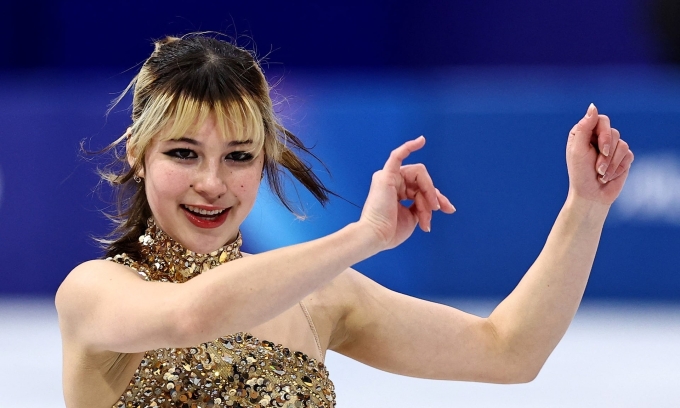
Alysa Liu performs during the 2026 Milan-Cortina Olympics. Photo by Reuters |
There were years in Alysa’s life that unfolded in exactly the same way. She would wake up, head to the ice rink at 7 a.m., train until nightfall and repeat the cycle the next day. Birthdays, holidays and teenage memories gradually faded away in that loop, to the point that the athlete now says she barely remembers that period of her life.
“I blocked them out,” Alysa said in an interview with Rolling Stone on March 7. “Probably because [that time in my life] was so bad, I just didn’t want to remember it.”
Alysa first stepped onto the ice at age five when her father took her and her sister to the rink. The speed immediately captivated her and she even enjoyed the process of falling down and getting back up. Her natural talent was undeniable, allowing her to progress rapidly from group lessons to serious training.
However, as she entered her early teenage years, her life looked way different from that of a normal child. Every single day, she was stationed at the rink from 7 a.m. to 7 p.m. Her training schedule spanned up to 12 hours, making her daily time feel like an endless loop.
“I didn’t enjoy being at the rink from 7 a.m. to 7 p.m.” “Every day, but I skated every day because I was scared that I would lose all my jumps and my abilities if I took a day off,” she added.
Every time she fell during these intense practice sessions, she would burst into tears. This reaction was not from physical pain, but from the overwhelming pressure to be perfect. Under the strict supervision of her coaching staff, Alysa recalled living in a constant state of “fight or flight”, a survival response triggered by extreme stress.
The price of early glory
Alysa made history as the youngest-ever national figure skating champion in the U.S. at just 13 years old. Standing at about 1.4 m tall, the prodigy required assistance to step onto the podium to receive her gold medal.
That historic victory immediately transformed her into a media phenomenon, and she was considered the future of American women’s figure skating. However, that early glory brought suffocating pressure. Her training environment was strictly controlled, even down to the smallest details.
Her life outside the rink was also narrowed. From the sixth grade onward, Alysa transitioned to homeschooling to dedicate time to her training. This shift proved to be a massive challenge.
Struggling with ADHD, she found independent studying incredibly difficult. While her peers enjoyed the normal experience at school, she spent her teenage years on the ice, often heavily procrastinating on her schoolwork.
“It was a really big struggle,” she added.
The years between ages 14 and 16 were arguably the toughest for her. She left her family home in Oakland, California, to live and train at the U.S. Olympic Training Center in Colorado Springs. Amid the isolation of the Covid-19 pandemic, she lived almost entirely alone.
“I was just Ubering from the OTC to the rink, back and forth, back and forth, every day,” she said. “That’s it. And it was Covid, so I was there by myself.”
 |
Alysa Liu in daily life. Photo by Instagram/@alysaxliu |
Even her coaches were not always physically present, leaving Alysa to skate entirely alone on the vast expanse of the rink, causing a sense of loneliness to build within her.
Her father, Arthur Liu, wielded a massive influence over her career. A single father raising five children, he invested hundreds of thousands of dollars into his eldest daughter’s skating journey. He would bring radar guns to the rink to measure the speed of her jumps and occasionally disguise himself to secretly monitor her coaching sessions.
His dedication was both a driving motivation and a crushing pressure. When Alysa abruptly decided to retire at age 16 following the 2022 Beijing Olympics, her father did not agree. This lingering tension is why his recent joyful reaction to her comeback annoyed her.
After the 2022 Games, she quietly posted her retirement announcement on Instagram, desperate to experience life as a normal teenager.
Away from the ice, she learned to drive, took her first real vacation with friends, and majored in psychology at UCLA. These simple, everyday experiences provided her with a sense of freedom.
“That was my first ever break,” she told The Guardian in 2025. “Once quarantine started, I was like, ‘Wow! This is what not skating is like.’ And I loved it so much.”
Back on the ice
Two years later, a casual ski trip with friends changed her trajectory. The familiar rush of cold wind and downhill speed reminded Alysa of why she had initially fallen in love with gliding on ice. She decided to return to the rink, initially committing to just one day a week.
Stepping back onto the ice was initially terrifying as old, painful memories flooded her mind. She later admitted she likely would not have returned for a second session if her best friend had not been by her side.
Slowly, the joy of figure skating returned to Alysa. This time, however, she established a non-negotiable rule: every single decision had to be hers, from her music choice and choreography to her diet. She stated on CBS News‘s 60 Minutes that no one is going to starve her or tell her what she can eat.
Less than a year after resuming her training, Alysa captured the World Championship title. She followed that up with her historic two Olympic gold medals at Milano-Cortina 2026. Despite this ultimate triumph, Alysa understands that this victory is not the end of her healing journey. She recognizes that those challenging years shaped the resilient person she is today.
“Genuinely, if I didn’t hit rock bottom so many times, I could not have gone up,” Alysa added. “So that’s why I say I wouldn’t tell my younger self a thing. I want her to go through all that, because that’s the only reason why I’m here. I wouldn’t change a thing about my past.”

Comments are closed.