

644
A quiet diplomatic outreach involving former Union minister and senior BJP leader Mukhtar Abbas Naqvi appears to have helped ease tensions between New Delhi and Tehran at a sensitive moment, with Iran allowing two liquefied petroleum gas tankers bound for India to pass through the Strait of Hormuz shortly after a high-level meeting at the Iranian embassy in the capital.
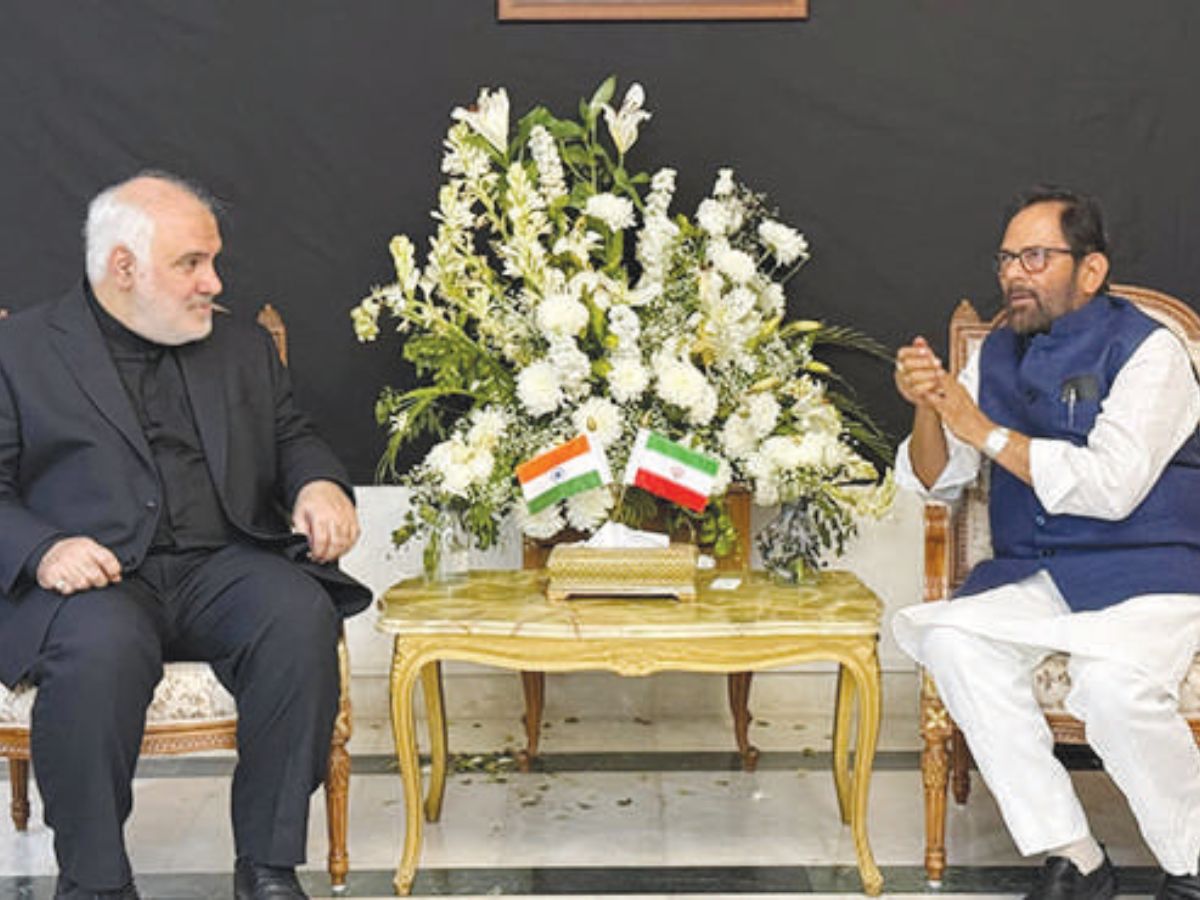
Sources said Naqvi visited the Embassy of the Iran in New Delhi on Monday and met Iran’s ambassador to India, Mohammad Fathali, where he conveyed condolences on the martyrdom of Iran’s supreme leader, Ayatollah Ali Khamenei, who is widely regarded within Iran as both a political authority and a leading religious figure.
Officials familiar with the development described the visit as part of a “silent diplomacy” effort linked to Prime Minister Narendra Modi, aimed at maintaining communication channels with Tehran during a period of regional tension.
According to sources, Naqvi held discussions with Ambassador Fathali for more than thirty minutes. The outreach was undertaken because Naqvi has long-standing personal contacts with political leaders and senior officials in Iran as well as across several Gulf countries, making him a useful informal interlocutor at moments when formal diplomatic signalling can be politically sensitive.
It is understood that the Iranian representative was conveyed and assured that PM Modi was very sensitive to Iran’s concerns which was greatly appreciated by Iranian Ambassador. People aware of the conversation said the interaction helped break an initial diplomatic chill.
The effects of that engagement became visible soon afterwards when Iran permitted two LPG tankers destined for India to transit through the Strait of Hormuz, one of the world’s most strategically important maritime energy routes.
For India, the clearance was significant because a large share of its energy imports from West Asia passes through the narrow waterway connecting the Persian Gulf with the Gulf of Oman and the wider Indian Ocean. Any disruption in the passage of tankers through the strait can quickly ripple through India’s energy supply chain.
The diplomatic signalling from Tehran became more explicit later in the week. On Friday, Ambassador Fathali publicly described India as an important partner for Iran and referred to the shared interests of the two countries in maintaining regional stability. The Iranian envoy also acknowledged India’s role during difficult periods faced by Iran, a reference that diplomats interpret as an acknowledgement of New Delhi’s historically balanced approach toward Tehran even while maintaining close relations with other major powers in the region.
Officials said the episode illustrates the continued use of quiet political channels by India alongside formal diplomacy in managing complex relationships in West Asia.

Comments are closed.