
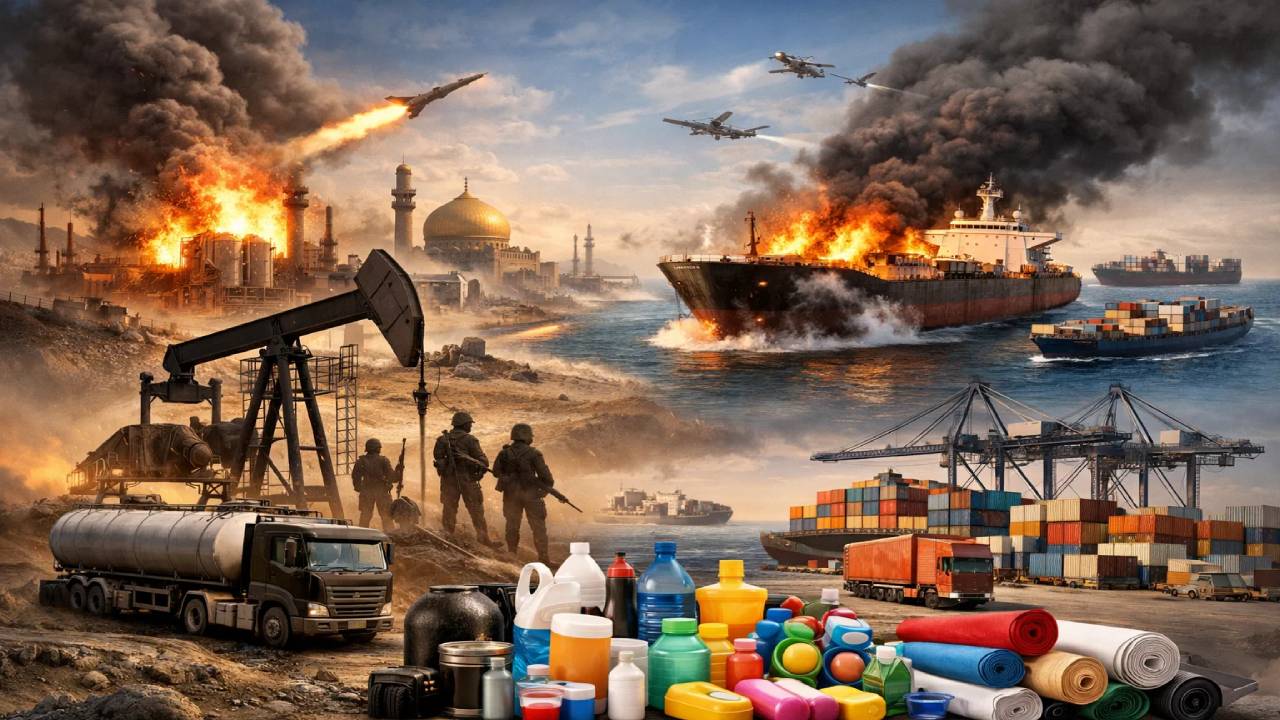
Without the bay everything is desolate! World’s supply chain shaken by Middle East crisis, which industries from oil to plastic were affected?

Middle East War Effects: iranThe escalating war between America and Israel has dealt a deep blow to the world’s supply chain. The impact of this conflict was not limited to the prices of crude oil only, but the supply of many important products made from it has also been affected. Petroleum and petrochemical industries, aluminum smelters, plastics manufacturers, olefin crackers and styrene producers are facing supply disruptions in many countries.
During the last 15 days, force majeure has been declared a total of 13 times in many countries. Force majeure is a situation when companies are unable to make supplies on time due to some extraordinary circumstances. This situation has affected a whole range of industries globally.
Which sectors are being affected by the Middle East War?
Its impact is clearly visible at the level of energy companies also. QatarEnergy has declared force majeure on LNG, affecting about 20 percent of the world’s total gas supply. Similarly, Saudi Aramco reduced production at two of its oil fields and closed the Ras Tanura Refinery. Kuwait Petroleum Corporation has imposed force majeure on the sale of crude oil.
In this sequence, Bapco stopped the supply to its only refinery, while Aluminum Bahrain has stopped the shipment from its big smelter.
Independent analyst Shanaka Anselm Perera has analyzed in detail the effects of this crisis on social media platform X. According to him, the disruption in the supply of crude oil has had a direct impact on many industries related to it.
How did the announcement of energy companies affect other companies?
These announcements of energy companies immediately had an impact on other industries as well. Singapore company PCS Singapore declared force majeure for its olefin cracking plant on March 5 because it was unable to get the required feedstock. After this TPC Singapore also made the same announcement.
Companies like Yeochun NCC of South Korea, Formosa Petrochemical of Taiwan, Chandra Asri and TPIA of Indonesia, SCC Rayong Olefins of Thailand and TKSC of Kuwait have also been affected by this crisis.
How were packaging companies and related sectors affected?
In fact, every announcement of force majeure affects the future industry. When the phenolic cracker does not get naphtha, the polyethylene plant cannot function. When polyethylene plants are closed, packaging manufacturing companies are affected.
When packaging manufacturers are unable to function, supplies to food companies are affected and prices begin to rise. In the end its effect reaches directly to the supermarket.
increase in prices
The effect of this crisis is also visible on the prices of raw materials. Polypropylene prices have been increased in Asia or have been temporarily stopped in many places. Spot premiums have increased by $50 to $100 per tonne.
How is this war affecting everyday life?
In Europe, contracts of polyethylene and polypropylene have become expensive by 60 to 200 euros per ton. These plastic products are used in medical devices, food packaging, automobile parts, construction materials, pipes and electrical insulation. This means that the increase in their prices will affect many things used in everyday life.
How is insurance and logistics being affected?
At the root of this entire crisis is not only the supply of oil but also the problem of insurance and logistics. Seven P&I clubs canceled war risk coverage on March 5. After this, it became commercially difficult to operate tankers carrying oil and naphtha.
Tankers carrying naphtha from the Gulf region to Asia were stopped. When the tankers did not arrive, the phenolic crackers did not get feedstock and started shutting down. After this, polyethylene plants also started closing.
This means that the entire supply chain does not depend only on the refinery or oil prices. Even though the price of Brent crude has reached $94 per barrel, the plants that were closed earlier will restart only if the tankers can get insurance and the naphtha can reach on time. Experts believe that it may take 12 to 24 months for the supply chain to return to normal.
This conflict is not limited to just one sea route or one region. This is affecting the manufacturing base of a large part of the world. Oil from the Gulf region is first converted into naphtha. Plastic is made from naphtha and the same plastic is used in thousands of everyday things. In this way, a crisis arising in one region affects the entire global industrial chain. 13 force majeure declarations in seven countries, disruptions in insurance systems and the continuing industrial impact show that this crisis is not limited to the energy market, but is impacting the entire global economy.
How is there a big crisis on phone exports?
- This war is also affecting phone exports. Mobile phone exports in the country were continuously increasing and in the first six months of the current financial year, it had generated a revenue of about 11 billion dollars i.e. about Rs 1,01,651 crore. But increasing tension in West Asia has increased the possibility of this boom being affected.
- Industry executives, analysts and brokerage firms believe that consumption, imports and freight movement may be affected due to the war. This can have a direct impact on India’s electronics exports. It is estimated that due to this, India may suffer a loss of about 2 to 3 billion dollars i.e. approximately Rs 18,494 crore to Rs 27,723 crore.
- A major reason for this potential loss is that India’s electronics manufacturing services companies export large quantities of mobile phones to the Gulf region countries. This area has long been considered an important market in terms of trade and consumption.
- Citing the data of India’s Ministry of Commerce, analysts said that in the financial year 2025, mobile phone exports to the countries of Gulf and West Asia had increased to 3.1 billion dollars i.e. about Rs 28,647.1 crore. This accounts for about 12 percent of India’s total electronics exports.
- Electronics Manufacturing Services i.e. EMS companies are largely dependent on mobile phone manufacturing. In such a situation, the ongoing tension in West Asia may affect these companies as well. Experts say that these companies may have to face business pressure and losses in the current quarter and the next quarter.

Comments are closed.