
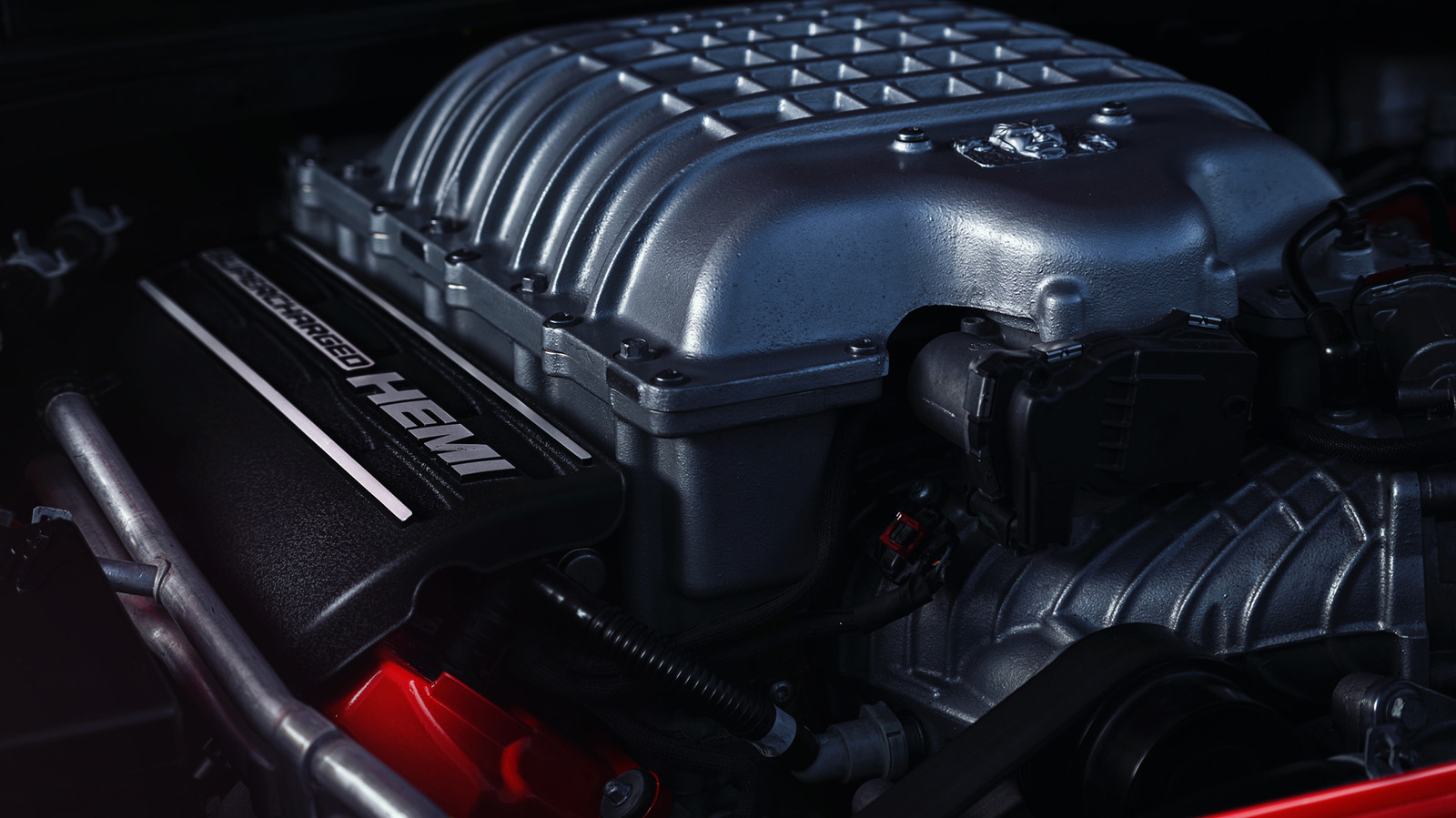

The HEMI nameplate has been practically synonymous with raw Chrysler horsepower since the 1960s, though the engine configuration itself dates back much farther. Named for its hemispherical combustion chamber, these engines feature inherently unique geometries: Valvetrains, pistons, and other components are all different to other layouts by design — combustion chambers are optimized for different purposes based on what’s expected of the engine.
In the HEMI’s case, a hemispherical combustion chamber generates higher chamber pressures versus a a more typical pentroof chamber, meaning it burns all the fuel faster and hotter, pushing the piston down sooner. This gives more mechanical leverage on the crankshaft, thus producing more power for a given amount of fuel, at least in principle.
It’s this unique configuration which leads to some interesting design choices with the HEMI’s cylinder head. Unlike a typical pentroof-shaped design, a HEMI uses a dome-shaped chamber with a rounded piston head, functionally increasing the surface area that the explosion pushes on and improving the engine’s volumetric efficiency. However, this increased surface area leads to a number of downsides, the notable ones here being heat and airflow. The more surface area there is, the faster heat dissipates. The airflow tends to get squashed in the sides of a traditional HEMI, which leads to poor efficiency. Moreover, the valves are huge; you simply cannot put a spark plug directly in the middle.
To solve this problem, modern HEMI designs incorporate two spark plugs on opposite ends of the combustion chamber. This ensures a more complete, even, and efficient burn across the entire chamber, as opposed to one centralized explosion which isn’t possible with the head design or airflow pattern. Let’s dive in and discuss how this works.
Airflow and spark in modern HEMI engines

Right off the bat, why do modern HEMI engines have two spark plugs at all when you only need one, aside from the valvetrain? Simple: Modern HEMI engines aren’t actually hemi engines in the traditional sense, and that’s a good thing. As stated before, a true hemi head, while excellent for hotter loads (think high-performance applications), isn’t ideal for passing modern EPA standards.
All those unburnt hydrocarbon emissions sitting so far away from the explosion, tucked away along the sides of the combustion chamber, eventually go out the exhaust and create too much pollutants. The solution Chrysler implemented was to modify the hemispherical chamber design into what’s best described as an oblong spheroid.
If you look at a HEMI piston head, you’ll notice grooves cut into the top. These are called quench pads, designed to swirl airflow in a certain predictable pattern. This allows the combustion process to occur more efficiently and cleanly, flowing like a river throughout the cylinder.
Basically, you want the airflow to reach every part of the combustion chamber for the most efficient burn. It’s like a miniature wind tunnel — if you have a pocket that’s out of the way, it won’t get enough air, whereas other areas get too much airflow. The modern HEMI’s head is designed in such a way to minimize these areas, creating its own unique airflow pattern within the combustion chamber. In order to provide a complete and efficient burn, Chrysler implemented a dual spark plug orientation, with 16 spark plugs across eight cylinders.
The valvetrain simply won’t allow it
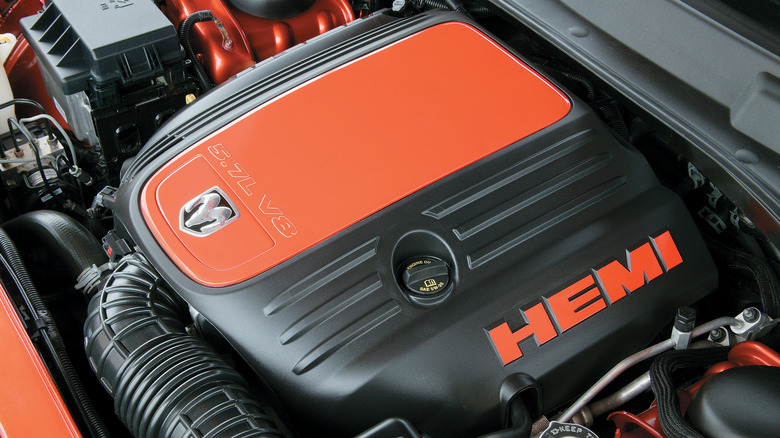
One of the benefits of a hemi head is being able to fit larger valves; in the case of modern Gen III HEMIs, these valves are so large that there’s no physical space between them to fit a single spark plug. This means using two spark plugs on either side of the valves, which then necessitates different airflow for a complete burn with two spark plugs, and so on. In other words, this all revolves around the head design and the combustion event’s inconsistency within the domed shape.
Is the second spark plug even necessary, though? In the old days, hemispherical chambered engines have implemented various fixes for the inconsistent combustion event dilemma. Because the more domed you make the chamber, the more disrupted and awkward the combustion process becomes, engineers have attempted fitting different shaped pistons, specialized slots, different chamber and head coatings, and more. Conversely, a modern HEMI’s design differs from the original template in substantial ways, thanks to its more advanced piston configuration. Its coil-on-plug ignition system, coupled with the dual spark plug configuration, leads to a more consistent, reliable, and even burn.
Against the classic (single-plug) HEMI configuration, modern designs offer a far cleaner solution while still making good power. Granted, it might not have the same character as older HEMI designs, but let’s be real: you simply cannot produce such an inefficiently-burning design today and get away with it; the engine would simply produce too many hydrocarbon emissions. In that sense, yes, it’s absolutely worth the trade-off of buying the extra eight spark plugs when you go to change them on your 5.7-liter HEMI.

Comments are closed.