
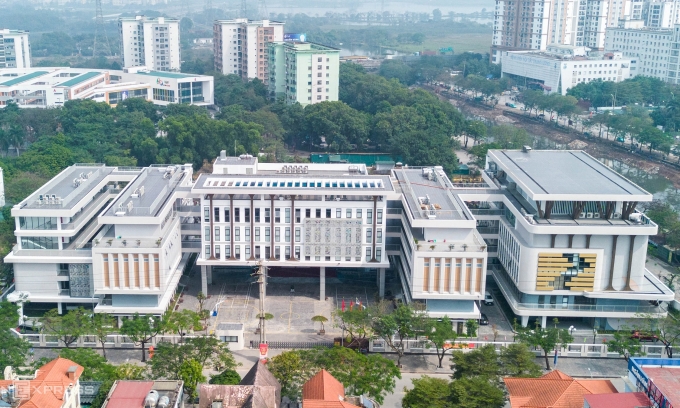

The capital currently has 2,954 preschools and general education schools serving 2.3 million students, second only to Ho Chi Minh City. But the system is straining. The city adds roughly 50,000 to 60,000 students every year, the equivalent of 30 to 40 new schools, and some classrooms in fast-growing wards already pack in 50 to 60 children per class.
The school construction plan is part of Hanoi’s Comprehensive Master Plan with a 100-year vision, a sweeping blueprint that aims to reshape the capital’s infrastructure, housing and public services through 2045 and beyond. The plan projects Hanoi’s population reaching 15 to 16 million by 2045, up from around 9 million today.
The city calculates school demand using student-to-population ratios for each residential area. For preschool, planners estimate 70 to 75 children per 1,000 residents depending on whether the area is urban or suburban. For primary and middle school, the range is 60 to 70 per 1,000 residents, and for high school, 40 to 45.
Based on those projections, Hanoi needs 986 additional schools between 2031 and 2045. Preschools account for the largest share at 441, followed by primary schools at 288, middle schools at 166 and high schools at 91. Under the plan, every commune, ward or new urban area must have at least one preschool, one primary school and one middle school, while each area with 30,000 to 50,000 residents will have a high school.
The city has identified 33 wards as priority areas where school shortages are most acute. They are concentrated in rapidly urbanizing wards such as Cau Giay, Hoang Mai, Ha Dong, Long Bien and Tay Ho, where population growth has far outpaced school construction.
To find land for the new schools, the city plans to set aside 5% of public-service land in each ward, repurpose undeveloped plots, and convert sites freed up by old apartment renovations or the relocation of government offices. Businesses and developers will be encouraged to establish private schools.
For existing schools hemmed in by dense urban neighborhoods, Hanoi is pursuing a different approach. The city wants permission to count floor area rather than land area when assessing whether a school meets national standards, which would allow inner-city schools to add stories and build basements without losing their accreditation. Priority for these upgrades goes to schools in core urban wards such as Hoan Kiem, Hai Ba Trung, Dong Da, Cau Giay, Thanh Xuan and Hoang Mai.
The policy would help reduce class sizes and ease the intense competition surrounding Hanoi’s grade-10 entrance exam, where limited public high school seats force thousands of students into private alternatives each year. Hanoi has repeatedly requested these special construction standards from the central government.
The school plan is one piece of a much larger puzzle. Hanoi’s 100-year master plan, drafted by a consortium that includes the Boston Consulting Group and Shanghai’s Tongji Urban Planning and Design Institute, also envisions relocating universities with small campuses out of the city center, freeing up that land for public schools and community facilities. The plan is expected to be submitted for approval by March 30, with final drawings completed by April 15.

Comments are closed.