
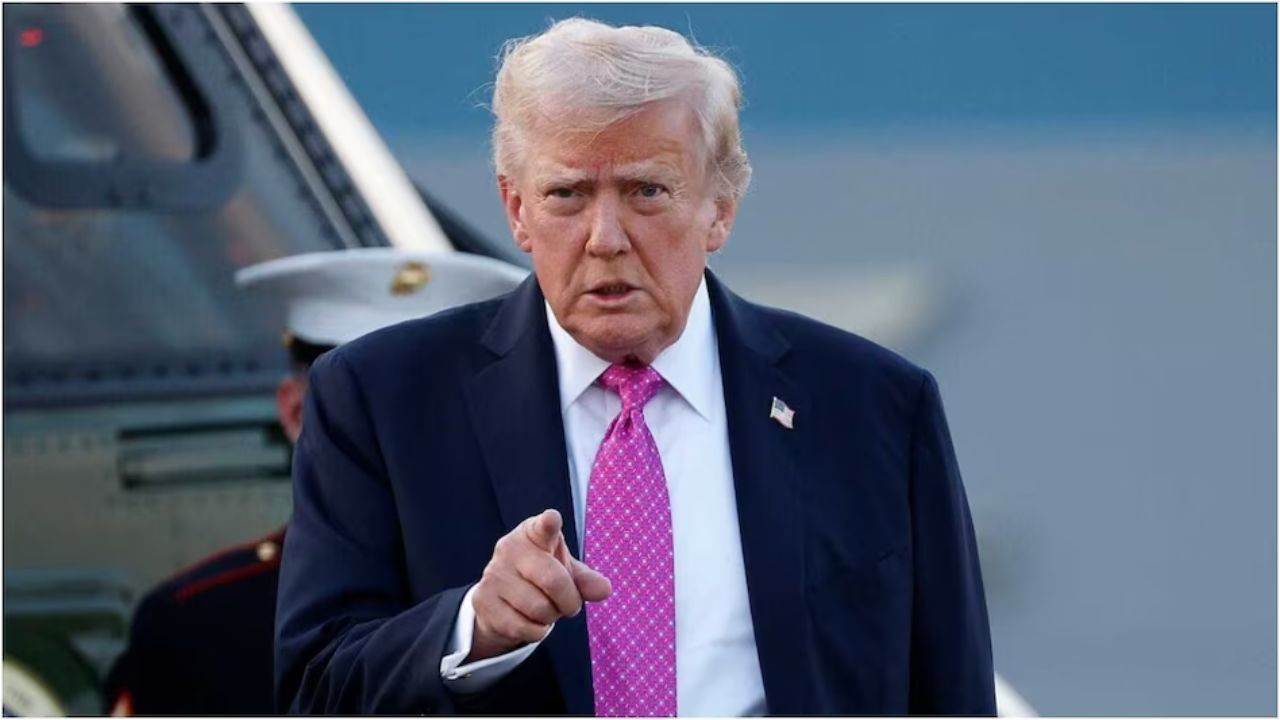
Confrontation with Iran becomes a big challenge for Trump, impact on economy and politics is visible

New Delhi: The impact of increasing tension and war in West Asia is now directly visible on America’s economy and politics. The global energy crisis is deepening due to Iran blocking the movement of ships in the Strait of Hormuz, the effect of which is clearly visible on fuel prices in America.
The price of diesel in America has crossed $5 per gallon, due to which the fear of rising inflation has increased. This situation is becoming a big political challenge for US President Donald Trump, because it may affect the performance of his Republican Party in the upcoming elections.
Strait of Hormuz: the lifeline of global oil supplies
The Strait of Hormuz is a very important sea route located between Iran and Oman, which connects the Persian Gulf with the Gulf of Oman and the Arabian Sea. About 20-22% of the world’s crude oil and petroleum products pass through this route, while about 20-25% of LNG is also supplied from here.
Even though America does not import much oil directly through this route, its blockage increases oil prices in the international market, which has an impact at the global level.
Iran’s reaction increased difficulties
According to reports, Iran had already deployed missiles and had made preparations to target Gulf region countries in case of an attack. After the initial attacks, it was believed that Iran would be weakened, but its retaliation in recent weeks has made the situation more complicated.
Attacks on countries like Qatar, Saudi Arabia, United Arab Emirates and Bahrain have destabilized the entire West Asia.
Questions raised on Trump’s statement
Donald Trump recently said that he did not expect Iran to respond in this way. His statement raised many questions, because intelligence agencies had already warned about Iran’s possible reaction.
Resentment at NATO allies
Trump to NATO "one-sided system" Stating that he alleged that America spends heavily on the security of its allies, but they do not support them in times of need. He said that America does not need anyone’s help and it can handle the situation alone.
Allies distanced themselves from war
Trump had sought military cooperation from other NATO countries, including Britain and France, to keep the Strait of Hormuz open, but most countries refused to join the conflict. He appealed to America and Iran to reduce tension and adopt diplomatic solutions.
Macron also targeted
Angered by the attitude of NATO allies, Trump also commented on Emmanuel Macron and said that he may soon be out of power.
Resignation of close associate
Joe Kent, director of the National Counterterrorism Center, resigned from his post. He said that there was no threat to America from Iran and termed the military action as wrong.
Trump reacted to this and said that it was good.
Support of Middle Eastern countries and leniency on China
Qatar appreciated the support received from Qatar, United Arab Emirates, Saudi Arabia and Bahrain. At the same time, he adopted a soft stance regarding China and said that relations between the two countries are good and have brought economic benefits.
Deepening crisis, increasing challenge
The Hormuz crisis has not only affected the global energy market, but its political and economic implications are clearly visible within America as well. The difference between Trump’s statements and the ground situation is making this entire incident more complicated.

Comments are closed.