

The publication notes that internationally inspired structures are increasingly shaping the island’s tourism identity, creating a distinct character through a mix of architectural styles. These influences, it says, are contributing to Phu Quoc’s development in a way comparable to how architecture has defined major global cities.
It draws a comparison with Singapore, where multicultural identity is reflected through history and communities, while Phu Quoc expresses a similar diversity through its built environment.
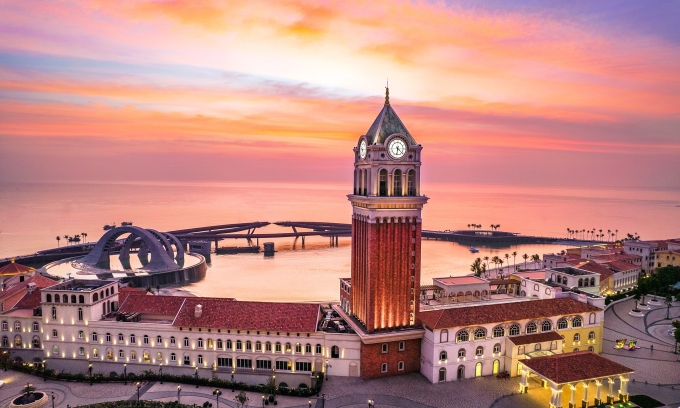
Sunset Town’s clock tower in Phu Quoc is inspired by Saint Mark’s Campanile bell tower in Venice. Photo courtesy of Sun Group |
Sunset Town features design elements such as colorful facades, cascading stairways and sea-facing public squares, drawing inspiration from Italian coastal settings. The magazine notes that these elements are adapted rather than replicated, forming a localized interpretation.
At the center of the area is a clock tower inspired by St. Mark’s Campanile, redesigned with four clock faces oriented in different directions. Nearby, the King of the Sun fountain, made from 30 tons of marble by Frilli Gallery, depicts the Sun God Helios and adds a classical European reference point.
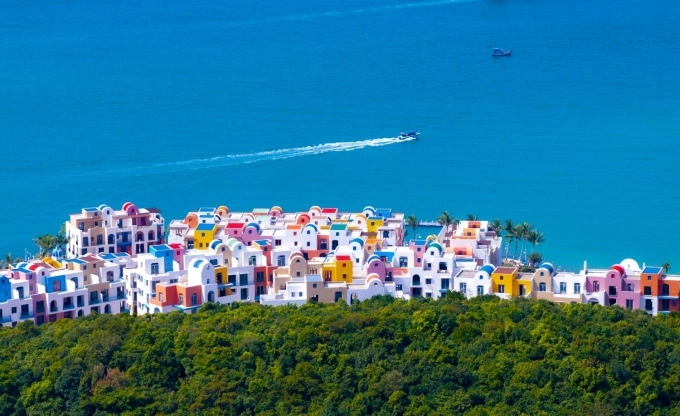 |
Santo Porto on Phu Quoc’s Hon Thom Island reimagines the spirit of Santorini in a distinctly original way. Photo courtesy of Sun Group |
On Hon Thom Island, Santo Port incorporates elements inspired by Santorini. While the Greek destination is known for volcanic cliffs and views of the Aegean Sea, the version in Phu Quoc is described as adapted to a tropical setting.
“Many describe it as a ‘tropical Santorini,’ bright, lush, and deeply rooted in Phu Quoc’s landscape… a tropical expression of Mediterranean beauty that you won’t find anywhere else in the world,” Travel + Leisure notes.
The magazine also highlights the involvement of internationally recognized architects in shaping newer developments on the island.
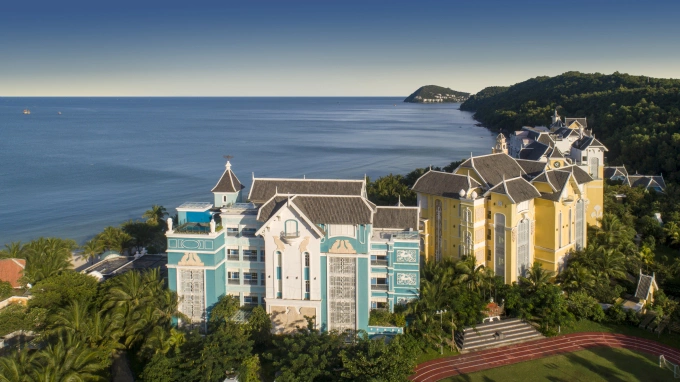 |
JW Marriott Phu Quoc Emerald Bay Resort designed by Bill Bensley. Photo courtesy of Sun Group |
Architect Bill Bensley designed the JW Marriott Phu Quoc Emerald Bay Resort, using a narrative concept inspired by a fictional 19th-century university. The publication describes the project as an “ultra-luxurious, highly artistic, immersive architectural universe.”
Bensley also designed the Sun Signature Gallery at Sunset Town, which features a Mid-Century Modern style.
Another project, Kiss Bridge by architect Marco Casamonti, emphasizes a minimalist approach and interaction with the surrounding landscape. Inspired by Michelangelo’s “The Creation of Adam” and a Vietnamese folk legend, the structure extends in two sections that nearly meet, leaving a small gap between them.
According to Travel + Leisuresuch projects position Phu Quoc as “a meeting point for some of the world’s most imaginative architectural ideas.”
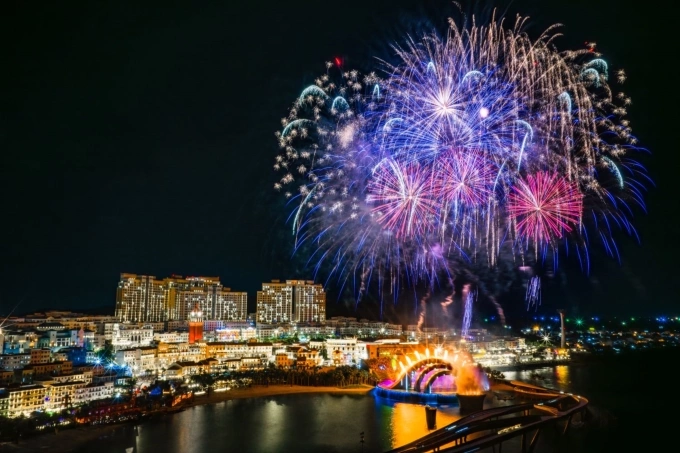 |
Fireworks light up Phu Quoc’s sky. Photo courtesy of Sun Group |
The magazine adds that architecture on the island is increasingly combined with large-scale performances and events. Shows such as “Kiss of the Sea” and “Symphony of the Sea”, along with regular fireworks displays, contribute to the overall visitor experience.
“By combining iconic architecture reimagined with a Phu Quoc twist, large-scale theatrical performances, and nightly fireworks displays, this Vietnamese island is carving out a bold creative identity, one that elevates the tourism experience to new heights,” Travel + Leisure observes.

Comments are closed.