

An EV Charging Overnight Killed Eight People In Indore. Here Is What We Know.
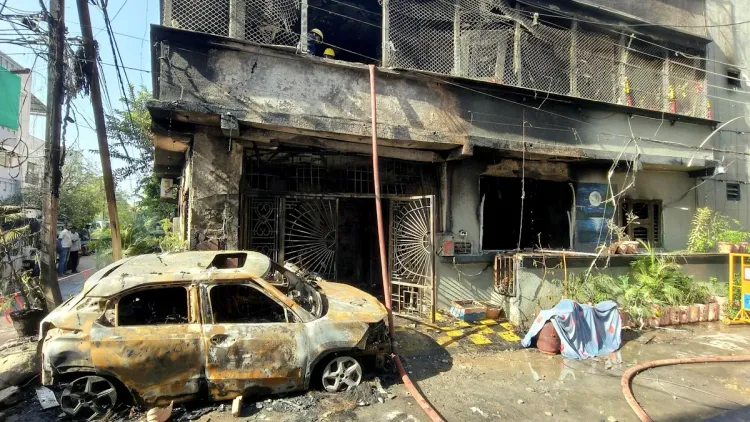
Eight members of a family are dead after an electric car being charged outside their home exploded in the early hours of Wednesday morning in Indore. The incident happened between 3:30 am and 4:30 am in the Brajeshwari Annex Colony near Bengali Square, when most of the family was asleep. The deceased include two minor children, three women, and three men. Three others were pulled out alive and taken to hospital with critical injuries.
According to Indore Police Commissioner Santosh Kumar Singh, a short circuit at the charging point caused the parked electric car to catch fire. The flames rapidly spread from the vehicle to the three-storey residential building it was parked in front of. Inside the house, more than ten cooking gas cylinders were stored. At least four of them exploded in quick succession, tearing through the structure and sending shockwaves across the neighbourhood. Eyewitnesses reported hearing a series of powerful blasts that woke up nearby residents.
Electronic Locks Turned Deadly
What made this fire especially fatal was a combination of the speed of the fire and a modern security feature that turned catastrophic in an emergency. The house had electronic locks on its doors. When power failed during the blaze, these locks reportedly stayed engaged and could not be opened manually. Police had to physically break the doors down to enter, losing precious rescue time in the process. The occupants inside, many of them sleeping, had no way out. By the time emergency teams arrived and forced their way in, most had already succumbed to smoke and fire.
The house belonged to Manoj Pugalia, a polymer trader. Investigators believe that apart from the cooking gas cylinders, flammable chemicals related to the polymer business may also have been stored on the premises. These materials would have significantly accelerated the fire’s spread through all three floors.
The EV, The Charger, And What Is Still Unknown
The exact make and model of the electric car involved has not been officially confirmed in any police statement or government communication as of the time of writing.
From the pictures of the burned car, it looks like a Tata Punch EV to us. UNI has reported that it was a Tata Punch. We will wait for confirmation from official sources to be sure.
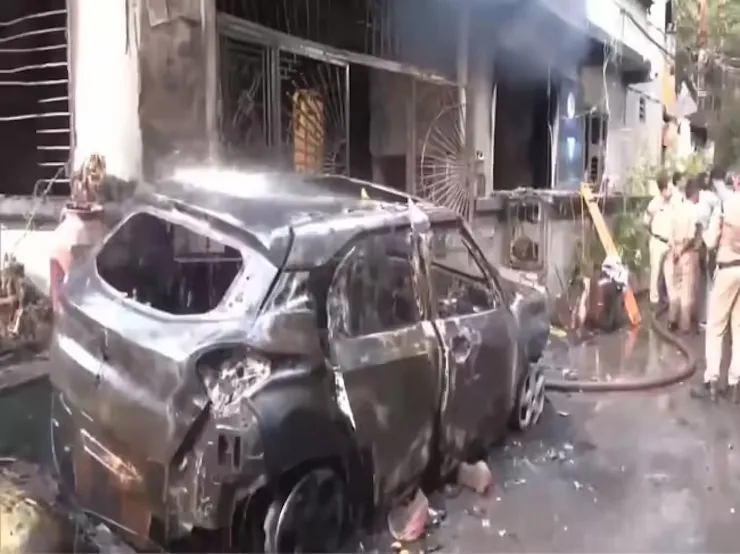
Investigators are still working through the debris to determine the specifics of the vehicle and whether the fault lay in the car’s onboard charging system, the charging cable, the wall socket, or the domestic wiring setup. Until a forensic investigation concludes, attributing the cause of the explosion to any particular brand or component would be premature.
What is known is that the car was being charged overnight using what appears to have been a home charging arrangement, a practice now common among electric vehicle owners across the country. Overnight home charging, particularly using basic domestic sockets or uncertified third-party cables, carries real risks if the wiring in the house is old, the socket is overloaded, or the charger does not have proper thermal protection.
Eight Dead And A Government Response
Prime Minister Narendra Modi announced an ex-gratia of Rs 2 lakh from the PMNRF for the next of kin of each of the eight deceased. The injured will receive Rs 50,000 each. The Madhya Pradesh government has ordered a probe into the incident.
The deceased were identified as Vijay Sethia, 65; Suman Sethia, 60; Chhotu Sethia, 22; Rashi Sethia, 12; Manoj Pugalia, 65; Simran, 30; Tinu, 35; and Tanmay,
A Question Every EV Owner Must Now Ask
This tragedy forces a hard look at how most people charge their electric cars at home. Certified home charging units with proper surge protection and thermal cutoffs exist, but a large number of EV owners rely on ordinary domestic plugs and basic cables. A single faulty connection, a worn socket, or a circuit that is not rated for sustained overnight loads can create a dangerous situation. Combined with stored flammable material inside a home and doors that cannot be opened manually during a power failure, the result can be catastrophic. The investigation is ongoing, and the exact sequence of technical events will only be clear once forensic teams complete their analysis of the vehicle and the charging setup.

Comments are closed.