

Entry-level workers in the sector will receive a minimum monthly pay of S$2,220 from July 1 this year, up from S$2,080 currently, the Ministry of Manpower said on Monday, as reported by The Business Times.
Most workers covered by the model are also set to receive further annual pay increases of S$140 in 2027 and 2028, while those in higher-tier roles like waiter supervisors will get yearly increments of S$145.
For instance, a drink stall assistant with a monthly gross wage of S$2,080 now will see their pay increase to S$2,500 by July 2028.
The increases will benefit more than 53,000 full-time and part-time workers across the sector, including stall assistants, cooks, waiters and kitchen staff.
For part-time workers, meaning those working fewer than 35 hours a week, their hourly gross pay will be pro-rated based on a 44-hour work week.
For example, a part-time food services worker currently paid S$10.91 an hour will see their hourly rate increase to S$13.11 by July 2028.
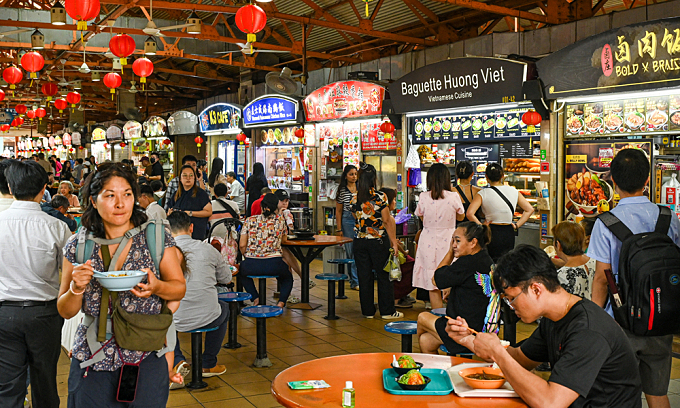
People buy food for lunch at a hawkers centre in Singapore on Jan. 7, 2025. Photo by Reuters |
Launched in 2014, the Progressive Wage Model is designed to boost the incomes of lower-wage workers in Singapore through wage progression that improves their career prospects while helping employers attract and retain staff.
Under the model, employers have to pay at least the baseline wage to eligible workers based on job level and meet certain training requirements.
It is developed by tripartite committees comprising unions, employers and the government, and has been rolled out in several sectors.
For the food services sector, the latest pay hikes, which were based on recommendations by the Tripartite Cluster for the Food Services Industry, mark the second round of wage increases.
The first set took effect in 2023 and lifted entry-level monthly pay in the industry from S$1,750 to S$2,080 by 2025. Wage hikes scheduled for 2026-2028, however, are smaller.
Dinesh Vasu Dash, Singapore’s Minister of State for Manpower, said employers and unions had held extensive discussions before agreeing that the increases were appropriate given current conditions, which differ from those in 2023.
He noted that a key aim of the latest adjustments is to narrow the wage gap, ensuring lower-wage workers in the bottom 20% do not “deviate too far” from those in the 50th percentile or higher.
“What we don’t want to see is a divergence between the wages that the lowest of our workers are earning vis-a-vis the rest of Singaporean workers,” he said, as quoted by The Straits Times.
Besides wage increases, the tripartite cluster also recommended updating job roles to better reflect changing industry needs, along with recognizing a wider range of qualifications to meet minimum training requirements, according to Channel News Asia.

Comments are closed.