

Hung Kings’ Commemoration Day gives workers a three-day weekend from April 25-27, and the Reunification Day and International Labor Day holidays run from April 30 through May 3. Only Tuesday and Wednesday, April 28-29, stand between them.
Several universities have already announced they will bridge that gap.
Ho Chi Minh City University of Industry and Trade will suspend in-person classes from April 26 through May 1, with the Saturday before and the weekend after extending the break to nine consecutive days. Missed classes will be made up on the Saturdays of May 9 and May 16.
About half the university’s students come from outside Ho Chi Minh City, and a longer holiday makes it easier for them to travel home, said Pham Thai Son, director of the school’s admissions and communications center. He called the schedule swap a growing trend among universities and businesses.
Gia Dinh University in Ho Chi Minh City is giving students April 26 through May 3 off.
East Asia University of Technology in Hanoi will be closed from April 27 to May 1, which with the adjacent weekends also creates a nine-day stretch. The Foreign Trade University and Thuong Mai University will hold online classes on April 28-29 so their breaks run uninterrupted.
Office workers are making similar calculations.
Thu Quynh, a communications professional in Hanoi, took on extra weekend shifts in mid-March and accelerated project deadlines to free up two days of annual leave on April 28-29. Her family plans to drive to Hue and Hoi An for the first half of the break, then visit relatives in Nam Dinh Province before returning to the capital.
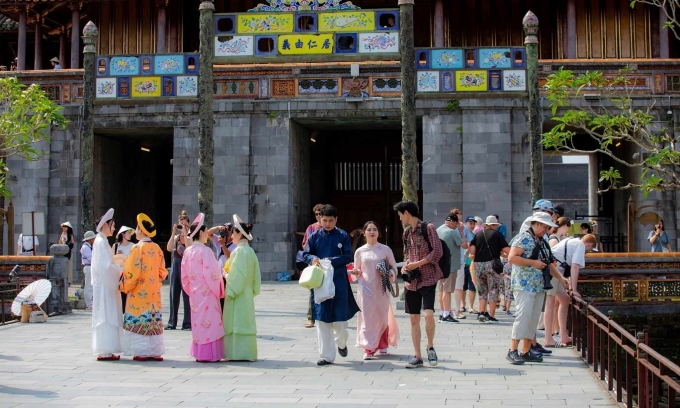
Tourists visit the Imperial Citadel in Hue, central Vietnam, during the Reunification Day and International Labor Day holiday in 2025. Photo by Read/Vo Thanh |
For Nguyen Thanh Luong, another Hanoi office worker, the two sandwiched days are a logistical headache. Her mother is expected to be discharged from a Hanoi hospital at the end of April, and the family’s hometown in Quang Tri Province is roughly 600 km away by rail, a 10-hour train ride each way. Returning to work for two days only to leave again would be exhausting, she said, and tickets get harder to find the closer the holidays approach.
“Motivation drops on those two sandwiched days,” Luong said.
The official holiday calendar applies to civil servants, public employees and the armed forces. The public sector will work normally on April 28-29 unless the Ministry of Home Affairs proposes an official swap to bridge the two breaks. Private-sector companies follow the Labor Code, which mandates one paid day off for Hung Kings’ Day and two for April 30-May 1. Employers and workers can negotiate additional leave or schedule swaps on their own.
Not every workplace can afford a nine-day shutdown. Dinh Sy Phuc, trade union chairman at Taekwang Vina, a footwear exporter in Dong Nai Province, said the company works full Saturdays and its shipping deadlines are set by foreign buyers whose calendars do not include Vietnamese holidays. The company is exploring letting workers use annual leave for the two bridging days rather than requiring makeup shifts.
Ho Thi Kim Ngan, deputy head of the labor relations department at the Vietnam General Confederation of Labor, said the law gives employers and unions the flexibility to design their own arrangements. Workers who want extra time off should negotiate individually or through their union rather than wait for a blanket policy, she said.
Vietnam currently has 11 official paid holidays per year. That number may soon rise: Politburo Resolution 80, issued on Jan. 7, designates Nov. 24 as Vietnam Culture Day and calls for it to become an additional paid holiday once the Labor Code is amended.

Comments are closed.