

Every so often, one of the major motorcycle brands will come out with a gem that gets us enthusiasts weak at the knees. These bikes don’t simply look good on Instagram or impress strangers at the lights — they look good, ride well, are attainable, and have that special something about them.
These are bikes that you could ride every single day for the rest of your life, and not feel like you’re missing out on much by staying faithful to them. The question of “what bike would you ride for eternity” has a fair bit of heft to it; more than is apparent at first.
Suddenly, that cutting-edge race bike with triple-digit hp figures is a lot less appealing than something fun that simply works without drama. Of course, these bikes are not do-it-all machines — you won’t be taking a Suzuki Hayabusa on a country trail — but we have tried to cater to most types of riders. From trail-pounding enthusiasts who love the outdoors, to long-distance touring aficionados who have no trouble covering a few hundred miles each trip, there’s bound to be something for everyone on this list.
Honda Gold Wing GL1800
The Honda Gold Wing roared onto the scene more than half a century ago, in 1975. Suddenly, the Harley-Davidson and Indian Motorcycles chokehold on the market wasn’t looking so bulletproof. The Gold Wing saw a great many generations, with the latest being the GL1800, and it replaced the ageing GL1500 platform at the turn of the century. 2026 models start at $25,500 ($775 destination) and pack several creature comforts, such as a digital cockpit, electric windshield, Apple CarPlay, and a TPMS, among other things.
In recent years, there have been two trim levels of the Gold Wing, including the base model and the Gold Wing Tour, the latter of which comes with a taller windshield and more storage. These behemoths have six-cylinder 1,833 cc engines mated to a six-speed transmission. Riders say that the seat is supremely comfortable, and that the massive 806-pound bike (for the current model year, anyway) handles superbly for its size.
Furthermore, even early generations of the bike came extremely well-equipped with a long list of optional extras that buyers could get to sweeten the deal — good news for those wanting to snag a deal on the used market. If going the used route, avoid the early model years (say, 2001 to 2005), as these had major issues with cracking subframes, leading to a recall.
(Any) Kawasaki Vulcan
Next up, we have another mega-sized touring bike from Japan. People might think the Vulcan was Kawi’s answer to the Gold Wing. However, the Vulcan followed policy, not the private sector, as it was designed to get around Reagan’s tariff on motorbikes with engines over 700 cc.
Kawasaki released the Vulcan 700 in 1985 and then promptly upped the displacement to 750 the following year. The Vulcan has been offered in varying displacements over its four-decade run, including the two-liter Kawasaki Vulcan Vaquero 2000.
All Vulcans have soul, but we particularly like the Vulcan 1700 Vaquero. The 2026 Vulcan 1700 comes with a twin-cylinder 1,700 cc engine with a bore of 102 mm and a stroke of 104 mm. This engine makes 82 hp and 108 lb-ft of torque, and is mated to a six-speed gearbox. If you’re considering a second-hand Kawasaki Vulcan, thoroughly inspect the gearbox and drivetrain, because a few owners have reported output shaft failure.
BMW R1200 RT
The only European bike on our list is the BMW R1200 RT. There were many versions of the BMW 1200 over the years, and the “RT” suffix indicated a touring setup. It should not be confused with the BMW R1200 LT – which stood for “Luxury Touring” – as that bike was horribly unreliable. In fact, we count it among the used cruiser bikes to steer clear of at all costs.
Like the Honda Gold Wing, the R1200 RT is a large-displacement sportbike with touring chops, but there are several key differences between the bikes. First up, the Beemer is no longer on sale, having been phased out in 2019. However, even then it wouldn’t have been an apples-to-apples comparison, since the Honda’s 1,833 cc displacement was about 50% more than the BMW’s 1,170 cc. This displacement was courtesy of a 101 mm bore and 73 mm stroke across dual cylinders, making 112 hp and 81 lb-ft of torque.
Another big difference was that the German bike had dual overhead cams, while the Honda had an SOHC unit. Overall, the BMW R1200 RT is the definition of luxury and comfort on two wheels, and is simply a joy to ride; it even won the Rider Magazine People’s Choice Award in 2014.
Honda CBR1000 RR
The Honda CBR1000 RR is a large, liter-displacement sportbike. It launched way back in 2004 and has dominated every conversation about superbikes ever since. Really, the only competition comes from the Suzuki GSX-R, Kawasaki Ninja, and Yamaha YZ-F model lines — at least from the models with similar displacements. Like many other bikes on this list, the CBR1000 RR can be purchased new in 2026, though it’s priced quite steeply.
In early 2026, the MSRP for one of these bikes is $16,999 before the $775 destination charge. For that money, you get a 999 cc engine with four cylinders, featuring a bore of 76 mm and a stroke of 55.1 mm. This power unit has a six-speed gearbox, and while we can’t source exact figures for the 2026 model, expect power for the non-SP model to be around 150 hp and 76 lb-ft of torque, as this was where the previous generation landed. If there is any major difference, Honda would definitely be harping on about it.
Also worth mentioning is the relatively modest compression ratio of 13:1 for the 2026 CBR1000 RR. At 432 pounds in running order, it’s not exactly the lightest thing on the planet, but its numerous racing victories suggest that the weight isn’t going to be an issue at all for most riders.
Suzuki Hayabusa
The Suzuki Hayabusa is another bike that will never get old. Hayabusa is the Japanese word for the peregrine falcon. The Hayabusa bird is also one of the main predators of the Japanese Blackbird. Honda’s halo bike at the time was the CBR1100 XX, nicknamed the “Super Blackbird,” making the Suzuki’s name a clever wink from the marketing team.
Today, the ‘Busa, as it’s affectionately known, ships with a 1,340 cc, four-cylinder liquid-cooled engine that makes 187 hp along with 110 lb-ft of torque. The transmission is a six-speed box, and the powertrain setup isn’t all too different from when the bike first launched, back in 1999. Despite its size, coming in at 85.8 inches long, with a wheelbase of 58.3 inches, and a not-insignificant weight of 582 pounds, riders state that the bike handles a lot more nimbly than expected.
The seat is well-padded and comfortable, and the bike can easily carry riders for multi-hundred-mile rides without causing their bones to creak. Pricing for current Hayabusa models begins at $19,499 plus a $700 destination fee.
Any Harley Tourer with the 103
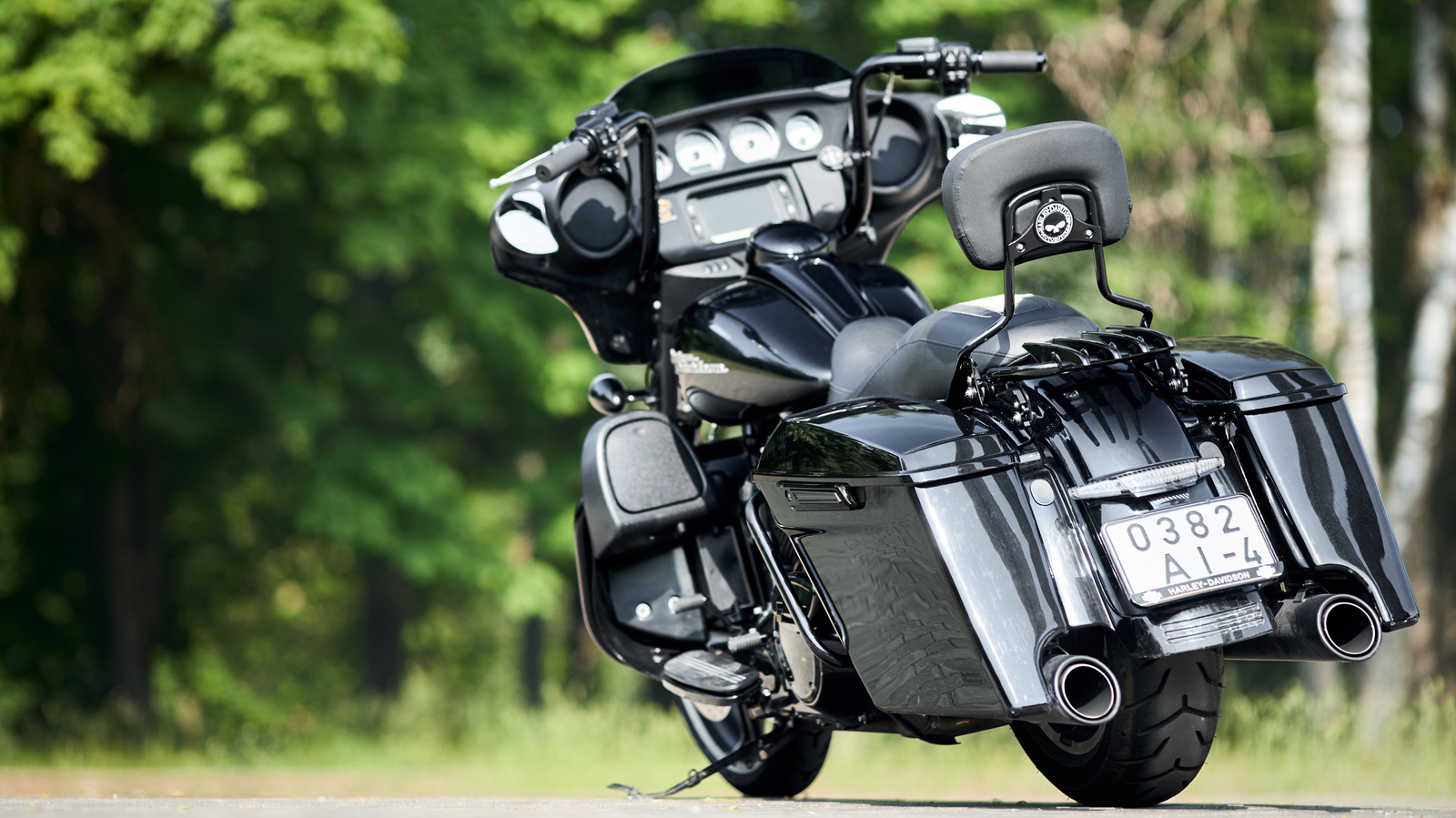
Harley-Davidson has made many iconic motorbikes of such quality that we’d be happy to have them as our only bike. Sure, there are tradeoffs to owning a Harley, but for some of us, these bikes are quintessentially American in a way few other things can be. We believe Harley’s (modern) golden era occurred between 2012 and 2015, when they shipped their big bagger-touring bikes with the legendary Twin Cam 103 engine.
This engine is widely regarded as one of the best Harley-Davidson engines ever made. It was arguably the peak aesthetic generation for big Harley tourers. Sure, you’re not getting some of that modern tech, and some parts will be due for replacement right about now, but these bikes put the soul back in riding. As an upside, any issues that these models have are likely well-documented across owner forums.
Aftermarket support should be good, too, including with non-OEM parts and upgrades. All things considered — including attractive prices on the used market — you probably won’t go wrong with this particular set of bikes. As always, do thorough due diligence if purchasing a second-hand bike, and make sure any recalls were done, and it was serviced on time.
Honda CRF300L Rally
Every other bike we’ve looked at above has been great, but intended mostly for the civilized world of paved surfaces and asphalt. However, some of us are more at home off the beaten path, so our next bike is the Honda CRF300F Rally.
For the uninitiated, Honda’s CRF line is a series of adventure (read: off-road) motorcycles that can be had in a range of various displacements. Of these displacements, the sub-300 cc version stands out because it hits a few sweet spots. First up, the size. With a seat height of 35.2 inches, a weight of 335 pounds, and a wheelbase of 57.2 inches, the bike is appealing to riders of all ages and builds.
Furthermore, the 27 hp and 20 lb-ft of torque from the 286 cc, single-cylinder engine should prove plenty powerful (and torque-y) for most riding situations. The inverted fork suspension at the front with 10.2 inches of travel, coupled with the monoshock at the rear, works in tandem with the 21- and 18-inch tires at the front and back, respectively, for some good off-road chops.
Sometimes, you just want a cheap dirt bike to pound trails in the backcountry on the weekend. Plus, you can get your kids the smaller versions like the CR50F or CR110F. The new 300 Rally begins at $6,499 ($600 destination) while the smaller models start at under $3,000.

Comments are closed.