
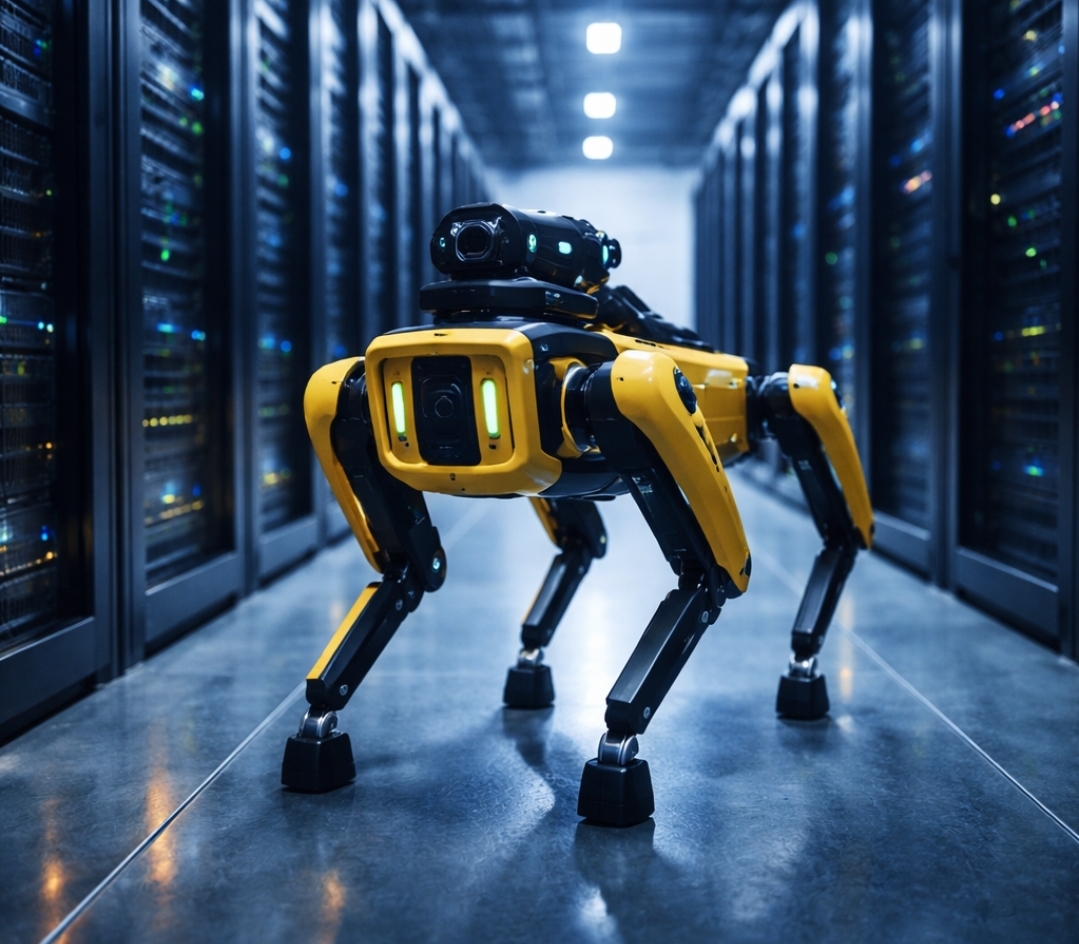

The idea of robotic dogs once belonged firmly to the world of imagination, popularized by characters like K9 from Doctor Who and Goddard from The Adventures of Jimmy Neutron, Boy Genius. Today, however, similar machines are no longer fictional. They are actively being deployed by technology companies to protect some of the most critical digital infrastructure in operation.
As artificial intelligence continues to expand rapidly, the data centers that power these systems have become increasingly important—and vulnerable. To address growing security and operational challenges, companies are now introducing quadruped robots, often referred to as “robot dogs,” to patrol these massive facilities.
AI Expansion Driving New Security Needs
The rapid growth of AI has triggered an unprecedented wave of investment in infrastructure. Technology companies are collectively spending hundreds of billions of dollars to build and upgrade data centers capable of handling complex AI workloads. These facilities house powerful servers that process enormous volumes of data continuously.
Modern data centers are not only costly but also vast in size. Some stretch across areas equivalent to several sports fields, while others reach even larger scales. One of the most ambitious projects, Meta’s Hyperion facility, is expected to span an area nearly four times the size of Central Park. Managing and securing such expansive sites presents significant logistical challenges.
Traditional security measures, which often rely heavily on human personnel, can struggle to keep up with the scale and complexity of these operations. This has led companies to explore automated alternatives that can operate continuously and efficiently.
Boston Dynamics and the Rise of Spot
Among the companies leading this shift is Boston Dynamics, a well-known developer of advanced robotic systems. Its quadruped robot, Spot, has become a popular choice for organizations seeking to modernize their security and monitoring capabilities.
Spot is designed to move autonomously through complex environments, making it particularly suitable for large, industrial-scale data centers. Equipped with cameras and sensors, the robot can patrol designated routes, monitor activity, and detect unusual conditions in real time. Its mobility allows it to navigate terrain that might be difficult or time-consuming for human guards to cover.
Interest in such robotic systems has grown significantly alongside the AI boom. As companies expand their infrastructure, they are increasingly looking for tools that can improve oversight while reducing long-term operational costs.
Balancing High Costs with Long-Term Benefits
Adopting robotic systems like Spot requires a considerable upfront investment. Units are typically priced between $175,000 and $300,000, depending on their configuration and intended use. Despite this, many companies see the technology as a cost-effective solution over time.
Robot dogs can operate around the clock without rest, reducing the need for large security teams and minimizing the risks associated with human error or fatigue. Over time, these efficiencies can offset the initial expense, making them an attractive option for companies managing large-scale facilities.
Additionally, their ability to perform multiple functions beyond security enhances their overall value.
Expanding Roles Beyond Surveillance
While perimeter security is one of their primary functions, robot dogs are increasingly being used for a broader range of tasks within data centers. These include routine inspections, site mapping, and monitoring construction progress.
Such capabilities are particularly useful in environments where early detection of issues is critical. For example, robots can identify leaks, standing water, or structural irregularities before they escalate into more serious problems. This proactive approach can help prevent costly downtime and improve overall safety.
With advanced sensing capabilities and near-complete environmental awareness, systems like Spot can gather and analyze data from across a facility, providing operators with insights that might otherwise be difficult to obtain.
Adoption Spreads Across Industries
The use of quadruped robots is not limited to the technology sector. In recent years, they have been introduced in fields such as construction, public safety, and defense.
Another key player, Ghost Robotics, offers similar robotic systems designed for a variety of applications. These include construction site inspections, safety monitoring, and even military reconnaissance. Their adaptability has made them appealing in industries where conditions can be hazardous or unpredictable.
Law enforcement and emergency response teams have also experimented with robotic systems for tasks such as search-and-rescue operations and handling dangerous materials.
Robotics Market Poised for Long-Term Growth
Although robotics adoption is accelerating, the industry is still developing. According to research from Deloitte, global sales of industrial robots have remained relatively steady since 2021, at around 500,000 units annually.
However, future projections suggest substantial growth. Analysts expect shipments to reach approximately 1 million units per year by 2030, with revenues climbing significantly. Looking further ahead, the robotics market could expand into a multi-trillion-dollar industry by mid-century, driven by continued advancements in AI and automation technologies.
Implications for Jobs and Workforce Evolution
The increasing presence of robotics is also shaping discussions about the future of employment. While AI is often associated with transforming knowledge-based work, robotics is expected to have a more pronounced impact on physical labor.
Zak Kidd, founder of AskHumans, has pointed out that AI tools are more likely to enhance productivity in office-based roles. In contrast, robotic systems—particularly those capable of mobility and physical interaction—may eventually take over tasks that involve repetitive or physically demanding work.
This shift could redefine how industries approach labor, especially in environments where safety risks are high or efficiency demands are constant.

Comments are closed.