
From Malaysia’s Zus to Indonesia’s Kenangan: How Southeast Asia’s homegrown coffee chains are growing overseas

At Kenangan Coffee outlets in Singapore, customers are offered not just the usual choices of milk and sugar, but also a selection of coffee beans to choose from, sourced from Indonesian regions, such as Aceh, Bali and Flores.
They also feature classic drinks with Indonesian signatures, such as lattes sweetened with palm sugar.
“It is cheap, and offers good discounts. In terms of taste, I find it similar to the coffee in other cafes,” Billy Ooi, a Singapore-based management professional, told Nikkei Asia.
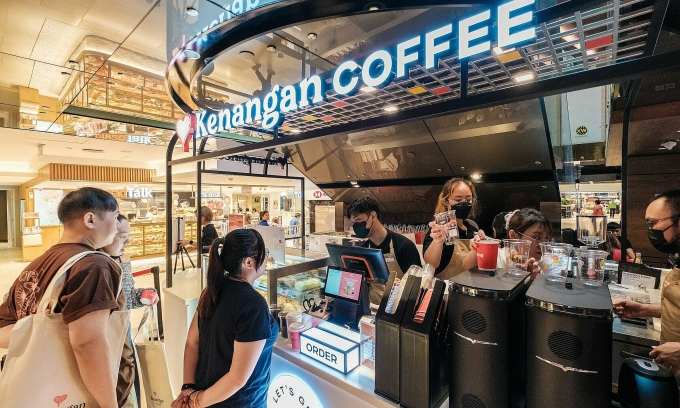
A Kenangan Coffee outlet in Singapore. Photo from the company’s website |
Back in Indonesia, where it operates under the name Kopi Kenangan, the brand has grown rapidly since its 2017 launch to become the country’s largest cafe chain, with over 1,100 outlets nationwide by the end of last year.
It was also among the early players to expand overseas, having set up around 187 stores across India, Australia, Singapore, Malaysia and the Philippines.
Other Indonesian brands like Tomoro and Fore have also opened in Singapore, with the former also present in China and the Philippines.
Similarly, Malaysia’s Zus Coffee, which started as a small kiosk in 2019 and has grown into the country’s largest coffee chain, has been expanding across the region.
The chain now operates more than 1,000 outlets across Malaysia, Singapore, Brunei, the Philippines and Thailand, with the majority located in its home market.
Zus is the first choice for Beej Marcado, a 25-year-old entrepreneur in the Philippines—the Malaysian chain’s biggest overseas market.
“I always order simple drinks such as iced americanos or lattes, so it is easy for me to tell if the coffee is good,” Marcado told the South China Morning Post.
“Another thing they do better than other chains is their use of edible straws. I find that sustainable.”
Fierce competition
As Southeast Asian coffee chains expand overseas, they face stiff competition from global giants such as the U.S.’ Starbucks and China’s Luckin Coffee, as well as strong local players in each country.
Thailand’s top player, Café Amazon, entered Vietnam in 2018 but shut all its outlets there last November, citing “fierce competition,” according to Thai newspaper The Nation.
To stay competitive, many chains are adding localized offerings to their menus. Zus Coffee, for instance, introduced an ube (purple yam) coffee in the Philippines and a Tom Yum Americano in Thailand.
 |
A Zus Coffee outlet in Singapore. Photo from Google Maps |
Adapting to local tastes has also been key for Sarnies, a café brand from Singapore with several outlets in Thailand. Its co-founders, Eric Chan and Benjamin Lee, said they adjusted the menu when they entered Thailand to better suit a more diverse customer base.
Founded in 2011 on Telok Ayer Street, Sarnies later expanded abroad as operating conditions in Singapore became more challenging, with Bangkok emerging as its second base.
While its Singapore outlet mainly serves office workers, its Bangkok locations attract a broader mix, including locals, returnees, expatriates and tourists seeking brunch fare.
“The Thais prefer something a bit more interesting … If we were to take the Sarnies in Telok Ayer and plonk it somewhere in Bangkok right now, it probably won’t be received as well,” Chan told Channel News Asia.
Roshan Raj Behera, partner at Redseer Strategy Consultants, said Indonesian consumers tend to favor sweet, milk-based iced coffee at affordable price points, whereas Singapore’s market leans more toward espresso and specialty coffee, as well as strong, sweet traditional kopitiam brews.
“Balancing a recognizable signature with local preferences on dairy, sweetness and price is a key challenge,” he said.
Southeast Asia’s modern coffee and tea market was valued at US$9.9 billion in 2025, up sharply from $8.3 billion in 2023, according to the “Coffee and Tea Chains in Southeast Asia 2026” report by venture capital firm Momentum Works.
This growth was driven by rapid store expansion, the rise of digital ordering and wider consumer uptake. Yet the industry is entering a new phase.
Weihan Chen, Insights Lead at Momentum Works, said the focus is shifting toward how effectively brands build their operating systems, from supply chains and in-store processes to digital infrastructure.
Competition, once centered on outlet expansion and brand positioning, is being shaped by productivity, unit economics and the ability to scale operations efficiently.
“The next winners will not simply be the brands with the best drinks or the most stores, but those with the strongest systems,” Chen noted, as quoted by Deal Street Asia.

Comments are closed.