
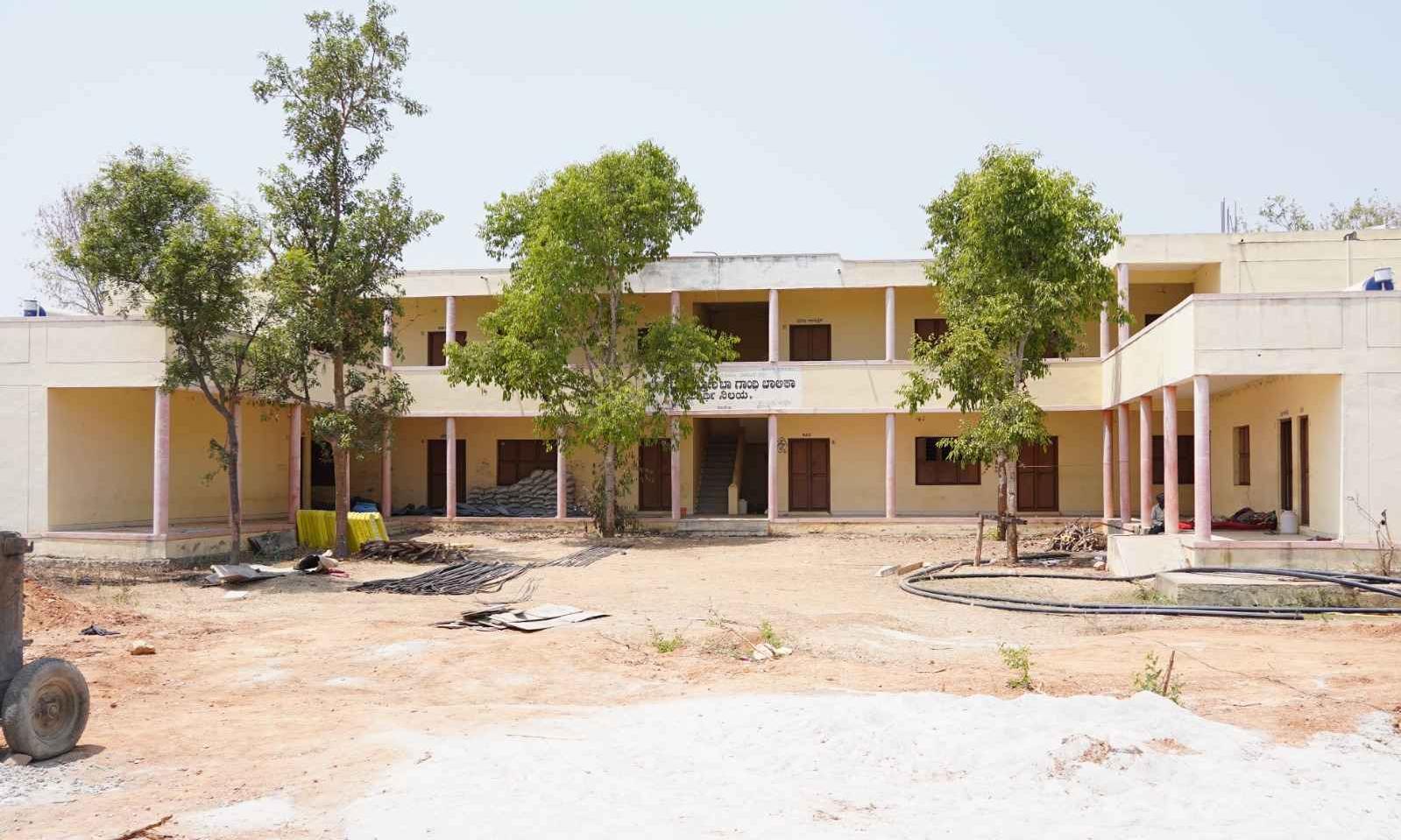

A well-equipped government girls’ hostel in Tumkur district’s Akkirampura village, Koratagere taluk — the assembly constituency of Karnataka Home Minister G Parameshwara — has been lying abandoned for nearly eight years.
The reason: a deeply entrenched local superstition that menstruating girls living near the village deity’s temple will invoke her wrath.
The Kasturba Gandhi Balika Vidyarthi Nilaya, built by the district panchayat and the Department of Public Education at a cost of Rs 80 lakh for girls from SC, ST and OBC communities, once housed around 45 students. Since COVID, not a single girl has enrolled.
Also read: Menstrual leave debate grows after Supreme Court rejects nationwide policy plea
Solar panels, water pipes and doors are rusting. The building’s balconies are littered with liquor bottles and cigarette packets. Construction materials for a Jal Jeevan Mission project are now stored inside, and workers from other districts have been housed there.
The goddess ‘roams’
The hostel sits within the perceived boundary of the Yelu Mandemma Devi temple, around 100 metres away. Locals believe the goddess roams within this boundary, and that menstruating women, new mothers and those who have eaten meat must not enter the area. The belief cuts across religious lines — Hindus and Muslims alike in this village of around 3,000 people abide by it.
The hostel sits within the perceived boundary of the Yelu Mandemma Devi temple (in picture), around 100 metres away.
“Earlier, girls used to stay here. But now no one has enrolled. People believe that those who are before-mountains (menstruating) must not be in this area, as the deity roams here,” farmer Srinivas told The Federal Karnataka.
Housewife Jayamma suggested a workaround, “The girls’ hostel is outside the village and not safe. If the boys’ hostel inside the village is moved here, the girls can use the building inside.” Muslim resident Shafi Ahmed echoed the same sentiment, saying, “Even we believe in Yelu Mandemma Devi. When we have our periods or have eaten meat, we don’t take this road.”
Also read: Taboos and social norms surrounding menstruation: A pain for women
Another resident, Allabhaksh, went further, “The high school next to the hostel is also within the temple boundary. We don’t send our girls to school for nine days when they are menstruating.”
Dissenting voices
Not everyone in the village accepts the superstition. “We don’t believe in such things. We walk on this road freely,” said resident Dadapeer. Another villager, Suresh, traced the crisis to a specific moment: “A warden once spread a rumour that something was moving around in the hostel. That’s what pushed parents into superstition. It isn’t right to keep the hostel closed because of the deity.”
The building’s balconies are littered with liquor bottles and cigarette packets.
C Yatiraju, vice-president of the Tumkur Science Centre, told The Federal Karnataka that the belief must be challenged through dialogue. “The district panchayat, the education department and all concerned authorities must hold awareness meetings in the village. A building built at public expense must not be allowed to fall to ruin,” he said.
Locals believe the goddess roams within this boundary, and that menstruating women, new mothers and those who have eaten meat must not enter the area.
Hulikal Nataraju, president of the Karnataka State Science Council, recalled visiting Akkiampura with his team at the request of the local block education officer. “We brought girls from surrounding high schools and had them stay in the hostel from morning to evening to show them there was no supernatural presence. The children were convinced. But the parents’ mindset had not changed.”
Also read: Coimbatore school incident not rare; period stigma still common in TN
He also questioned the superstition’s logic, “If the goddess roams here, all the better. And is the goddess not a woman herself? A female deity would only bless girls, not harm them.”
The irony of it
Progressive thinker KS Vimala called the practice unconstitutional. “Menstruation, pregnancy, childbirth — these are natural biological processes. Calling them impure is a stain on humanity and the Constitution. Parameshwara has himself wept in public while recalling his experiences of untouchability. Yet in his own constituency, a girls’ hostel lies abandoned in the name of superstition. The government, the minister and the Women and Child Welfare Department owe the public an answer,” she noted.
Solar panels installed at Kasturba Gandhi Balika Vidyarthi Nilaya.
Education expert Niranjanaradhya VP was equally blunt, “The survival of such blind beliefs in this scientific age is a clear sign that our education system has failed to cultivate a rational temper.”
Officials non-committal
M Ramesh, in-charge panchayat development officer of Akkirampura gram panchayat, told The Federal Karnataka that the hostel was shut during COVID and no students enrolled after that. “The temple belief may also be one reason. Our superiors have asked us to invite applications in June. Villagers have requested that the hostels be swapped. We will decide the next steps once applications come in,” he said.
Also read: After crushing menstrual taboo, here’s how female athletes are coping with it
The Karnataka Prevention and Eradication of Inhuman Evil Practices and Black Magic Act has been in force since 2020, and falls directly under Parameshwara’s jurisdiction. That a practice it was designed to prevent continues unchecked in his own constituency raises uncomfortable questions about the government’s commitment to enforcing it.
The minister recently promised action, but how it pans out remains to be seen.
This article was originally published in The Federal Karnataka.

Comments are closed.