
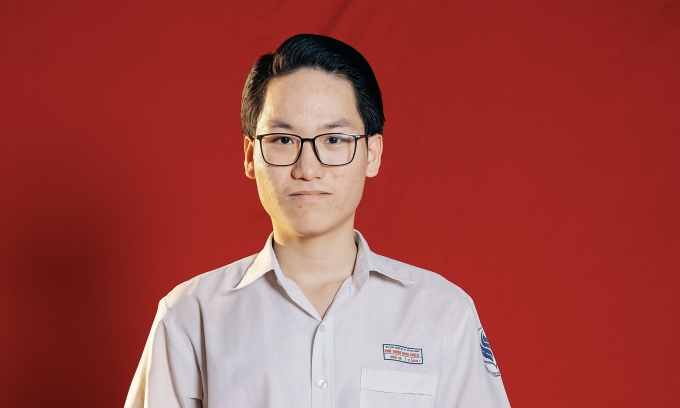
Vietnamese teen with 9.9 GPA wins one of 20 full-tuition spots worldwide at University of Sydney

The scholarship covers 100% of tuition fees, worth around US$140,000, plus additional fees for the full duration of his degree.
The university ranks third in Australia and 25th globally in the QS World University Rankings 2026. Its Sydney International Undergraduate Academic Excellence Scholarship, established in 2024, is among the most competitive undergraduate awards in Australia.
An, a former student in the specialized math track at the High School for the Gifted under Vietnam National University Ho Chi Minh City, had previously topped the entrance exam for the architecture and smart urban design program at the Ho Chi Minh City University of Economics. He chose to study abroad instead, enrolling in architectural design at the University of Sydney for the first semester of 2026.
The scholarship application took him a year and a half from start to finish. An described the essay as the “star” of his entire application, the component he invested the most time in.
The application required two essays. The first, at 500 words, asked what the applicant had done during high school. An wrote about his time on both the math and history olympiad teams, and two extracurricular projects he founded: Saigon Art Council, an arts initiative, and Polinerdy, a forum on international relations.
The second essay, 800 words, asked about the applicant’s vision and how the university could support it. An opened with the story of his two grandfathers, both veterans of Vietnam’s resistance war, and asked himself how he could carry forward their legacy.
To build his argument, he read government planning documents including the Vietnam 2035 Report, Resolution 42 outlining Vietnam’s vision to 2045, and the University of Sydney’s Strategic Vision to 2032, identifying challenges in sustainable urban development that he wanted to address through architecture.
“This is a scholarship for outstanding students. I needed to show seriousness, logic, and a certain level of ambition,” An said.
An showed a talent for drawing from a young age, but as he advanced through the rigors of a math-focused academic environment, his creative instincts gradually gave way to logical thinking. Architecture, he realized, was a discipline where both strengths could be put to use.
Toward the end of ninth grade, he began considering Australia as a destination. He recognized that the country had inherited centuries of European architectural and urban planning traditions, offering a systematic body of knowledge that could be applied in Vietnam.
Knowing that Australian universities tend to weight academic results heavily, An pushed for the highest possible final-year GPA. He carefully tracked his scores on every test and looked for any opportunity to improve.
His study method was to work backward: starting with summaries or conclusions from each lesson, then layering in supporting details. This allowed him to balance Olympiad training with coursework, winning a national consolation prize in history in both 11th and 12th grades while finishing his final year with a GPA of 9.9 on Vietnam’s 10-point scale.
Though he was in the math track, An deliberately switched to the national history Olympiad team in 11th grade. The preparation exposed him to economic and political knowledge he considers essential for large-scale urban planning work.
He also sorted tasks by speed and priority. For IELTS, he focused his preparation into a single month during 11th grade and scored 7.0, meeting the university’s English proficiency requirement. He prepared a design portfolio from self-initiated projects and school club activities.
A portfolio is not mandatory for the scholarship application, he said, but it is expected of applicants in creative fields and serves as a competitive differentiator. He learned this from conversations with architecture students who had applied before him.
An’s homeroom teacher in 12th grade, Ta Hoang Thong, described him as intelligent and eager to learn. “Even after switching to the History team, An kept up with his math coursework and still came to me for help,” Thong said.
In Australia, An plans to pursue a master’s degree afterward to deepen his expertise before returning to Vietnam to work as an architect focused on sustainable infrastructure and cultural heritage preservation.

Comments are closed.