
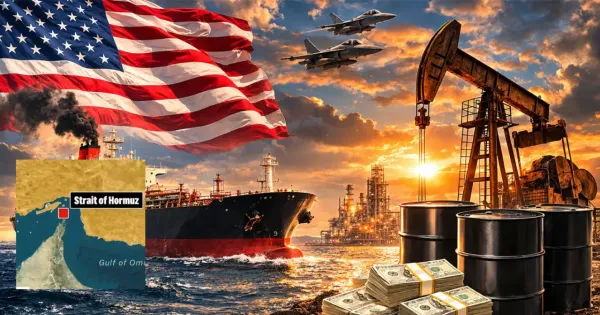
Trump gives permission to Iran to sell oil, prepares to release 140 million barrels in the market amid Hormuz tension

Washington/Tehran: The Donald Trump administration has temporarily allowed Iran to sell about 140 million barrels of crude oil to reduce volatility in global markets as the war in West Asia enters its fourth week. Under this exemption issued late Friday night, Tehran will be able to market the oil stored in tankers, which is equal to about one and a half days of global demand. This decision has been taken with the aim of reducing the supply concerns arising due to the blockage in the Strait of Hormuz. On one hand, Trump hinted at reducing tensions and talked about ending military operations against Iran.
He claimed that the US has come “very close” to achieving its military goals in West Asia. According to Trump, the US is “completely crippling” Iran’s missile capabilities, launchers and defense industrial infrastructure.
He also said that preventing Iran from acquiring nuclear capability and ensuring the security of allies in the region are among his main objectives. He said on his social media platform that the US is close to restoring the security of allies like Israel, Saudi Arabia, Qatar, UAE, Bahrain and Kuwait. Regarding the future management of the Strait of Hormuz, Trump said that it should be controlled and monitored by the countries that use it. He added that America will cooperate if needed.
However, tension still remains in the area. Thousands of additional US Marines and naval personnel are being deployed, showing increased military readiness. Meanwhile, Iran launched a missile attack on the US-UK joint military base in Diego Garcia in the Indian Ocean, which was foiled according to US officials. Bahrain has become the first regional country to support efforts to reopen the Strait of Hormuz, while European countries, Japan and Canada have also expressed support.
However, till now no country has given a concrete commitment regarding naval deployment. Iran has warned the United Arab Emirates that it could target port cities such as Ras al-Khaimah if the islands it holds in the Gulf are attacked. Whereas Kuwait and Saudi Arabia have informed about foiling missile and drone attacks. Iran has launched missile attacks on Israel, in response to which Israel has attacked Hezbollah targets in Beirut, further increasing tensions in the region.

Comments are closed.