
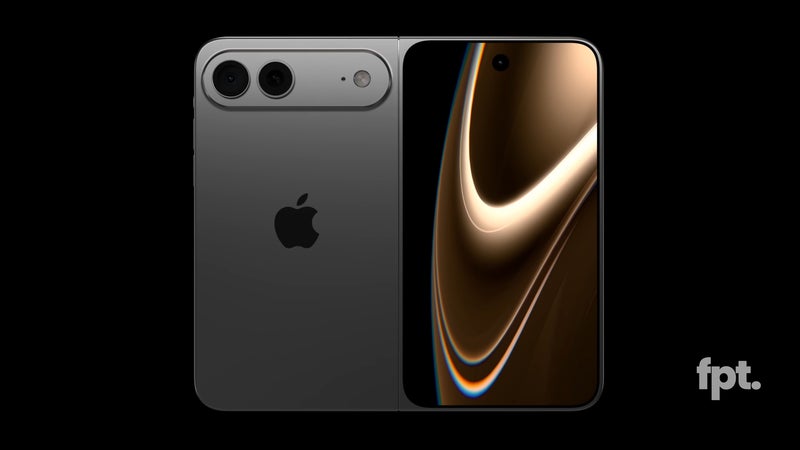

For years, the tech world has watched from the sidelines as Samsung, Google, and a host of Chinese manufacturers iterated on the foldable smartphone. While these devices have grown increasingly polished, one aesthetic and functional hurdle remained: the visible, tactile crease. Apple is finally ready to enter the fray, and they are doing so by claiming to have solved the “crease problem” once and for all. This isn’t just another foldable; it is Apple’s attempt to redefine the category in time for its 50th anniversary.
The headline feature of the rumored iPhone Fold is a display that Apple internally refers to as “Zero-Crease.” While competitors have managed to minimize the dip in the screen, Apple has reportedly spent years developing a “new material property” in collaboration with Samsung Display.
Leaks suggest a crease depth of less than 0.15mm, a measurement so shallow it is virtually indistinguishable to both the eye and the thumb. To achieve this, Apple is utilizing a custom laser-drilling process on the underside of the ultra-thin glass (UTG). This allows the display to bend at a more natural radius without the structural stress that creates a permanent “valley.” Combined with a folding angle optimized to be under 2.5 degreesthe iPhone Fold aims to deliver a tablet experience that is indistinguishable from a standard iPad Mini when unfolded.
The Liquid Metal Hinge: Durability Meets Elegance
A creaseless display is only as good as the mechanism supporting it. For the iPhone Fold, Apple is reportedly pivoting away from standard stainless steel hinges in favor of a Liquid Metal (amorphous alloy) interlocking system. This material is significantly stronger and more elastic than traditional metals, allowing the hinge to be thinner rumored to be just 4.5mm when the device is unfolded while maintaining rigid structural integrity.
The hinge is designed to distribute pressure evenly across the central axis of the screen. By using a series of interlocking gears rather than a simple pivot, the mechanism ensures that the flexible OLED panel is never “pulled” too tightly, a common cause of the micro-tears seen in earlier foldable generations. This focus on durability is Apple’s answer to the skepticism that still haunts the foldable market.
Under the Hood: The A20 Pro and the 2nm Era
Performance on the iPhone Fold will be anchored by the A20 Pro chipsetbuilt on TSMC’s cutting-edge 2nm process. Because a foldable display requires significantly more power to drive its 7.8-inch internal canvas (with a rumored 2480 x 1860 resolution), the A20 Pro features a dedicated “Display Engine” specifically for the Fold.
This silicon is paired with 12GB of LPDDR6 RAMa necessity for the “iPad-like” multitasking features expected in iOS 27. The goal is a device that can handle three simultaneous “Active Windows” without stuttering, effectively allowing the iPhone Fold to replace both a standard smartphone and an iPad Mini for power users. To support this massive power draw, the device will utilize a dual-cell battery system totaling approximately 5,500mAhthe largest ever in an iPhone.
The Return of Touch ID
In a surprising design pivot, the iPhone Fold is expected to ditch Face ID on the internal display. To keep the screen entirely “uninterrupted” and minimize the thickness of the top bezel, Apple is reportedly integrating Touch ID into the power button.
While the external 6.5-inch cover screen may still feature a punch-hole for a 12MP TrueDepth camera, the internal 7.8-inch screen is rumored to feature an Under-Display Camera (UDC) or no camera at all, forcing users to use the high-quality rear sensors for video calls via a “Candid Mode” that uses the cover display as a viewfinder. This prioritization of screen real estate highlights Apple’s vision of the Fold as a consumption and productivity beast first, and a communication tool second.
Market Strategy: The $2,000 “Halo” Device
Apple is not positioning the iPhone Fold as a mass-market replacement for the iPhone 18. Instead, it is being launched as a “Halo” product with a starting price expected between $1,999 and $2,199.
By launching in late 2026, Apple is entering a market where the “early adopter” phase has ended, and the “premium consumer” phase has begun. Following the recent discontinuation of the first-gen Samsung Galaxy Z TriFold due to high production costs, Apple’s move is a calculated bet: they aren’t trying to be the first to fold; they are trying to be the first to fold perfectly.
If the “Zero-Crease” display proves as seamless as reports suggest, the iPhone Fold could fundamentally shift the smartphone landscape. It represents a decade of “strategic patience,” waiting for the materials science to catch up to the industrial design. As the world moves toward an AI-first mobile experience, a device that can transform from a pocketable phone into a 7.8-inch AI workstation without the distraction of a visible crease might just be the defining product of Apple’s next 50 years.

Comments are closed.