
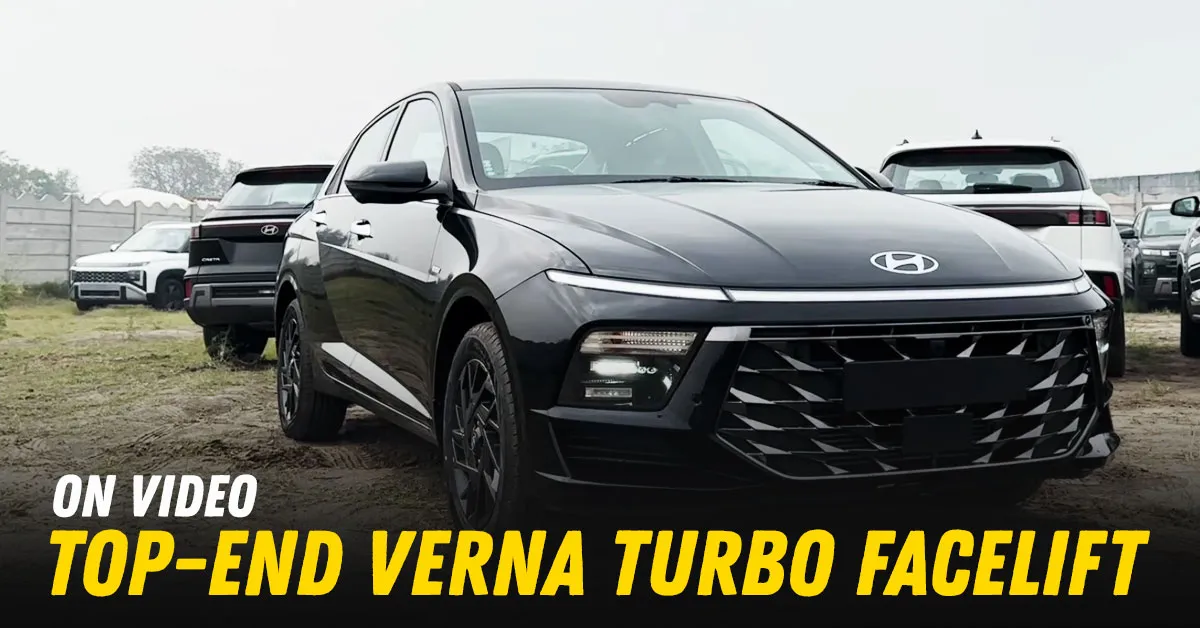

Hyundai India soft-launched the new Verna facelift in the second week of March. The sedan now has a starting price of Rs 10.98 lakh, ex-showroom. Several changes have been introduced on the updated model, one of which is the new trim nomenclature. The updated Verna now comes in six broad trims- HX2, HX4, HX6, HX6+, HX8 and HX10, aligning with the carmaker’s modern variant-naming system. A video showing the range-topping HX10 Turbo automatic variant in detail, has now surfaced online.
Drrive Expothe YouTube channel that shared this video claims it to be the first on the internet. It shows a Verna Turbo HX10 DCT finished in Titanium Black.
The host starts by mentioning the powertrain details of the vehicle. The updated Verna continues to be offered with two engine options- 1.5L naturally aspirated petrol and 1.5L turbocharged petrol, both of which are available on the HX10 trim. The HX10 is an automatic-only trim. The vehicle in this case, has the 1.5L turbo-petrol engine mated to a seven-speed dry clutch DCT automatic transmission. It has an ex-showroom price of Rs 18.25 lakh.
The host then explains the design changes on the facelift. The front fascia has the most prominent changes. Even so, it is not a comprehensive design overhaul. Just parts of the design have been enhanced. The front grille has been redesigned and now comes finished in Piano Black. It is stylish, blends seamlessly into the front bumper, and even houses the registration plate, front camera (of the 360 camera- a new addition), and a radar for the ADAS system.
Like the pre-facelift model, the new Verna has a full-width LED DRL. Another notable change is the in the design of the headlamp cluster. The headlamps (both high and low beams) are LED units. The indicator lamps get a unique design and are halogen units. The car lacks fog lamps. We can also see four parking sensors at the front- something that makes life a lot easier for the driver.
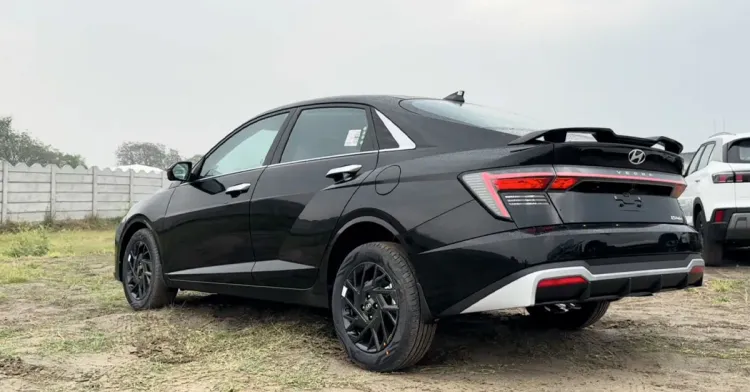
The side view continues to be familiar, except for the new set of 16-inch wheels. Callipers on the Turbo variant are painted in Red and the wheels themselves are Black. All wheels get disc brakes. The beltline and door handles continue to boast a Satin Chrome finish.
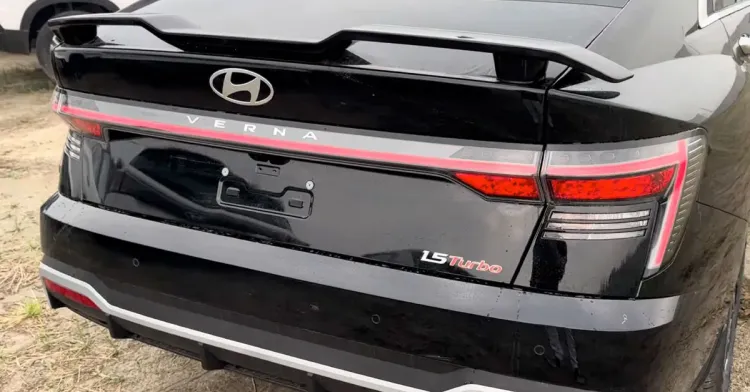
Other design highlights include a prominent rear spoiler, shark-fin antenna, connected LED tail lamps, and a redesigned rear bumper. The host opens the trunk and shows the boot space and spare wheel. The new Verna offers 528 litres of usable boot space and even has a ‘smart trunk’ function. He also talks about how big the car is. It has a wheelbase of 2,670 mm and measures 4,565 mm and 1,765 mm in length and width. It is, in fact, the widest offering in its class.
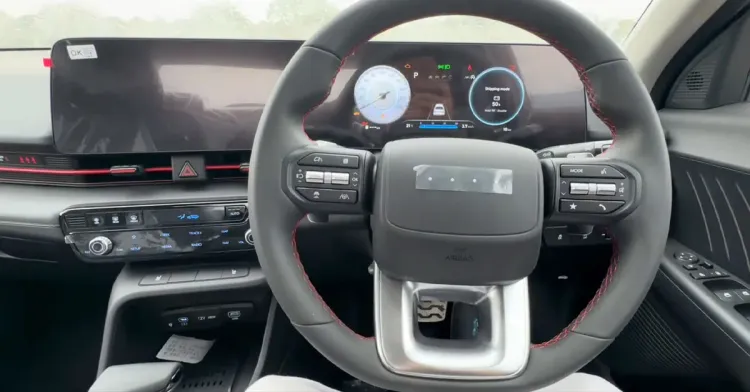
Later in the video, the host shows the car’s interior. It gets a sporty Black theme. The new Verna comes with powered front seats with a memory function (two custom positions) for the driver seat. Buttons for this are placed on the driver-side door. The driver’s seat offers 8-way adjustments and even has a welcome retract function. The front passenger seat can be adjusted in four ways and comes with an ‘electric boss’ mode. The seats get leatherette upholstery and now features slightly different textures. The front seats now offer just ventilation function and no heating.
Another interesting change inside is the new steering wheel. The updated sedan gets Hyundai’s new-age, chunky four-spoke steering wheel design with the ‘four-dot’ (morse code) logo and integrated controls. Interestingly, audio and telephony controls are on the right side while the ADAS and in-cluster navigation buttons are placed on the left.
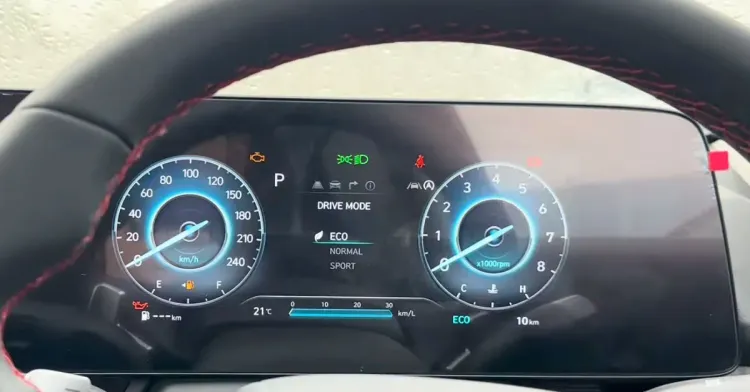
The host then explains the top-end Verna’s features one by one. The vehicle comes with two 10.25-inch screens (infotainment touchscreen and a new digital instrument cluster), 8-speaker BOSE audio system, connected car features, integrated dashcamera, auto-dimming IRVM, wireless charger, ambient lighting, a single-pane sunroof, 360-degree camera, blind-spot monitor, selectable drive modes, wireless Android Auto and Apple CarPlay, Level 2 ADAS and more.
Interestingly, Hyundai hasn’t upsized the screens to 12.3-inch units as seen on the second-generation Venue. This is likely because the Verna’s Electrical/Electronic architecture doesn’t support the same.
The host then moves to the rear seats, The seats offer ample room and comfort. There are rear sunshades, AC vents and charging points as well. The rear seat also has a central armrest.
The host doesn’t, however, speak about the engine specifications of this car. The 1.5L turbocharged engine on this car makes 158hp and 253Nm. This makes it the strongest in its segment. The HX10 DCT variant also comes with paddle shifters.

Comments are closed.