
Three European countries craft gold-plated crosses set to crown Saigon Notre-Dame Cathedral for 200 years

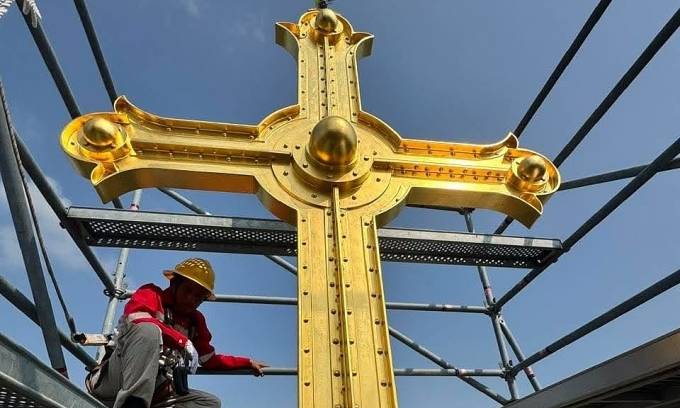
The crosses were lifted by crane to the top of the cathedral’s 57-meter zinc spires before a crowd of onlookers and senior church officials, including Archbishop Giuse Nguyen Nang and Archbishop Marek Zalewski, the Vatican’s resident representative in Vietnam.
They replace a pair of 128-year-old originals that were removed in March 2023 during the cathedral’s ongoing restoration and found to be corroded beyond repair. The steel plates had rusted through, ornamental details were warped by trapped water, and the zinc lily ornaments at each base had become completely brittle.
With restoration ruled out, Father Ignatio Ho Van Xuan, head of the cathedral’s restoration committee, received approval from the archbishop to commission entirely new crosses.
The first obstacle was that the original design drawings no longer existed. The restoration team spent months tracking down blueprints and archival documents from libraries in France, then used 3D scanning to reconstruct the 1895 design digitally.
Drawing of the zinc spire and the lily-shaped zinc base where the cross is mounted atop the Saigon Notre-Dame Cathedral. Photo by Read/Thanh Tung |
Once the template was finalized, Belgian firm Altri Tempi, a subsidiary of Group Monument, cast the crosses from high-durability specialized steel. The gilding was entrusted to Giusto Manetti Battiloro, an Italian company based in Florence that has been producing ultra-thin gold leaf for over four centuries.
Giusto Manetti has supplied gold leaf for some of the world’s most famous restorations, including the golden sphere atop Florence Cathedral’s dome, the Marble Court at the Palace of Versailles in France, the Catherine Palace at Tsarskoye Selo near St. Petersburg in Russia, and Topkapi Palace in Istanbul, Turkey.
The 24-karat gold leaf was selected from dozens of varieties specifically for tropical endurance. The gilding process was painstaking: specialists first cleaned and primed the steel surface with an adhesive layer, placed sheets of gold leaf with tweezers, brushed them repeatedly with fine-bristled tools to fix them in place, and finally polished the surface using specialized techniques.
Father Xuan, who observed the process firsthand, said the ultra-thin gold leaf had to be handled with extreme precision. Even the slightest touch could cause a sheet to crumple and tear. The entire process took place in a sterile, dust-free room to prevent any imperfections in the gilded surface.
“This type of gold leaf is not expensive, but applying it demands extraordinary craftsmanship,” he said.
The church originally specified a minimum lifespan of 100 years for the new crosses. The contractor committed to 200, which extended the fabrication timeline to two full years.
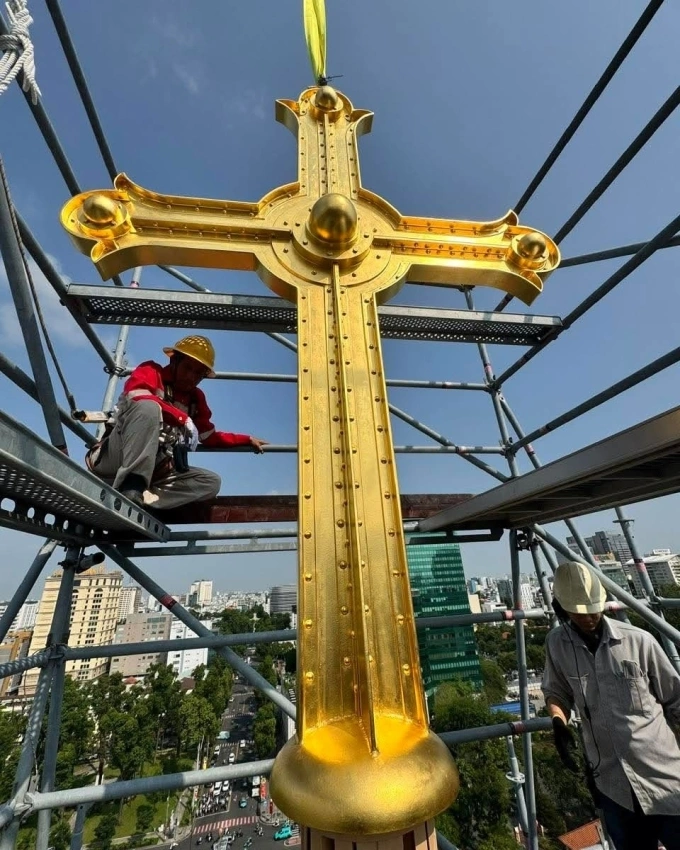 |
A gold-plated cross is installed atop the Saigon Notre-Dame Cathedral on March 19, 2026. Photo by the Archdiocese of Ho Chi Minh City |
In late August 2025, the finished crosses were placed in specialized containers and shipped from Belgium to Cai Mep port in Ba Ria-Vung Tau Province over a five-week voyage before being transported to the cathedral. They were displayed inside the church under Plexiglas for public viewing from Dec. 8, 2025, until the installation.
Each cross stands 3.73 meters tall and 1.85 meters wide, with two perpendicular beams, rounded upper ends with petal-shaped edges, and four decorative spheres at the junctions matching the original design. The base is secured to the spire with 36 bolts.
Gold-plated zinc lily ornaments, each 2.2 meters tall, will later be mounted at each base, replicating the original arrangement. The lily is a traditional Christian symbol of purity and resurrection. At the very top of each cross sits a spiked copper sphere that serves as a lightning rod.
During the crane lift, engineers maintained strict distance from the gilded surfaces and avoided any contact with hard objects to prevent scratches.
From March 20 to 25, Belgian specialists are inspecting both installed crosses to confirm the gilding meets the same quality standard as when the work was completed.
The two old crosses are now preserved at the Archdiocese of Ho Chi Minh City.
Saigon Notre-Dame Cathedral was completed in 1880 and originally had only two square bell towers. The pointed spires, six bronze bells and original crosses were added in 1895, bringing the structure’s total height to over 60 meters. The cathedral launched a major restoration in 2017, the first in its history.
Nine years into the project, work has been completed on the crosses, roof tiles, exterior brickwork and both bell towers. Scaffolding was erected inside the cathedral late last year to address water-damaged walls and deteriorating structural components, with most materials imported from specialized heritage firms abroad. The full restoration is expected to be completed in 2027.

Comments are closed.