
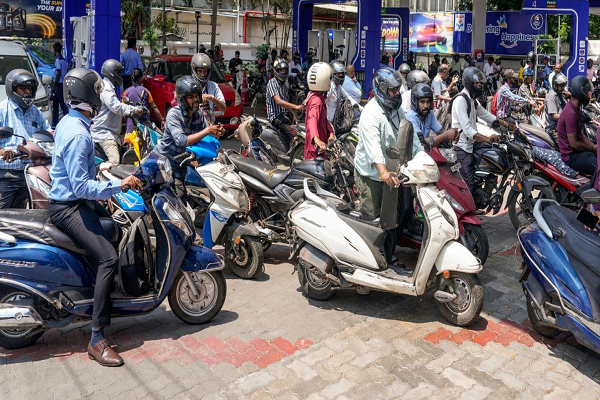
Middle East crisis directly impacts Sri Lanka, fuel prices rise, huge impact on public and transport

New Delhi. The rising tensions in West Asia are now directly affecting the lives of ordinary people, a recent example being Sri Lanka, where a sharp rise in fuel prices has made the situation worrisome. The ongoing conflict between Iran, the US, and Israel has shaken the global oil market, directly impacting smaller and import-dependent countries.
In response, the Sri Lankan government has increased petrol and diesel prices by an average of 25 percent, effective midnight on Sunday. This is the second major increase in a week and the third in March. Following the implementation of the new rates, fuel prices in the country have surpassed 400 Sri Lankan rupees per liter, a significant blow to the general public.
According to data released by the state-owned fuel company Ceylon Petroleum Corporation, the price of auto diesel has risen from 303 rupees to 382 rupees per liter. Super diesel has risen from 353 rupees to 443 rupees. 92 octane petrol has risen from 317 rupees to 398 rupees, and 95 octane petrol has risen from 365 rupees to 455 rupees per liter. Kerosene has also seen the highest price increase, at over 30 percent.
At the root of this crisis is rising tensions in the Strait of Hormuz, which supplies much of the world’s oil. Joint US and Israeli actions against Iran, and Iran’s retaliatory actions, have impacted this vital route, disrupting global supply chains and driving up prices.
This increase has created a stir in Sri Lanka’s transport sector. Private bus operators say this is the largest increase in diesel prices ever, and operations are impossible without fare hikes. Bus owners have demanded a fare hike of at least 15 percent, while the National Transport Commission has stated that a hike of more than 10 percent is necessary. They have also warned of a nationwide strike if the government does not take a decision soon.
The government maintains that despite the increased prices, it is heavily subsidizing fuel. According to government spokesperson Nalinda Jayatissa, the subsidy is subsidizing diesel by ₹100 and petrol by ₹20 per liter, resulting in an additional burden of ₹20 billion per month. He also stated that if prices had not been increased, the government would have incurred an additional burden of ₹1.5 billion.
However, the opposition has accused the government of burdening the public and said that relief could be provided by removing heavy taxes on fuel. The entire development has brought back memories of the economic crisis of 2022, when the country faced a severe financial crisis and political instability.
Overall, global geopolitical tensions have once again demonstrated how energy dependence can impact a country’s economy and everyday life.

Comments are closed.