
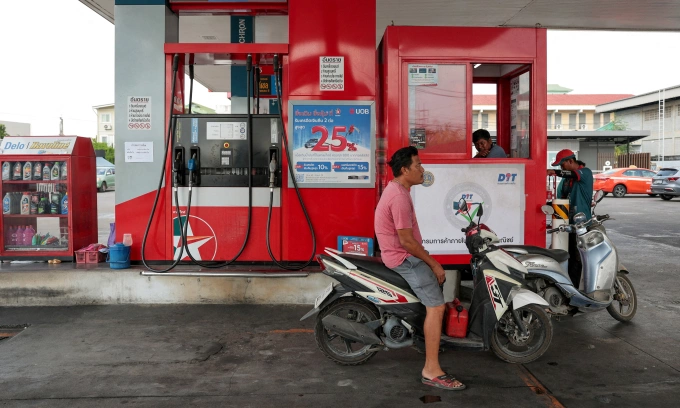
From palm oil to bottled water, prices surge in Thailand as Middle East war rattles Southeast Asia supply chains

It will not be the last.
Five of Thailand’s largest consumer goods manufacturers, including Unilever, Nestlé and Saha Pathanapibul, the maker of Mama instant noodles, have formally warned trade partners to expect price increases from April, according to the Bangkok Post. The companies cited rising raw material and logistics costs driven by the conflict.
Wholesale prices of bottled drinking water have already climbed from 20 baht to 25 baht for low-cost 500-milliliter packs due to higher plastic resin and transport costs, and some manufacturers have begun discontinuing snack products priced at 5 baht per pack because production is no longer viable at that price point, Somchai Pornrattanajaroen, honorary adviser to the Thai Wholesale and Retail Trade Association, told Nation Thailand.
Fuel shock behind price hikes
The cascade began with fuel. Since the U.S. and Israel launched strikes on Iran on Feb. 28, effectively shutting the Strait of Hormuz to commercial shipping, global crude prices have surged past $100 a barrel. Thailand imports about half its crude from the Persian Gulf, according to S&P Global Commodities at Sea data, and the shock hit domestic fuel markets within days.
The government capped diesel at 29.94 baht per liter on March 3 using the state Oil Fuel Fund, but the cost of maintaining that cap proved staggering. The fund was losing more than 1 billion baht ($32 million) a day, subsidizing diesel at up to 18.31 baht per liter, according to the Oil Fuel Fund Office. Within two weeks the fund swung from a 2.5 billion baht surplus into a deficit exceeding 12 billion baht.
The cap became unsustainable. On March 18, the government raised the diesel ceiling to 33 baht per liter and began allowing gradual increases, starting with 0.5 baht per liter. By March 22, standard diesel stood at 31.14 baht per liter at PTT and Bangchak stations, the Chiang Rai Times reported.
But the cap’s removal triggered panic buying that pushed daily fuel consumption from around 67 million liters to 84 million liters, Prime Minister Anutin Charnvirakul told reporters, as cited by Named.
That figure exceeded the country’s maximum production capacity of 77 million liters.
Diesel shortages followed across northern provinces. In Phrae, stations ran completely out. In Chiang Mai, a 10,000-liter delivery at one PTT station sold out in under an hour. Stations in Chiang Rai began limiting purchases, and drivers posted real-time updates on social media: “PTT on Superhighway, diesel gone.”
Energy Minister Auttapol Rerkpiboon said Thailand holds fuel reserves for more than 100 days and insisted there is no shortage, attributing the dry pumps to logistics delays.
The government has secured nearly 2 million barrels of crude from Angola and over 600,000 barrels from the U.S. to diversify supply, according to Nation Thailand.
It is negotiating with Russia for additional imports, Deputy Prime Minister Phiphat Ratchakitprakarn told Reuters.
Thai Airways raised fares 10% to 15% in response to surging jet fuel costs, the airline’s chief executive Chai Eamsiri confirmed, telling Bloomberg that jet fuel prices had roughly doubled.
The price of palm oil has been driven up partly by the energy crisis and partly by government biodiesel policies that have diverted crude palm oil into fuel production, reducing supply available for cooking, the Thai Wholesale and Retail Trade Association said.
Thailand’s Commerce Ministry is now preparing to tighten price controls, requiring prior government approval before any increases on six categories of essential goods including detergent, personal care products and sanitary items, according to the Bangkok Post.
Nine major producers including Unilever, Procter & Gamble and Nestlé agreed to hold consumer goods prices steady through at least April after government consultations.
Regional crisis
Thailand is one of several Southeast Asian economies grappling with the cascading costs of the Hormuz closure, which has disrupted roughly 20% of global oil and LNG supply.
In the Philippines, which operates a fully deregulated fuel market, diesel has surged past P114 ($2) per liter, with year-to-date net increases reaching roughly P57.55 per liter, according to the Department of Energy. Congress is rushing to pass a bill granting the president authority to suspend excise taxes on fuel.
In Vietnam, gasoline has risen roughly 37% and cooking gas prices have jumped about VND120,000 per 12-kilogram cylinder in 15 days, as the government draws down its fuel price stabilization fund for six consecutive periods.
In Malaysia, the government is spending an estimated RM3.2 billion ($810.7 million) per month to hold subsidized gasoline at RM1.99 per liter through the BUDI95 program, analysts told The Stareven as unsubsidized diesel has hit a record RM4.72 after rising nearly 50% in two weeks.
In Singapore, 95-octane petrol has surpassed the peak set during the 2022 Ukraine crisis, with prices climbing nearly 20%, according to the Consumers Association of Singapore’s price tracker.
The U.N. Economic and Social Commission for Asia and the Pacific warned on March 20 that regional inflation could rise to 4.6% in 2026, up from 3.5% in 2025, with higher fuel prices already pushing up transport, production and food costs across developing Asia-Pacific economies.

Comments are closed.