

Held in conjunction with World Water Day, the seminar titled “Water Security in the Mekong Delta under Climate Change” was organized by Tien Phong Newspaper and the People’s Committee of Can Tho City.
As part of its ongoing activities under the Living Well initiative, Keppel also contributed two solar-powered water filtration systems to Khanh Hoa Ward and Lieu Tu Commune in Can Tho to support access to safe water at the community level.
Joseph Low, Chief Representative, Vietnam and President, Vietnam, Real Estate, Keppel Ltd., speaking at the panel discussion on solutions and vision for water security in the Mekong Delta amid climate change. Photo courtesy of Keppel |
According to Joseph Low, Chief Representative, Vietnam and President, Vietnam, Real Estate, Keppel Ltd., the Mekong Delta is facing increasing challenges related to climate change, particularly in water availability and saltwater intrusion.
“Through this seminar, we hope to support ongoing dialogue among policymakers, experts, and stakeholders on strengthening water resilience in the region,” he said. “Alongside this, our Living Well initiative focuses on practical, community-level support. To date, the initiative has helped provide access to clean water for some 157,000 people across 11 communes in seven provinces, reflecting how targeted efforts, delivered in partnership with local stakeholders, can make a meaningful difference to daily life in the Mekong Delta.”
The seminar brought together representatives from the Ministry of Agriculture and Environment, local authorities from Mekong Delta provinces, as well as participants from Keppel, Tien Phong Newspaper, industry experts, businesses, social organizations, and students from Can Tho University.
Discussions focused on the role of water security in supporting sustainable development in the Mekong Delta, particularly in the context of increasing saltwater intrusion and climate-related pressures.
“In recent years, the Mekong Delta has experienced increasingly frequent droughts, saltwater intrusion, and freshwater shortages during the dry season. Can Tho, the region’s central hub, despite its dense river and canal network and relatively abundant water resources, is still facing growing impacts from climate change,” said Nguyen Hoang Anh, Deputy Director of Can Tho’s Department of Agriculture and Environment.
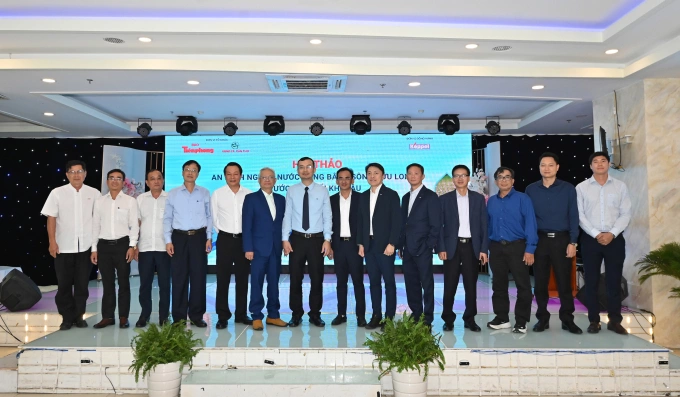 |
The delegates take a group photo after the event. Photo courtesy of Keppel |
At the event, Associate Professor Dr. Nguyen Phu Quynh, Deputy Director of the Southern Institute of Water Resources Research under the Ministry of Agriculture and Environment, noted that the Mekong Delta is facing significant external pressures. He emphasized that sustainable development requires a combination of technological solutions, integrated management approaches, and stronger collaboration among stakeholders.
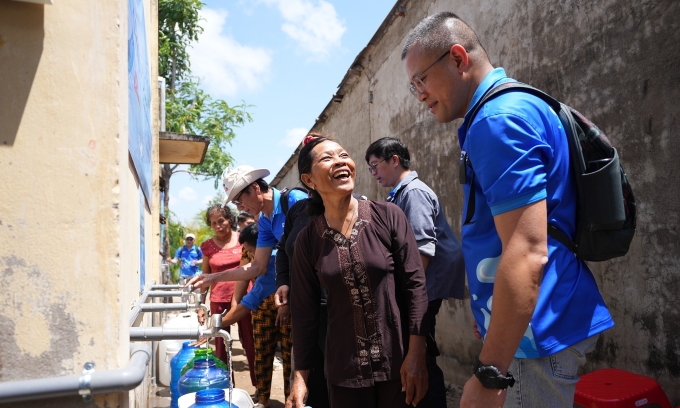
As part of the expansion of the Living Well initiative, Keppel donated two solar-powered water filtration systems with a combined capacity of over 4.3 million liters per day to Khanh Hoa Ward and Lieu Tu Commune in Can Tho.
The systems are intended to support access to clean water for more than 68,000 residents, particularly during periods of drought and saltwater intrusion.
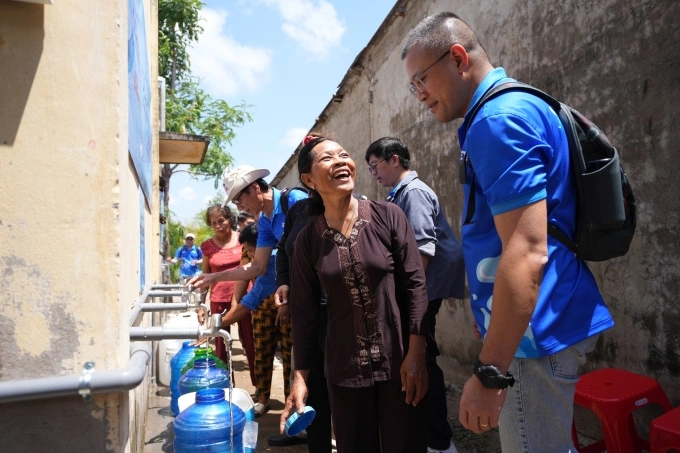 |
Keppel volunteers helping residents of Khanh Hoa Ward, Can Tho, take water from the water filtration system. Photo courtesy of Keppel |
Launched in 2022, the Living Well initiative supports communities affected by drought and saltwater intrusion linked to climate change, a growing challenge in the Mekong Delta.
The program has provided access to clean water for approximately 157,000 people across 11 communes in seven provinces through 11 water filtration systems, with a total capacity of around 24 million liters per year.
Keppel has a longstanding track record in the investment, development, and operation of water infrastructure, including desalination, water treatment, and reuse solutions.
In Singapore, the company developed and operates the Keppel Marina East Desalination Plant, a dual-mode facility capable of treating both seawater and freshwater, contributing to the country’s water supply system.

Comments are closed.