
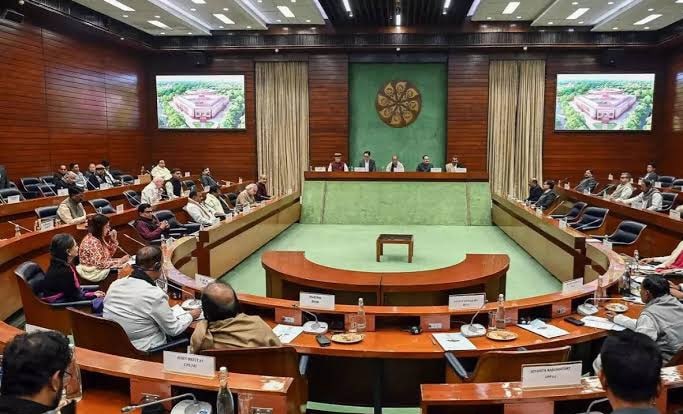

The Government of India has convened an all-party meeting on March 25 to deliberate on the escalating conflict between the United States and Iran, amid mounting criticism from Opposition parties over India’s response to the crisis.
The meeting is scheduled to take place at 5 pm within the Parliament complex and is expected to bring together leaders from across the political spectrum to discuss the geopolitical and economic implications of the ongoing war in West Asia.
High-Level Security Review Held
The development follows a high-level review meeting chaired by Defence Minister Rajnath Singh earlier on Tuesday. The बैठक included senior defence leadership such as Chief of Defence Staff General Anil Chauhan, Air Chief Marshal Amar Preet Singh, Army Chief General Upendra Dwivedi, and Navy Chief Admiral Dinesh K Tripathi, along with DRDO Chairman Samir Kamat.
The discussions focused on assessing the evolving situation and its potential impact on India’s security and strategic interests.
Opposition Criticises PM Modi’s Statement
The all-party meet comes in the wake of criticism directed at Prime Minister Narendra Modi following his recent address in Parliament.
In his speech, Modi assured that the government is actively working to minimise the war’s impact on India, particularly in areas such as fuel supply, fertilisers, and national security. He also reiterated India’s diplomatic stance, calling attacks on commercial shipping and disruptions in the Strait of Hormuz “unacceptable.”
However, Opposition leaders argued that the Prime Minister’s remarks lacked a direct condemnation of the US-Israeli strikes on Iran, which triggered the current crisis.
Leaders from parties such as Congress and Shiv Sena (UBT) criticised the government’s response, describing it as delayed and politically selective. They also questioned the timing and tone of the government’s communication on the issue.
Impact on Energy and Trade
The blockade and disruptions in the Strait of Hormuz—a key route for global oil and gas shipments—have raised concerns about energy security and supply chains.
Despite challenges, Indian-flagged vessels have continued operations through the region. Reports indicate that LPG carriers from the UAE and crude oil shipments from Saudi Arabia are en route to Indian ports, reflecting ongoing efforts to maintain supply continuity.
Government Focus on Stability
The Centre has stated that it is working on short-, medium-, and long-term strategies to mitigate the crisis’s effects. Officials have emphasised that India’s economic fundamentals remain strong, even as global uncertainties persist.
Conclusion
The upcoming all-party meeting is expected to serve as a platform for political consensus on India’s approach to the US-Iran conflict. With energy security, diplomacy, and domestic economic stability at stake, the discussions are likely to play a crucial role in shaping the country’s response to the evolving geopolitical situation.

Comments are closed.