
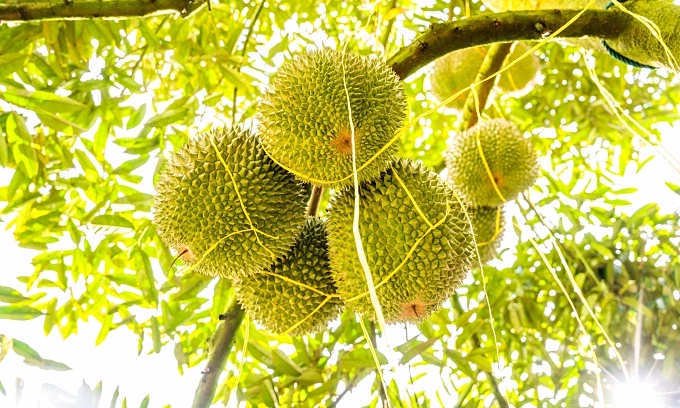

Tan Chee Keat, a third-generation durian farmer with five orchards, said a prolonged dry spell has created favorable conditions for flowering.
Some 20% of his trees have already started fruiting far earlier than usual, putting him on track to begin selling durians by mid-April, he said.
“This means less competition and better business for me. The rest will come from end-April to mid-August,” the 35-year-old told Malaysian newspaper The Star.
He added that this weather also minimizes fungal issues during the flowering stage, which could boost fruit quality.
Another orchard owner, 61-year-old Tang Boon Ley, has also reported early flowering in durian trees, with some already beginning to fruit.
“We just need the dry weather to stay stable now and durian lovers will have a good time in two or three months,” he said.
Durians are seen at a durian orchard in Malaysia, Nov. 21, 2021. Photo by Xinhua via AFP |
Penang, especially its town of Balik Pulau, is known for its durian orchards, which produce some of Malaysia’s finest varieties like Black Thorn, Musang King, Red Prawn (Ang Heh) and Green Skin (Cheh Poay). Rather than vast single-crop plantations seen elsewhere, farms in Penang typically cultivate a mix of varieties side by side, which helps produce a wider range of flavors and textures.
The state has two durian seasons each year. The main harvest usually peaks in June and July and a smaller, less predictable crop may occur between November and January.
Schedules released by durian orchards offering eat-and-stay experiences show that some are listing packages from early May while others have begun taking bookings for the end of May, according to AsiaOne.
Last year, Penang’s main durian harvest was hit by heavy rain and strong winds during the flowering stage, cutting yields by an estimated 30% from 2024.
Similar weather-driven shifts were reported in other durian-producing states in 2025.
Tan Hai Jie, general manager of Singapore-based importer 99 Old Trees Durian, which sources its fruit from Malaysia’s Pahang state, said durians were typically harvested only in July several years ago.
“Because the weather is becoming hotter and hotter, we can harvest durians in January as well,” he told The Straits Times last year.
Although current conditions in Penang are favorable, Tan warned that a spell of heavy rain could still cause flowers to fall and affect the harvest.
“If the weather holds, we expect a long season, with prices becoming more competitive from mid-May into June,” he said.
Farmers might also have to brace for rising costs this year as the Federation of Malaysia Fruit Farmers Association recently warned that shipping disruptions caused by the Middle East conflict might make fertilizer more expensive and harder to find.
Koh Lai Ann, the association’s president, said supply delays could disrupt fertilization schedules, leading to weaker growth, higher fruit drop rates and trees lacking sufficient nutrients.
“This will not only reduce yields in the next season by an estimated 15% to 20%, but may also affect the long-term productivity of fruit trees,” Koh told Sin Chew Daily.
The impact of the conflict could raise fruit prices in Malaysia by 20% or more, he noted.

Comments are closed.