
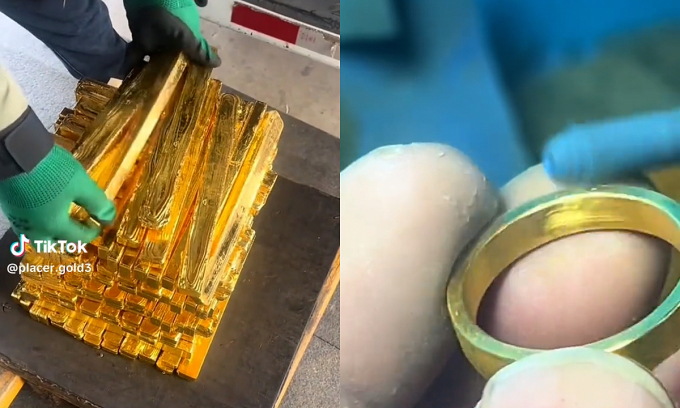

One dealer who asked not be identified said he has lodged 50% more police reports than during the same period last year, after encountering suspicious sellers attempting to offload fake items, according to Channel News Asia.
Screenshots from videos showing fake gold. Photos courtesy of TikTok/placer.gold3 |
He now comes across as many as five counterfeit pieces each week, ranging from buyers seeking authentication for online purchases to individuals trying to resell questionable gold.
In January, gold surpassed the US$5,100 mark for the first time. Although it has since retreated, it remains above $4,400, a 46% rise compared to a year ago.
Rising prices drove up demand. Gold retailers in Singapore are increasing their inventories to meet rising interest in the precious metal amid the ongoing crisis in the Middle East, The Straits Times reported.
David Mitchell, founder and managing director of bullion dealer Indigo Precious Metals, said demand at his store has risen by more than 100% so far in 2026 compared with the same period in 2025.
“We have seen more buyers than sellers over the past year, but we also are beginning to see more sellers entering the market, which is typical after strong price moves,” he said.
The secondary markets such as online platforms and social media resale channels are also booming.
E-commerce platform Carousell reported a 17% year-on-year increase in searches for gold items in February.
Kwek Seow Bin, owner of Singapore-based startup Metal & Picks, who operates a Telegram channel for private buyers, said social media platforms are becoming more popular due to limited stock at physical stores.
“When supply is tight, (dealers like us) don’t have enough ready stocks to meet consumers’ demands,” he told Channel News Asia.
“When people purchase physical gold, they want to get their stock immediately. So, if they can’t get it (from bullion stores), they will try secondary markets.”
Dealers noted that many counterfeit items are entering the market through these channels, often originating from overseas.
They added that these fakes may carry certificates and serial numbers but some are actually made of copper or nickel.
Such counterfeits are becoming increasingly difficult to detect, especially for ordinary buyers. Fake goods range from crude imitations to high-quality replicas.
Brian Lan Zhongping, managing director of GoldSilver Central, said not all online sellers clearly disclose the authenticity of their products. Some even use packaging and marketing materials resembling those of established jewelers.
“They price it slightly below the (market) price so many people think this might be a good deal. It comes with a box and even with a certificate. And because (customers) think it’s the reputable jeweller, they will buy it,” he said.
Dealer Billy Chiam said the gold rush has resulted in as much as a 40% increase in fake items being brought into his store for resale.
He said these often arrive in bulk and may include so-called “sand gold” designed to mimic the look and weight of genuine gold. He believes some customers may be attempting to pass off counterfeits alongside real gold.
Chiam noted that even testing machines may not immediately detect such fakes, particularly when materials like tungsten, which has a density similar to gold, are used.
“It could have a thick layer of gold on top of it, then some other material can hide inside. So, you have to cut it and test the core to ensure that the content is really gold.”
Dealers warned that private buyers remain especially vulnerable, as they often lack the equipment needed to verify authenticity. They said one of the key warning signs is a price that appears too good to be true.
“Gold is very expensive and very easy to sell. So, it becomes very attractive for scammers,” said Kwek.
Industry players expect such cases to increase further if gold prices continue to climb, and are urging buyers to stay vigilant and rely on reputable sources.

Comments are closed.