
IIT Kharagpur’s big discovery: Moon’s ancient magma secrets will provide direction to Chandrayaan-4 mission

Scientists of Indian Institute of Technology Kharagpur have made an important discovery regarding the internal structure of the Moon, which can prove important for India’s upcoming Chandrayaan-4 mission. This research has been done in collaboration with the Physical Research Laboratory and has made major progress towards understanding the mysteries related to the early development of the Moon.
In the research, scientists studied rare rocks called ‘ilmenite-bearing cumulates’ (IBC), which are believed to be about 4.3 to 4.4 billion years old. At that time there was a huge ocean of magma on the surface of the Moon. As it cooled, heavy mineral layers sank deep into the Moon, preserving its early history.
Scientists replicated extreme conditions like those inside the Moon in the laboratory. For this, pressure up to 3 gigapascals and temperatures of more than 1500 degrees Celsius were generated. These experiments showed that IBC rocks partially melted to form titanium-rich magma, which matches the basalt found on the Moon’s surface.
“These results will help us better understand the origin and evolution of samples brought back from the Moon,” said lead researcher Professor Sujoy Ghosh. They also pointed out that the nature of magma formed at different temperatures varies, which could explain the variety of titanium-rich rocks found on the lunar surface.
This research also sheds new light on the dynamics of magma within the Moon. Some magma rises towards the surface, while some sinks back into the depths. This process is called ‘mantle overturn’, which renders the Moon as a dynamic body, not a stable one.
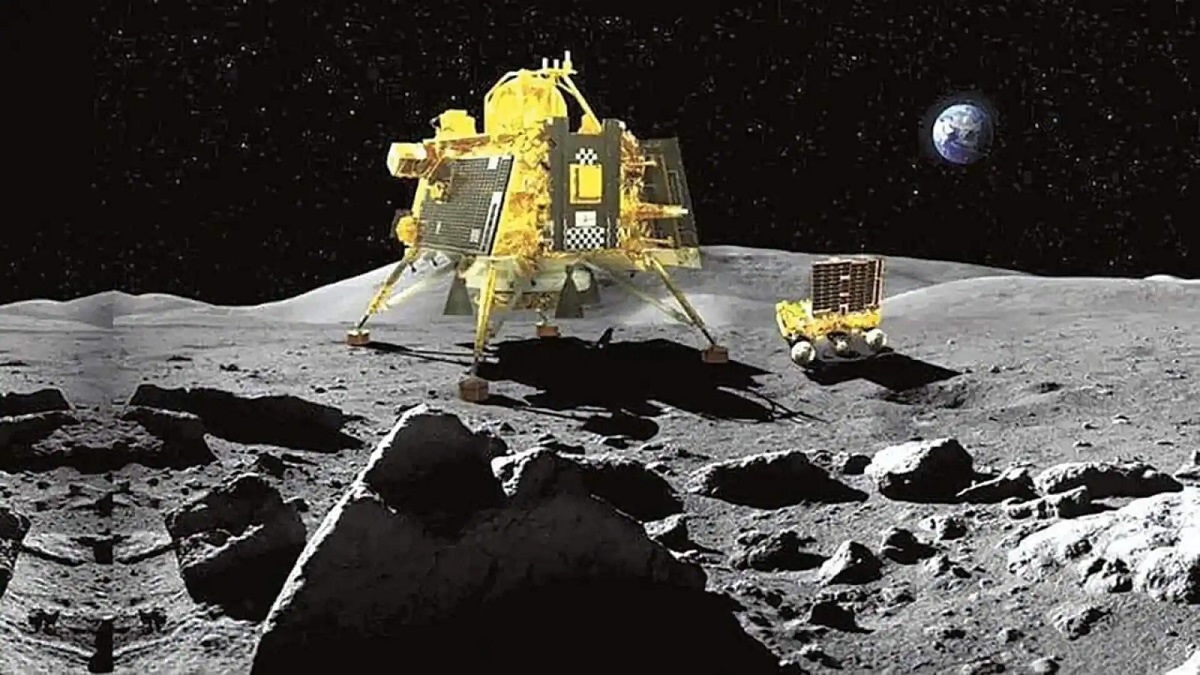
This discovery will have a direct impact on the Chandrayaan-4 mission, which is planned to bring samples from the Moon to Earth this decade. This mission will be operated under the leadership of ISRO and is considered to be the next big step after the success of Chandrayaan-3.
According to scientists, identification of titanium-rich areas will make landing site selection more accurate. Such regions have already been mapped by orbital missions such as Chandrayaan-2, but this new discovery will make their interpretation more clear.
India’s lunar mission program is making steady progress. Chandrayaan-1 discovered signs of water on the Moon in 2008, while Chandrayaan-3 created history by making a successful landing near the South Pole in 2023. Now the sample return mission through Chandrayaan-4 can take India to new heights in global space research.
Also read:
Muslim organizations demand Congress to give Rajya Sabha MP to Umar Khalid
Efforts ongoing to settle the culprits of 1971 massacre in Pakistan: Sheikh Hasina!
‘He used to pay attention in exams, stayed with him when he was ill’, Shabana Azmi remembers Farooq Shaikh!

Comments are closed.