
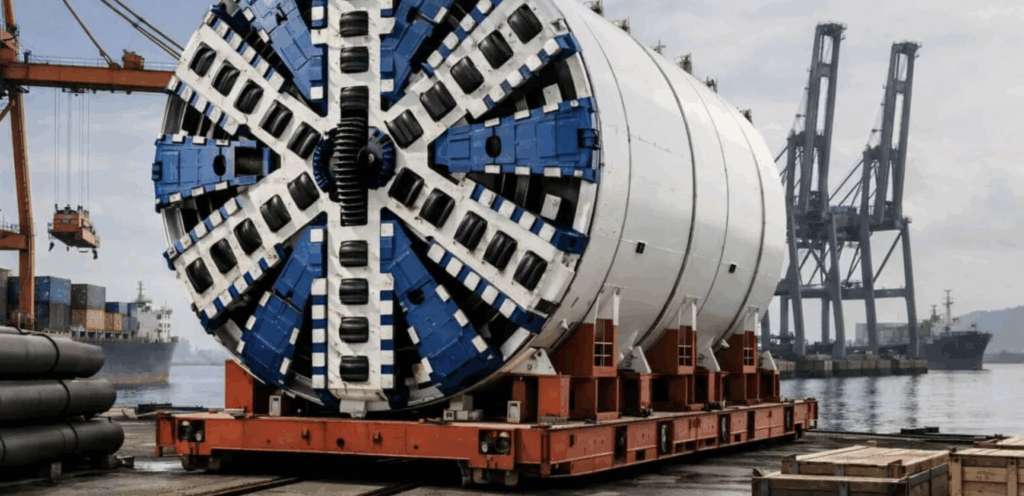

Two tunnel boring machines (TBMs) built by the German company Herrenknecht, but manufactured in Guangzhou, are scheduled to reach Mumbai’s Jawaharlal Nehru Port on March 23, 2026, for use in the bullet train project’s 21-km underground section.
German-Made TBMs Set to Arrive in Mumbai for Bullet Train Underground Corridor
Although their arrival is now confirmed, the shipment had been held up for several months due to clearance-related complications in China, which delayed progress on the project.
With the machines finally arriving, work can move forward on excavating the remaining 16.12 km of the tunnel, which also includes a significant 7-km stretch running beneath Thane Creek under the sea.
Notably, this marks the first instance in India where mixed-shield TBMs with a diameter of 13.65 metres will be deployed in a large-scale infrastructure project.
Meanwhile, the earlier delays were not just technical but also influenced by geopolitical circumstances, which caused the equipment to remain stuck in China for an extended period.
In response, the issue was taken up through diplomatic efforts, with the railways ministry coordinating closely with the external affairs ministry to resolve the situation.
At the same time, recent policy adjustments, particularly the relaxation of investment rules for companies with limited Chinese ownership, played a role in easing approvals and facilitating smoother logistics for the project.
TBM Transport and 90-Day Assembly Plan for Bullet Train Project
Once the shipment reaches India, the TBM components will be moved using more than 150 trailers to assembly locations in Vikhroli and Savali.
The assembly process itself is expected to take around 90 days before the machines are ready for operation.
After assembly and testing are completed, tunnelling activities will begin, with TBMs offering a safer alternative to blasting, especially in densely populated urban areas.
The planned tunnel will pass through varying depths, ranging from 25 to 65 metres below ground, and will go as deep as 114 metres beneath Parsik Hill.
Looking ahead, if the tunnelling phase proceeds without interruptions, the entire 508-km Mumbai–Ahmedabad corridor could be finished by December 2029, which would enhance trade, tourism, and overall connectivity.
However, any additional setbacks, whether during assembly, due to geological difficulties, or from supply chain issues, could delay completion and impact the momentum of the Rs 1.08 lakh crore project.
Image Source

Comments are closed.