
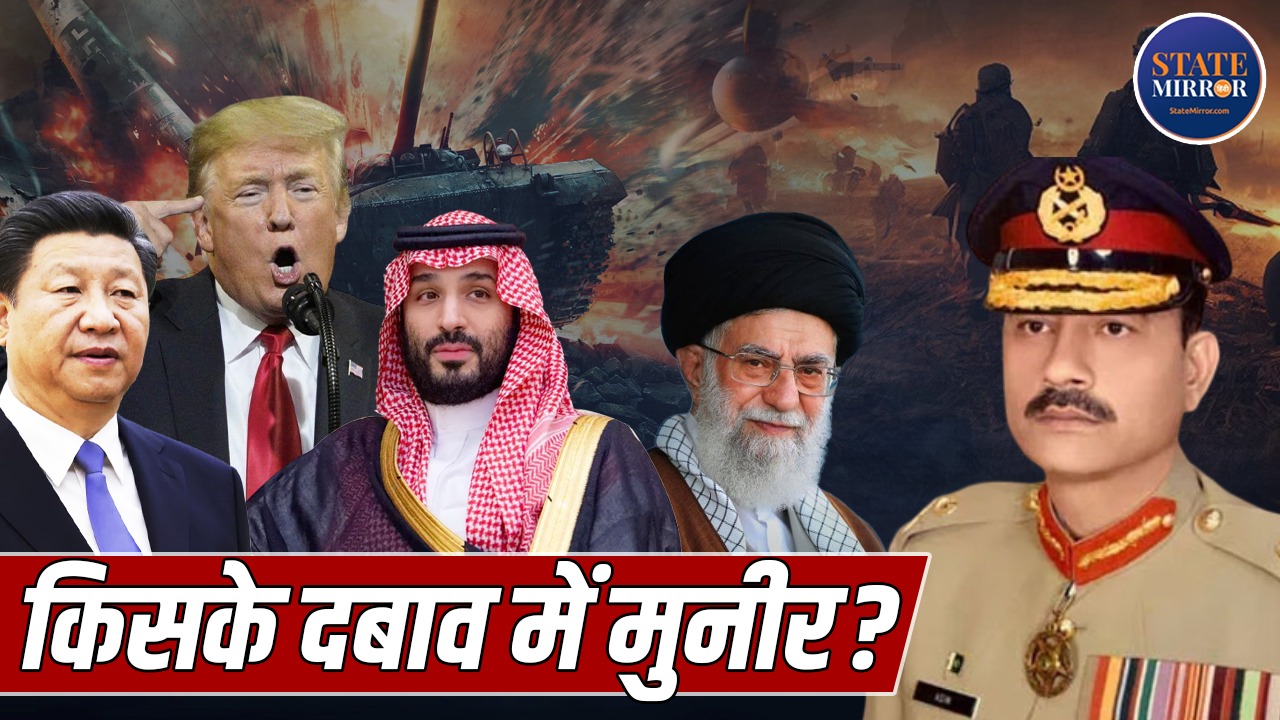
Is ‘Asim Munir’ the name of compulsion, why does he want flowers to rain between America and Iran, not missiles?

Questions are constantly being raised on Army Chief Asim Munir regarding Pakistan’s stand amid the Middle East War. People want to know whether his policy of “No missiles, no rain” is a compulsion of the country or something else? Actually, the answer is hidden in many layers. The real story starts from the economic condition of Pakistan. The country is struggling with huge debt, high inflation and decreasing foreign exchange reserves and in such a situation the biggest support is the International Monetary Fund. If a war erupts between the US and Iran, oil prices will rise and Pakistan’s import bill will be further jeopardized. so, Asim Munir The country’s peaceful stance is not an ideal, but a direct economic compulsion. In a way, Munir’s stand is a “survival policy”.
Does Asim Munir want money and support from America?
The answer to this question is largely ‘yes’. America still has influence on IMF, FATF and global financial institutions. Pakistan knows that if it wants repeated bailouts, military help and diplomatic protection, then it is necessary to improve relations with America. This is why he is trying to show himself as a ‘responsible partner’. So that Washington again considers it strategically useful and economic avenues open up.
Read this also:Net closed in Iran amid Middle East War, Jugaad on – ‘Digital Lockdown’, understand the connection game in 5 points
Is the closeness to Saudi Arabia so that the Islamic world remains in power?
Saudi Arabia has long been Pakistan’s largest informal financier. Through oil loans, cash deposits and emergency assistance. The role of Mohammed bin Salman is important here. Pakistan tries to maintain its position in Islamic countries and not distance itself from the Saudi leadership. Therefore, it does not openly confront Iran and does not go out of the Saudi line. That means ‘keeping both balanced’ is both his compulsion and strategy.
Is this also a reason not to ask for return of MBS loan?
Pakistan repeatedly gets Saudi loans rolled over. If relations deteriorate, Saudi Arabia can take strict action like UAE. Can stop new help or increase pressure on old loans. In such a situation, it becomes necessary for Munir to strike a balance, so that the lifeline of financial support remains.
From where does Pakistan take loan?
This network of Pakistan is quite big. China gives infrastructure and commercial loans under CPEC. Gulf countries like UAE and Saudi Arabia offer cash deposits and oil credit. Whereas the World Bank and Asian Development Bank give project and policy loans. Apart from this, bonds are also taken from the international market and loans from private banks, however, higher interest has to be paid there because trust is less.
Does Asim Munir have any connection with Muslim Brotherhood?
He does not have any direct and public connection with the Muslim Brotherhood. Pakistan has historically been associated with Islamic networks, but today’s reality is that countries like Saudi Arabia and UAE are against the Brotherhood. That is why Pakistan openly maintains distance from this organization. So that its relations with the Gulf countries do not deteriorate.
Read this also:Middle East War: Rumors of agreement or preparations for war, where is the Iran-Israel crisis going?
Is Pakistan’s distance from China a strategic move?
China is still Pakistan’s “all-weather friend”, but now this relationship has also become practical. There are strict conditions on China’s loans, security threats on CPEC projects have increased and the pace of investment has slowed down. In such a situation, instead of relying only on China, Pakistan is also maintaining a balance with America and Gulf countries. This is called “Strategic Hedging”. That means maintaining relationships with many powers simultaneously so that there is no complete dependence on any one.
Is it also a compulsion to avoid conflict with Iran?
Pakistan shares a long border with Iran and sensitive areas like Balochistan are spread in both the countries. If tensions increase, border instability, terrorist activities and Shia-Sunni conflict may increase, which will directly affect Pakistan’s internal security. Therefore, Munir tries to keep the situation with Iran under control.
How correct is it to say “the name of compulsion is Asim Munir”?
This is what the picture shows. More than an idealistic peace message, his “flowers, not missiles” stance is a forced but calculated strategy that combines hope from the US, dependence on Saudi Arabia, the risk of conflict with Iran and a balance with China. It is clear that Pakistan is currently running on “Survival Mode Diplomacy”, where every step is being taken by maintaining a balance between compulsion and strategy.
This stance of Asim Munir is actually directly related to the weak economic condition of Pakistan. The country is under the pressure of huge debt, high inflation and dwindling foreign exchange reserves, where the biggest support remains the International Monetary Fund. In such a situation, if tension increases between America and Iran, oil prices will increase and Pakistan’s economy will be directly affected. This is why Munir talks about peace. This is not idealism, but an economic “survival strategy”. At the same time, Pakistan also understands that it is important to keep America satisfied, because it has influence on IMF, FATF and the global financial system; Therefore, showing itself as a “responsible partner” is both its compulsion and also a diplomatic move.
Is the balance between Saudi, China and the Islamic world the real game?
Another major aspect of Pakistan’s strategy is to create a balance between Saudi Arabia and China. Saudi Arabia, especially Mohammed bin Salman, provides loans, oil and cash support to Pakistan, hence Pakistan does not go out of Saudi lines to maintain its hold in the Islamic world and continue financial support. At the same time, it also does not have open confrontation with Iran. On the other hand, China is a big lender through CPEC and infrastructure loans, but due to strict conditions and security challenges, Pakistan no longer wants to depend only on it.

‘Munir US’s tools, they have nothing except helplessness’ – Pro. Subodh Kumar
Subodh Kumar, professor of political science at Delhi University, says on this issue, “It is clear that what Pakistan i.e. Asim Munir is doing is out of compulsion. There is nothing in his control but to maintain relations with his masters i.e. America, China, Saudi Arabia and others. That is why he is dancing at the behest of America in the middle of the Middle East war.”
Asim Munir tried mediation on his request. On the other hand, considering its loss, Iran might have indicated that they should talk and see, but that did not happen. This is because the conditions set by America cannot be acceptable to Iran. Pakistan could not do anything in this matter. That’s why he seems trapped. Despite this, Asim Munir has to do whatever Trump wants.
Meanwhile, the entire story of America and Iran came in front of the world. Then no Muslim country is with Iran. Oman was mediating on this issue from the beginning, but Iran attacked it. However, this is also a big truth that neither of them wants the war to last long. Especially Trump is trying to end the war without wasting any time because of America’s misdeeds across the world. The world countries are holding America responsible for the closure of the Strait of Hormuz.
There is compulsion for Asim Munir also because China is in favor of Iran. In such a situation, even if Pakistan wants to do something, it cannot do it. Not only this, Pakistan has promised security to Muhammad bin Salman. Since it has a border with Iran, it cannot anger Iran either. That means Munir is trapped everywhere.

Comments are closed.