
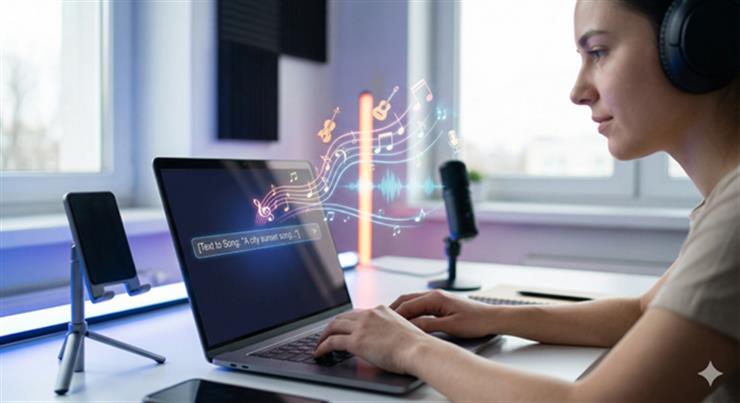

For centuries, the barrier to entry for musical creation was high. It required years of dedication to master an instrument, a deep understanding of music theory, and access to expensive recording studios. Even for those with a story to tell or a poem to share, the transition from written word to melodic composition was a bridge too far for the average person. However, we are currently witnessing a seismic shift in the creative landscape. The democratization of art, once limited to digital photography and graphic design, has finally reached the realm of melody.
The catalyst for this change is artificial intelligence. Specifically, the emergence of sophisticated Text to Song AI platforms has begun to blur the lines between professional composers and casual enthusiasts. This technology allows individuals to transform simple prose, heartfelt lyrics, or even abstract thoughts into fully realized musical arrangements. It is not merely a tool for automation; it is a new medium for human expression that prioritizes ideas over technical proficiency.
The Intersection of Language and Rhythm
At its core, music is a form of communication. From the rhythmic chants of ancient civilizations to the complex narratives of modern folk and hip-hop, language has always been the heartbeat of song. The challenge has always been “the translation.” How does one take the somber tone of a breakup letter and find the exact minor chord progression to match it? How does a celebratory announcement find its way into a high-energy pop tempo?
Breaking the “Talent” Bottleneck
The traditional view of music often leans on the concept of “innate talent.” While practice is essential, many believe you are either born with “an ear” or you aren’t. AI challenges this gatekeeping. By lowering the technical floor, it allows a much larger demographic to participate in the musical conversation.
Consider the educator who wants to turn a history lesson into a catchy jingle to help students memorize dates. Or the small business owner who needs a unique, copyright-free background track for a social media campaign but lacks the budget for a session musician. In these scenarios, the goal isn’t necessarily to top the Billboard charts, but to use music as a functional and emotional tool. The ability to generate a song from text means that the “visionary” no longer needs to be the “performer.”
The Creative Process in the AI Era
One of the most common misconceptions about AI-generated music is that it removes the human element. In reality, the process is highly collaborative. A user doesn’t just click a button and receive a finished product; they iterate.
- The Conceptual Phase: The user provides the “soul” of the track—the lyrics or the thematic description.
- The Stylistic Direction: The user selects genres, moods, or specific instruments.
- The Iteration: The AI provides a draft, which the user then refines by changing words, adjusting the tempo, or tweaking the vocal style.
This loop is fundamentally creative. The human remains the director, while the AI acts as the orchestra and the engineer. This shift allows creators to focus on the what and the why of their music, rather than getting bogged down in the technical how.
From Bedroom Producers to Content Creators
The rise of AI music coincides perfectly with the explosion of the creator economy. Platforms like TikTok, YouTube, and Instagram are fueled by audio. In the past, creators were limited to using “trending sounds” or library music that thousands of others were also using. This led to a homogenization of content.
With text-to-song technology, creators can now generate bespoke soundtracks that fit the exact timing and mood of their videos. If a travel vlogger is showing a sunset over the Swiss Alps, they can generate a cinematic orchestral piece that swells at the exact moment the sun dips below the peak. This level of customization was previously reserved for high-budget film productions. Now, it is accessible to anyone with an internet connection.
Personalized Music: The Next Frontier
Beyond content creation, there is a burgeoning world of personalized music. Imagine a world where you can send a “song-gram” instead of a birthday card—a track where the lyrics are specifically about your friend’s life, sung in their favourite genre. Or consider the therapeutic applications: personalized ambient tracks generated from a patient’s journal entries to help with anxiety or sleep.
The psychological impact of hearing one’s own words reflected through music is profound. It validates the creator’s emotions and provides a sense of accomplishment that was once out of reach for the “non-musical.”
Conclusion
We are standing at the threshold of a new era in human creativity. The transition from text to song is more than just a technical feat; it is the ultimate expression of the “democratization of the arts.” By removing the barriers of cost, time, and technical training, we are inviting millions of new voices into the global choir.

Comments are closed.