
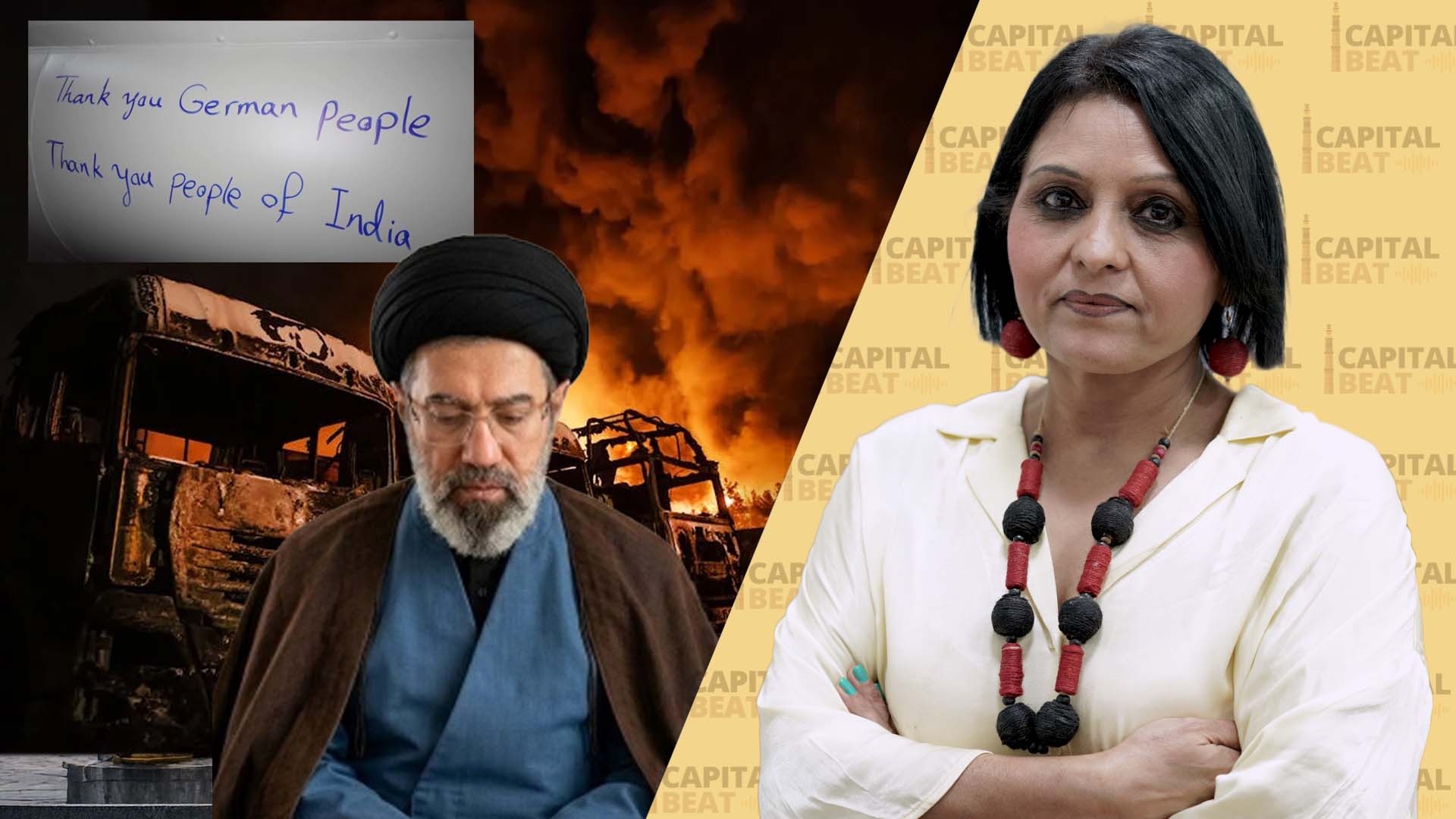

Iran’s decision to inscribe “Thank you people of India” on missiles launched towards Israel has triggered a sharp debate on India’s diplomatic positioning, with experts questioning whether New Delhi’s silence reflects strategic restraint or a policy dilemma.
Amid escalating tensions in the Middle East, the development has also drawn attention after US President Donald Trump highlighted the gesture, raising questions about India’s stance in the conflict.
The Federal spoke to Neelofar Masood, National Conference spokesperson, and KS Dakshina Murthy, international affairs expert and consulting editor at The Federalon the implications of Iran’s message and India’s response.
Missile message
The controversy stems from visuals showing Iranian aerospace personnel writing handwritten notes on missiles before launching what has been described as the 83rd wave of strikes.
Also read | Strait of Hormuz crisis: Why Iran’s toll plan is big global concern
The notes included messages thanking people from India, Spain, Pakistan, and Germany for their support. The Islamic Revolutionary Guard Corps (IRGC) reportedly carried out the strikes targeting key US and Israeli-linked installations, including oil depots and military facilities.
The gesture was amplified by Iran’s Consulate General in Mumbai, which publicly acknowledged the support and solidarity extended by the people of India during the ongoing conflict.
Public support
Reports cited in the discussion highlighted that individuals and groups from regions such as Kashmir, Ladakh, and Kargil contributed donations to Iran.
These contributions reportedly included gold, silver, cash, livestock, and vehicles, reflecting what panelists described as a “large-scale and diverse” humanitarian response.
Masood noted that such efforts were not isolated, stating that people across India participated in aid collection efforts.
She emphasised that the government’s role cannot be separated from public action. “Without government facilitation, such aid cannot reach another country. So, people of India include the government as well,” she said.
Balanced approach
Masood rejected the idea that Iran was drawing a line between Indian citizens and the Indian government. “I don’t think Iran is making any distinction. India has strategically supported Iran while also protecting its own interests,” she said.
She added that India has maintained a balanced approach by calling for peace and diplomacy while safeguarding trade routes, energy interests, and the safety of its citizens abroad.
However, she acknowledged criticism over delayed responses. “We should have reacted promptly when innocent people were killed. That delay has hurt sentiments,” she said.
Strategic silence
Murthy described India’s approach as a “low-key engagement” strategy shaped by geopolitical pressure, particularly from the United States.
Also read | Jaishankar, Canadian Foreign Minister discuss West Asia crisis on G7 sidelines
“India cannot afford to antagonise Iran, nor can it withstand pressure from the US. Therefore, it operates quietly,” he explained.
He pointed out that India has continued informal engagement with Iran, citing instances where Indian and Sri Lankan efforts helped protect Iranian ships after an attack.
“Iran has acknowledged India’s support in such situations, so engagement continues, but discreetly,” he said.
Trump factor
The situation became complex after Donald Trump shared the missile message on social media, effectively spotlighting India’s position.
Murthy interpreted this as a deliberate move. “Trump is asking India—are you with us or with them? It is a direct question about India’s foreign policy,” he said.
According to him, Iran’s gesture may also have been strategic. “Iran is trying to show that global public opinion supports it. This also irritates Trump,” he added.
Policy dilemma
The panel agreed that India now faces a diplomatic challenge in balancing its relationships.
Murthy described the situation as a “time of reckoning,” suggesting that India may eventually be compelled to clarify its stance.
However, he predicted that the government would avoid making any explicit declaration. “India will likely remain silent. It will not want to burn bridges with either side,” he said.
Masood, on the other hand, argued that clarity is necessary. “We cannot remain silent indefinitely. As a growing global power, India must state its position clearly,” she said.
Sentiment in Kashmir
Masood also spoke about sentiment in Kashmir and other regions with significant Shia populations. She said that people were emotionally affected by developments in Iran, particularly following the reported killing of its supreme leader.
Also read | Global supply shock from US-Iran conflict may push beer prices up in India
“People are hurt by the delay in India’s response. But they also understand the pressures involved,” she said. She added that both Shia and Sunni communities have shown solidarity, contributing to aid efforts and expressing concern over the conflict.
Quiet diplomacy
Despite criticism, Murthy maintained that India’s behind-the-scenes diplomacy has yielded results.
“Iran has allowed Indian ships safe passage through the Strait of Hormuz. That shows there is communication and cooperation,” he said.
He described India’s current approach as “risk management diplomacy,” where public silence is paired with private engagement.
Uncertain path
As tensions continue, the debate over India’s stance is unlikely to fade.
The Iranian gesture, combined with Trump’s intervention, has brought India’s foreign policy into sharper focus, exposing the delicate balance it must maintain between competing global powers.
Whether India chooses to maintain its silence or articulate a clearer position remains to be seen, but the pressure to respond is steadily mounting.
The content above has been transcribed from video using a fine-tuned AI model. To ensure accuracy, quality, and editorial integrity, we employ a Human-In-The-Loop (HITL) process. While AI assists in creating the initial draft, our experienced editorial team carefully reviews, edits, and refines the content before publication. At The Federal, we combine the efficiency of AI with the expertise of human editors to deliver reliable and insightful journalism.

Comments are closed.