
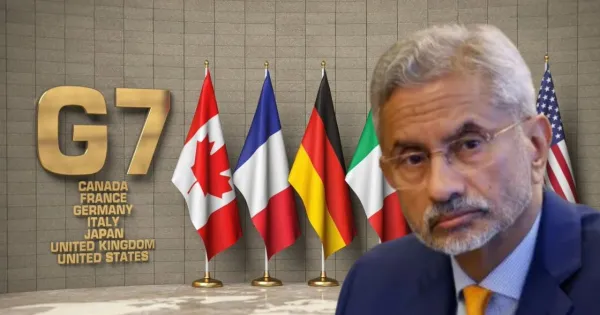
Discussion took place in G7 meeting regarding Iran war and Hormuz, foreign ministers from all over the world gathered in Paris, know what S. Jaishankar

Delhi. When the world was grappling with the devastating consequences of the West Asian conflict, External Affairs Minister S. Jaishankar raised the concerns of countries in the Global South regarding energy, food and fuel security and also stressed the urgent need for global governance reforms. At the G7 foreign ministers’ meeting in France on Thursday, the foreign minister also talked about the importance of sustainable trade corridors and supply chains in view of the uncertainties arising from the conflict in West Asia. Although India is not a member of the G7, its current president France has invited it as a partner country.
Foreign ministers from all over the world gathered
Apart from India, France has invited Saudi Arabia, South Korea and Brazil to participate in the G7 foreign ministers’ meeting at the Abbey des-Vaux-de-Cernay. At the beginning of the G7 meeting, Jaishankar held separate talks with US Secretary of State Marco Rubio, Saudi Arabian Foreign Minister Faisal bin Farhan, German Foreign Minister Johann Wadeful and Ukrainian Foreign Minister Andriy Sibiha. It is believed that the West Asia crisis was discussed prominently in these talks.
Jaishankar congratulated Nepal’s Foreign Minister
External Affairs Minister S Jaishankar on Friday congratulated his Nepalese counterpart Shisir Khanal and expressed hope of working together with him to further strengthen the traditional partnership. “Hearty congratulations to Shisir Khanal on assuming charge as the Foreign Minister of Nepal,” Jaishankar said in a post on ‘X’.
Nepal’s new Prime Minister Balendra Shah ‘Balen’ took oath along with his ministers on Friday in a special ceremony held at Sheetal Niwas, the official residence of the President in Kathmandu. Jaishankar said, “I look forward to working closely with them to further strengthen our traditional partnership.” Balen is the youngest democratically elected leader for this post in Nepal and is also the first person from the Madhesh region to reach the post of Prime Minister.
Iran war discussed in G7 meeting
G7 foreign ministers met in France on Friday to discuss the conflict in West Asia and the ongoing war between Russia and Ukraine. In this meeting, deep differences regarding the US-Israel war with Iran were clearly revealed. The differences come after US President Donald Trump’s repeated complaints that America’s allies have ignored or rejected requests for help in countering Iran’s retaliation. US Secretary of State Marco Rubio attended the meeting along with his counterparts from the G7 countries.
Oil markets remain volatile with the Iran war entering its fourth week and uncertainty over the status of potential talks to end the crisis. British Foreign Secretary Yvette Cooper has called for a “swift resolution” to the war in West Asia and the reopening of the Strait of Hormuz. Cooper said Iran was undermining the global economy by blocking oil tankers passing through the Strait of Hormuz, the most important waterway.
The G7 group includes Canada, France, Germany, Italy, Japan, Britain and America. Trump said, “We are very disappointed with the North Atlantic Treaty Organization (NATO) because NATO has done absolutely nothing.” Rubio said, “Frankly, I think countries around the world, even the countries that are complaining a little bit about this, should be really grateful that America has a president who is prepared to confront this kind of threat.”
Iran cannot be allowed to hold the global economy ‘hostage’
British Foreign Secretary Yvette Cooper has called for a “swift resolution” to the war in West Asia and the reopening of the Strait of Hormuz. Addressing a meeting of G7 foreign ministers on the outskirts of Paris, Cooper said Iran was undermining the global economy by blocking oil tankers passing through the Strait of Hormuz, the most vital waterway. “To be clear, Iran cannot be allowed to hold the global economy hostage because of the Strait of Hormuz, which is so critical to freedom of international navigation,” he said.

Comments are closed.