
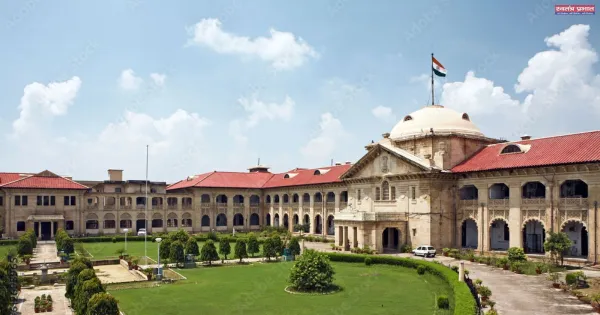

Bureau Prayagraj- The Allahabad High Court, while hearing a case related to section 295A of IPC on the petition of a priest associated with Mau, has made a scathing comment in its important decision while rejecting the petition. Allahabad High Court, while refusing to grant relief to the priest, said that it is wrong for a person to claim that his own religion is true because doing so is tantamount to insulting other religions.
The court said that such acts come under section 295-A of the IPC, which prohibits acts done knowingly and maliciously with the intention of hurting religious sentiments. The court, while rejecting the petition filed by the applicant priest under section 528 of the BNSS, made it clear that this order will not stop the applicant from taking advantage of the remedies available under the law. This order has been given by the single bench of Justice Saurabh Srivastava while rejecting the petition of Reverend Father Vineet Vincent Perera alias Father Vineet Vincent Paresh.
According to the case, the applicant priest had challenged the charge sheet of 19 February 2024 and the cognizance order of 18 May 2024 by the Mau Court in the Allahabad High Court, after the FIR registered against him under section 295A of the IPC at the Muhammadabad police station in Mau on September 4, 2023. The applicant priest, through a petition, had demanded from the Allahabad High Court to cancel the charge sheet, cognizance order filed against him and the entire proceedings going on in the Mau court.
During the hearing in the High Court, the counsel for the applicant priest argued that the applicant has been falsely implicated in this case by party number two only for the purpose of harassing him. Because the applicant has never committed any alleged crime like illegally converting the deprived section of the society or speaking against other religions.
Counsel for the applicant also argued that during the investigation the concerned investigating officer had already concluded that no illegal religious conversion had ever been done by the applicant. As far as the allegation of criticizing other religions is concerned, counsel for the applicant submitted that on reading the details of the FIR, no case is made out against the applicant under Section 295-A of the IPC.
The applicant’s counsel further argued that there was hardly any evidence against the applicant to link him to the alleged crime. The applicant’s counsel said that without conducting a fair investigation, the concerned investigating officer submitted a charge sheet against the applicant, on which the concerned court, without exercising its judicial discretion, took cognizance of the crime on the basis of the charge sheet, which is an abuse of the process of law. And hence it should be cancelled.
The state government, while opposing the petition of the applicant priest, argued that the arguments being raised on behalf of the applicant relate to disputed questions of facts and would require evaluation of evidence. It has been submitted that while taking cognizance, only prima facie case has to be seen and the concerned court is not expected to conduct any ‘mini trial’.
After hearing the arguments of all the parties, the Court held that only one question arises in this case, that is whether the act imputed to the applicant through the details of the FIR falls within the scope of the offense described in Section 295-A of the IPC or not.
The court said that Section 295A of the IPC deals with deliberate and malicious acts aimed at hurting the religious sentiments of any class by insulting its religion or religious beliefs. Under Section 295A, if anyone attempts to do so, he will be punished with imprisonment of either description for a term which may extend to three years or with fine or with both.

Comments are closed.