
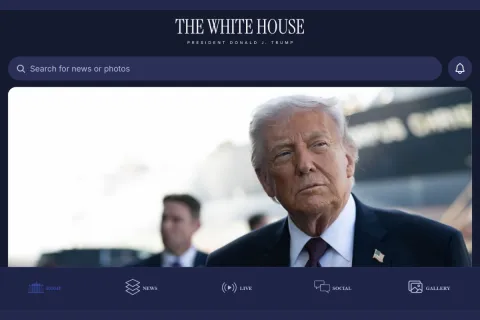

A newly released mobile application from the administration of Donald Trump is drawing increasing scrutiny after a developer claimed the app may be collecting detailed user location data and sharing it externally.
The concerns first emerged on 28 March 2026, when a user on X posted what they said was decompiled code from the official White House app. The post quickly gained attention online, drawing hundreds of thousands of views and sparking widespread discussion about how the app handles user data. According to the developer, the code indicates that the application frequently accesses a user’s GPS location and transmits that information to a third-party system.
So far, there has been no direct response from the White House addressing these specific technical claims.
Code Suggests Regular Background Location Checks
At the center of the controversy is the app’s apparent integration with OneSignal, a commonly used service that helps developers send notifications and manage user engagement.
Based on the shared code snippets, the developer alleged that the app includes a system capable of tracking location at regular intervals. The code reportedly references timing constants that would allow the app to check a user’s position approximately every 4.5 minutes while in use, and roughly every 10 minutes when running in the background.
If accurate, this setup could allow continuous location monitoring—even when the app is not actively open on a device. The presence of Android permissions related to background location access further adds to concerns that the app may be designed to operate beyond visible user interaction.
Documentation from OneSignal indicates that such functionality is possible, but only when developers deliberately enable it and users grant the required permissions.
Broad Permission Requests Raise Eyebrows
The location tracking claims are not the only issue drawing attention. A separate viral post highlighted the app’s extensive list of permissions, prompting further debate among users and privacy observers.
Screenshots circulating online suggest that the app requests access to precise and approximate location data, biometric authentication tools such as fingerprint scanners, and the ability to read and modify files stored on a device. Additional permissions reportedly include access to Wi-Fi and network connections, the ability to keep the device awake, and authorization to automatically launch when the phone starts.
Individually, many of these permissions are commonly used across modern apps. However, experts note that the combination of so many sensitive permissions in a single application—particularly one operated by a government—can raise legitimate concerns about scope and necessity.
Questions Over Transparency in Data Handling
Another point of criticism is the lack of clear information about how user data is handled. On the Apple App Store, the app reportedly provides only limited insight into its data practices. Users seeking more details are redirected to a general privacy policy, which does not clearly explain how specific types of data—such as location or biometric information—may be used or shared.
Privacy researchers argue that this level of disclosure may fall short of expectations for a government-backed platform. Given the sensitivity of the data involved, they say users should be given straightforward explanations about what is collected, why it is needed, and where it ultimately goes.
A Communication Tool With Expanding Capabilities
The White House introduced the app on 27 March 2026 as a way to connect directly with the public. It was promoted as a platform offering real-time updates, including breaking news alerts, live briefings, multimedia content, and a way for users to send feedback.
Officials framed the app as a direct communication channel designed to bypass traditional media and provide unfiltered access to official updates. While these features align with standard government outreach efforts, critics question whether they justify continuous access to precise user location.
Wider Concerns About Location Data Use
The situation also highlights broader concerns about how location data is used across the mobile app ecosystem. Research published in 2025 identified OneSignal as one of the most widely integrated tools for collecting GPS data in Android apps.
Such data can reveal far more than just a user’s position at a given moment. Over time, it can build a detailed picture of daily routines, including where a person lives, works, and spends time. In some cases, it may also expose visits to sensitive locations, raising additional privacy risks.
Although platforms like OneSignal emphasize that location tracking requires both developer activation and user consent, critics argue that many users may not fully understand the extent of what they are agreeing to when granting permissions.
The controversy comes amid ongoing global debates about digital privacy and the power of large-scale data collection. Advocacy groups, including Free Press Action, have previously highlighted how modern technologies can gather vast amounts of personal information—from browsing habits to biometric identifiers.
When combined, these data points can create highly detailed user profiles. Experts warn that such profiles, if misused, could influence decision-making, enable targeted messaging, or even lead to discrimination.

Comments are closed.